
AI-Powered Healthcare Software Development Company
Space-O AI is a AI-powered healthcare software development company with 500+ delivered projects and 15+ years of engineering experience. We build HIPAA-compliant telemedicine platforms, EHR-integrated clinical systems, patient portals, AI-powered clinical tools, and revenue cycle management software.
Our engineering teams architect compliance from sprint one, validate clinical workflows with practicing clinicians, and integrate with Epic, Cerner, and Allscripts in production healthcare environments.
Hospitals, multi-provider clinics, and digital health startups trust Space-O AI to deliver software that meets both clinical and regulatory demands.
Trusted By






4.3

4.8

4.9


HIPAA Compliant

HL7 FHIR

SOC 2 Type II
The Problem
What Problems Does Space-O AI Solve for Healthcare Organizations?
Healthcare executives and technology leaders reach out when off-the-shelf tools stop working and internal teams lack the compliance expertise to build what the organization actually needs.
01
Disconnected Clinical Systems Burn Clinician Time
Most healthcare organizations run scheduling, documentation, prescribing, billing, and messaging on five separate systems. Clinicians switch between these tools dozens of times per shift. That switching costs 15-30 minutes per shift in lost clinical time. Space-O AI builds unified platforms that connect all five workflows into one interface.
02
EHR Integration Timelines Never Match Vendor Promises
Most vendors quote “FHIR integration” like a checkbox item. Epic credentialing alone takes four to six months, and production testing exposes data mapping issues that force teams to redesign half the interface. Space-O AI engineers have integrated with Epic, Cerner, and Allscripts in production environments and scope each system as a separate project.
03
Telemedicine Platforms Fail When Clinicians Refuse to Adopt
The patient-facing app looks polished. Patients can book visits in two taps. Clinicians abandon the platform within a quarter because documentation adds time instead of saving time. Intake forms collect data that never reaches the clinical note, forcing duplicate entry. Space-O AI measures time-to-complete-a-documented-visit during design validation, not after launch.
04
Compliance Retrofitting Delays Launch by Months
The development team finishes the build. The compliance team runs a security review and fails the platform. The encryption architecture needs a full rebuild. The audit logging layer was never implemented. Push notifications display patient names on lock screens. Space-O AI architects HIPAA compliance into every sprint cycle and catches these issues during development, not before launch.
05
Revenue Leaks Between Clinical Documentation and Billing
The billing team manually extracts CPT codes from visit notes because the software separates clinical encounters from claims submission. That gap increases denial rates and delays reimbursement. Space-O AI connects clinical documentation directly to revenue cycle workflows and eliminates the manual coding step.
06
Patient Portals Exist but Nobody Uses Them
The registration flow requires seven steps before a patient can book a visit. Patients abandon the portal and call the front desk instead. That portal investment generates zero return. Space-O AI builds patient engagement platforms where registration completes in under 60 seconds and appointment booking requires one tap.
The Approach
What Healthcare Software Solutions Does Space-O AI Build?
Space-O AI provides custom healthcare software development services across seven solution categories. Each addresses a specific clinical, operational, or financial workflow that generic platforms cannot support.

Telemedicine and Remote Patient Monitoring Platforms
Space-O AI builds telemedicine platforms with HD video, audio fallback, scheduling, intake forms feeding clinical notes, e-prescribing via Surescripts, and ambient AI documentation. The platforms connect RPM devices including blood pressure monitors, glucose monitors, and wearables with configurable alert thresholds. Space-O AI delivers across primary care, behavioral health, dermatology, and pediatrics.

EHR/EMR Integration and Interoperability
Space-O AI integrates with Epic, Cerner, and Allscripts using HL7 FHIR R4 APIs. Integration covers chart access during consultations, clinical note push-back, lab retrieval, referral management, and medication reconciliation. Each EHR requires its own credentialing, sandbox environment, and production testing cycle. No two EHR vendors implement FHIR the same way.

Patient Portals and Engagement Platforms
Space-O AI builds patient portals with secure registration, scheduling, health records access, prescription tracking, secure messaging, and in-app payments. Registration completes in under 60 seconds and appointment booking requires one tap. Well-designed portals reduce call center volume by 30-50% and improve patient retention by 20-35%.

Revenue Cycle Management Software
Space-O AI connects registration, eligibility verification, charge capture, claims submission, denial management, and payment tracking into one revenue workflow. Clinical documentation feeds directly into billing codes without manual coding intervention. One billing automation platform Space-O AI built cut denial rates from 22% to 9% and recovered $180,000 per month.

AI-Powered Clinical Tools
Space-O AI builds ambient clinical documentation, AI-powered triage, predictive analytics for readmission risk, automated medical coding, and clinical decision support. All AI features deploy on HIPAA-eligible infrastructure (AWS Bedrock, Azure OpenAI Service) with clinician oversight. Space-O AI advises piloting AI tools with a small clinician group before enterprise deployment.

Healthcare Legacy System Modernization
Space-O AI migrates legacy systems to HIPAA-eligible cloud platforms (AWS, Azure) with API enablement, UX redesign, performance optimization, and data migration. Active clinical operations continue running throughout the transition without downtime. Legacy modernization is a prerequisite for AI adoption because FHIR-native data exchange cannot integrate with pre-API architectures.
Organizations We Serve
Which Healthcare Organizations Does Space-O AI Work With?
Space-O AI delivers custom software development for healthcare organizations across four segments, each with different compliance scope, integration requirements, and engagement timelines.

Hospitals and Health Systems
Enterprise platforms supporting 10-200+ concurrent providers across multiple facilities and state jurisdictions. Multi-EHR integration, department-level analytics, and multi-state telehealth compliance.

Multi-Provider Clinics and Practice Groups
Focused telemedicine, scheduling, and billing platforms that work with existing EHRs. Workflow improvements without full system replacement.

Digital Health and Healthtech Startups
MVP-to-scale healthtech software development with HIPAA compliance from day one. Investor-ready architecture, fast iteration cycles, and engineering teams that balance product velocity with regulatory constraints.

Healthcare Payers and RCM Companies
Claims processing automation, denial management workflows, provider credentialing systems, and analytics platforms with EDI/X12, HL7, and clearinghouse integration.
Proven Results
What Results Has Space-O AI Delivered for Healthcare Organizations?
Healthcare CTOs and founders evaluate healthcare software development companies by what those companies have actually shipped.
01
Case Study
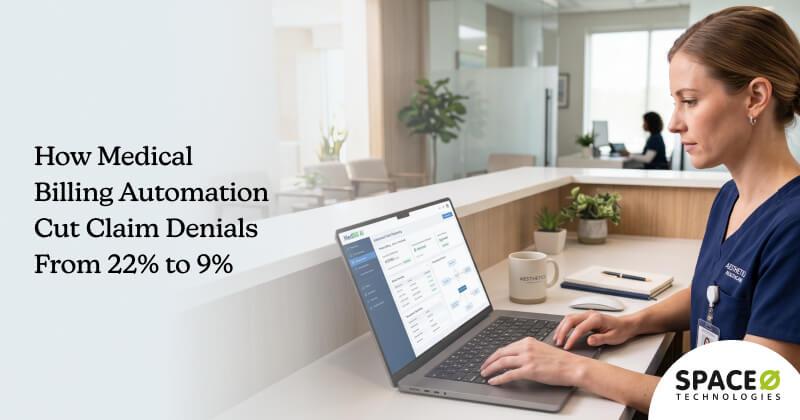
Claim Denials Cut From 22% to 9%
A 30-provider practice lost $180,000 per month to preventable claim denials. Most rejections traced back to missing modifiers, expired authorizations, and diagnosis-to-procedure mismatches that the billing team caught only after payer rejection. Space-O AI built an AI-powered validation engine that checks every claim against payer-specific rules before submission.
$180K/mo
Revenue recovered
18 days
Payment cycle, down from 40

02
Case Study
Claims Turnaround Cut From 18 Days to 4
A regional health plan processed 45,000 claims per month through manual adjudication. Examiners checked eligibility in one system, benefit rules in a printed binder, and provider contracts in a third application. Two examiners reached different payment decisions on identical claims 16% of the time. Space-O AI built a configurable rules engine encoding 940+ adjudication rules.
82%
Auto-adjudication rate
99.2%
Decision consistency, from 84%
03
Case Study
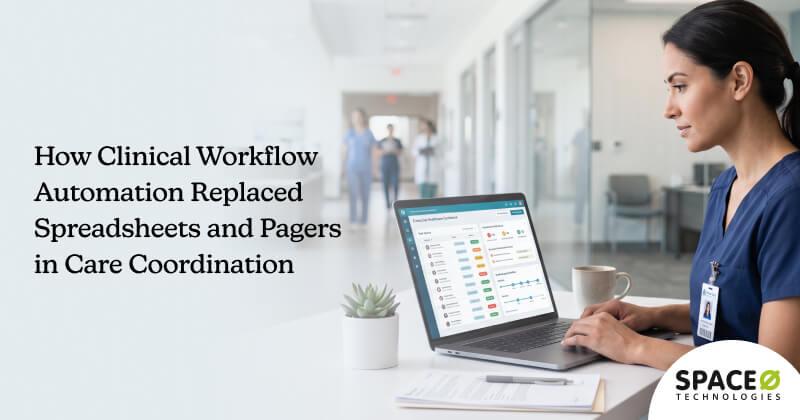
Hospital Readmissions Cut From 18.4% to 9.1%
Five care coordinators tracked discharged patients on a shared spreadsheet and passed updates by pager. Patients returned through the emergency department within 30 days because nobody could see the gap in real time. Space-O AI built a live care coordination dashboard with structured task workflows and automated escalation.
$1.2M
Annual CMS penalties eliminated
97%
Medication reconciliation rate
Process
How Does Space-O AI Build Healthcare Software?
Every healthcare software project at Space-O AI moves through six stages. Each stage has a clear output that feeds the next.
01
Discover
Space-O AI maps clinical workflows, compliance requirements, and integration dependencies before development begins. This phase produces a scope document, compliance checklist, integration inventory, and timeline estimate. From our experience, 80% of budget overruns trace back to skipped discovery.
02
Architect
Space-O AI defines encryption standards, access control structures, audit logging events, and BAA requirements before any code is written. HIPAA, HL7 FHIR, and FDA considerations get resolved during architecture. Retrofitting these decisions after development costs 2-3x more.
03
Design
Space-O AI tests wireframes and interactive prototypes with practicing clinicians before development begins. Documentation time and workflow efficiency get measured during design validation. A platform that adds clinician documentation time gets abandoned within a quarter.
04
Develop
Space-O AI builds in two-week agile sprints with HIPAA validation, security scanning, and code review in every cycle. Compliance debt never accumulates into a pre-launch crisis. Working software ships at the end of every sprint for stakeholder review.
05
Test
Space-O AI runs QA and penetration testing against healthcare-specific attack vectors including PHI exposure through push notifications, session hijacking in video streams, and API responses leaking patient data. Generic QA frameworks miss these healthcare-specific vectors entirely.
06
Launch
Space-O AI provides clinician training, patient onboarding support, and 90-day adoption tracking after launch. Post-launch iteration addresses usage patterns that pre-launch testing cannot predict. The same engineering team handles maintenance with zero knowledge transfer risk.
Compliance
What Compliance Standards Does Space-O AI Follow?
Your procurement team needs compliance evidence, not claims. Here is what Space-O AI delivers.

HIPAA
End-to-end encryption, RBAC, audit logging, BAAs with every vendor, annual risk analysis, breach notification, penetration testing.

HL7 FHIR R4
EHR interoperability, patient data portability, 21st Century Cures Act compliance.

GDPR
European patient privacy including consent management, data minimization, right to erasure, 72-hour breach notification.

FDA
SaMD scope assessment for AI features that diagnose, treat, or make autonomous decisions.

SOC 2 Type II
Organizational security controls for availability, integrity, confidentiality, and privacy.
Tech Stack
What Technologies Do Healthcare Software Developers at Space-O AI Use?
| Category | Technologies |
|---|---|
| Mobile | React Native, Flutter, Swift, Kotlin |
| Frontend | React.js, Next.js, Angular |
| Backend | Node.js, Python (Django, FastAPI), Go |
| Cloud (HIPAA BAA) | AWS, Microsoft Azure, Google Cloud |
| EHR Interoperability | HL7 FHIR R4, Epic FHIR, Cerner Ignite, Allscripts |
| Video | WebRTC, Twilio, Agora |
| E-Prescribing | Surescripts |
| AI/ML | TensorFlow, PyTorch, GPT-4, Claude, AWS Bedrock |
| Security | AES-256, TLS 1.2+, OAuth 2.0, MFA |
| DevOps | Docker, Kubernetes, CI/CD, Terraform |
Engagement Models
How Can You Engage with Space-O AI for Healthcare Software Development?
You choose the engagement model that matches your project maturity, internal capacity, and timeline.
Dedicated Healthcare Development Team
Hire a full-time team of healthcare engineers, designers, and QA specialists working exclusively on your platform. Space-O AI embeds HIPAA-experienced developers and FHIR integration specialists who understand clinical workflows from day one.
Best For
Long-term telemedicine platforms, EHR integrations, multi-phase healthcare products
Timeline
1-2 weeks setup | 3-24 months engagement
Team Size
3-15 specialists
Management
Daily standups, sprint demos, dedicated project manager
Compliance
HIPAA validation built into every sprint cycle
Recommended
Fixed-Scope Healthcare Projects
Space-O AI delivers end-to-end healthcare software with a clearly defined scope, timeline, and budget. Discovery and compliance planning run before development begins. Ideal for organizations with defined clinical workflows and budget approval.
Best For
Patient portal MVPs, telemedicine launches, EHR integration projects
Timeline
3-12 months (based on complexity)
Payment
Milestone-based | 20-50% upfront
Deliverables
Complete solution with HIPAA compliance, penetration testing, clinician training
Compliance
BAA signed before project kickoff
Staff Augmentation for Healthcare Engineering
Space-O AI embeds HIPAA-experienced engineers, FHIR integration specialists, or healthcare AI developers into your existing team. Scale expertise up or down as your project evolves without long-term hiring commitments.
Best For
Organizations with internal teams needing healthcare compliance or EHR expertise
Rates
Custom pricing based on specialization and engagement length
Billing
Weekly or monthly with detailed timesheets
Flexibility
Add or reduce specialists based on sprint requirements
Expertise
HIPAA engineering, Epic/Cerner integration, ambient AI documentation, RPM
Differentiators
What Makes Space-O AI Different From Other Healthcare Software Development Companies?
Healthcare-First Engineering
Space-O AI maintains a dedicated healthcare practice. Healthcare is a core vertical with named project references and clinical workflow understanding. Not one of 15 industries on a services page.
500+ Projects Over 15+ Years
Verified delivery track record since 2010. Clutch rates Space-O AI at 4.9 based on healthcare, AI, and enterprise software reviews.
HIPAA Compliance From Sprint One
Encryption, RBAC, audit logging, BAAs, and penetration testing run every sprint. Your compliance never becomes a launch-blocking surprise.

Named EHR Integrations in Production
Space-O AI engineers have integrated with Epic, Cerner, and Allscripts in production healthcare environments. Your timeline reflects real experience.
AI Applied to Clinical Workflows
Ambient documentation, AI triage, predictive analytics, and automated coding built with both AI engineering skill and clinical domain knowledge.

Enterprise Quality at Accessible Rates
$25-49/hour. HIPAA compliance, EHR integration, and AI capabilities at rates that make custom medical software development feasible for funded startups, not just hospital systems with seven-figure budgets.
WHAT HEALTHCARE LEADERS SAY
What Do Space-O AI Clients Say?
Space-O AI understood our compliance requirements before we finished explaining them. The Epic integration shipped on the timeline they committed to.
Dr. Sarah Chen
Chief Medical Information Officer
Our clinicians actually use the platform Space-O AI built. That sounds like a low bar until you have watched three prior telehealth rollouts fail on adoption.
Marcus Webb
VP Clinical Operations
The team caught HIPAA gaps during architecture review, not during our pre-launch audit. That alone saved us a two-month delay.
Priya Raman
Founder & CEO
Frequently Asked Questions
How quickly can Space-O AI start on my healthcare project?
Space-O AI begins discovery within 1-2 weeks of contract signing. Your dedicated team is assembled within 2-3 weeks. Discovery runs 2-4 weeks before development begins. Total time from first call to development start is typically 4-6 weeks.
Can Space-O AI integrate with my existing Epic or Cerner system?
Yes. Space-O AI engineers have integrated with Epic (via FHIR APIs and App Orchard), Cerner (via Ignite FHIR APIs), and Allscripts in production. Each integration includes sandbox development, security review, and production testing. Epic credentialing typically takes 6-12 months.
What happens if my requirements change during development?
Space-O AI uses agile sprints with scope adjustment built into the process. Changes within the sprint are handled through backlog reprioritization. Significant scope changes trigger a re-estimation conversation before any additional development begins. You never get a surprise invoice.
Do you sign a BAA before development begins?
Yes. Space-O AI signs a Business Associate Agreement before any PHI exposure occurs. BAA execution is a prerequisite for project kickoff, not a formality handled during development.
How do you handle post-launch bugs and updates?
Your build team handles post-launch maintenance. Same engineers who wrote the code fix the bugs. Annual maintenance covers security patches, OS updates, EHR API version migrations, compliance updates, and feature iterations based on clinician feedback. Maintenance runs 15-25% of your build cost annually.
Can you work with my existing engineering team?
Yes. Space-O AI offers staff augmentation where HIPAA-experienced engineers, FHIR specialists, or healthcare AI developers embed in your existing team. You retain technical ownership while gaining healthcare compliance expertise.
What if I am not sure whether to build custom or buy SaaS?
Space-O AI runs a paid discovery engagement that maps your clinical workflows, integration requirements, compliance scope, and budget constraints. The discovery output includes a build-vs-buy recommendation based on your specific situation, not a generic sales pitch.
How do I justify healthcare software ROI to my board?
Space-O AI provides ROI modeling during discovery. A 20-provider clinic investing $120,000 typically sees ~$252,000 in annual benefit from reduced no-shows, lower admin costs, and increased provider throughput. Break-even arrives around month 8. We help you build the business case with your own numbers.
Where is your team located?
Space-O AI operates from India and Canada with 200+ engineers serving healthcare organizations across the United States, Canada, Europe, and the Middle East. 4-6 hours of timezone overlap with US clinical stakeholders ensures real-time collaboration during sprint cycles.
Start Here
Your Healthcare Software
Project Starts Here
You have the budget approval. You have the clinical workflow requirements. You need an engineering partner that understands both. Share your requirements with Space-O AI. You receive a free project assessment with scope definition, timeline estimate, and cost breakdown within one week.