


Agile Software Development Life Cycle: A Comprehensive Guide
Charles Darwin’s quote, “It is not the strongest of the species that survives, nor the most intelligent that survives. It is the one that is most adaptable to change”, strongly supports the thirst among business owners for evolving strategies to keep up with market and technological changes. One path to consider is opting for Agile software development, a conventional software development method involving enhanced collaboration, rapid prototyping and continuous improvement from beginning to end.
According to a 2019 report by KPMG, 91% of IT business used Agile principles and approaches, which emphasizes the methodology’s popularity with organizations. If you’re looking to bring about structure and greater adaptability to your business, Agile software development can be of immense help to you. But first, let’s understand what the Agile software development life cycle (SDLC) is.
Agile life cycle phases involves breaking down the product development into manageable stages. By the end of this tour, you’ll be able to:
- Divide difficult tasks into smaller, more doable phases.
- Encourage team members to communicate and work together effectively.
- Accept continuous feedback for users and make adjustments to meet evolving needs.
- Use effective technologies to improve the efficiency of your Agile workflow.
- Use best practices to make sure your Agile initiatives succeed.
Join us on the journey to unlock the limitless power of Agile software development to transform ideas into reality.
What are the Six Stages of Agile Software Development Life Cycle?
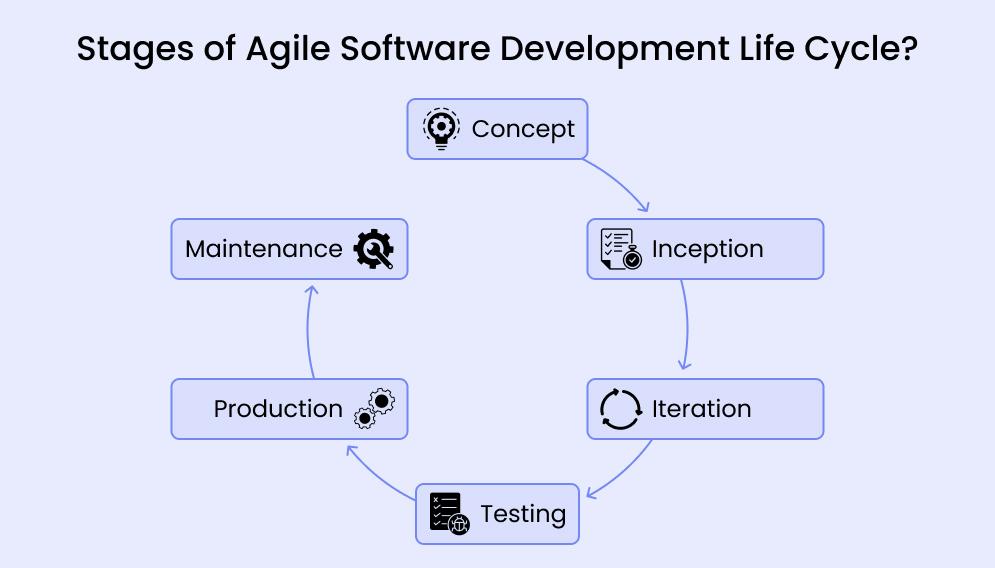
1. Concept
This stage is all about ideation and defining the broader aspect of the project. By including business analysts, project managers and team members, you can define the goals, scope and feasibility of the project. It helps understand potential risks, expected costs and required resources.
Activities:
- Identify the business problem or opportunity
- Gather business and user requirements
- Conduct feasibility analysis
- Define project scope and objectives
- Estimate initial resources, time, and cost
2. Inception
Inception can also be considered as the shape molding stage of an Agile software development project. Your in-house teams and you can collectively gather requirement details, where you can define the granular details to set a system.
Activities:
- Assign project team members
- Create an initial project plan and timeline
- High-level architecture and design discussions
- Prepare a risk assessment and mitigation plan
- Set up the initial project environment and tools
3. Iteration
At the core of Agile methodologies, is iteration, which typically lasts for 2-4 weeks to complete a set of features and tasks. Each iteration involves planning, development, testing, and reviewing, that continues until the project goals are achieved.
Activities:
- Definition of goals and tasks for the iteration
- Writing code, developing features, and integrating components
- Performance of unit testing and integrate new features
- Conduction of iteration review meetings to assess progress and gather feedback
- Reflection on the iteration process to identify improvements
4. Testing
Testing is an integral step for each iteration to ensure quality software development. System testing evaluates the entire system’s functionality to ensure it meets the specified requirements. Defects are identified and fixed throughout the testing stage.
Activities:
- Testing individual components for correctness
- Verifying that combined components work together
- Testing the entire system’s functionality
- Validating the software against business requirements
- Ensuring new changes do not break existing functionality
5. Production
This stage involves final preparation and validation to ensure the software is ready for release. Deployment plans and procedures are finalized, and a final round of testing and validation is conducted to catch any last-minute issues. The successful completion of this stage snakes the official release of the software.
Activities:
- Finalizing deployment plans and procedures
- Conducting final testing and validation
- Deploying the software to the production environment
- Monitoring the system for any issues and ensure smooth operation
- Providing training and support to users
6. Review/Maintenance
This is the last but ongoing phase that starts after the software is deployed. It leads with gathering user feedback which is analyzed to identify the areas that can be enhanced and to address defects. It also gives longevity and effectiveness of software thereby maintaining alignment with business goals and user requirements.
Activities:
- Monitoring the software for performance and issues
- Gathering user feedback and address any defects
- Implementing updates and new features as required
- Conducting regular maintenance activities to ensure system health
- Planning for future iterations and enhancements based on user needs and feedback
Looking to Hire Software Developers?
Get in touch with Space-O and assemble an Agile development team tailored to your project needs, ensuring flexibility and continuous delivery throughout the software development lifecycle.

What are the Five Main Agile Methodologies?
1. Scrum
First on the list, Scrum is the most popular framework within Agile methodologies. The stages and cycles of software development are characterized as sprints in this methodology. It focuses on the maximization of development time to achieve the Product Goal, which is a larger value objective for the team to move towards.
Scrum methodology can be successfully used in business-related contexts. This software development process begins with a daily 15-minute meeting, called the daily Scrum. Here is a the list of Scrum benefits:
- Team motivation: Programmers aim to meet sprint deadlines.
- Transparency: Project progress is visible to all team members and the organization.
- Simple ‘definition of done’ for requirement validation.
- Constant focus on quality to reduce mistakes.
- Dynamic method: Developers can reorganize priorities for incomplete sprints.
- Prioritized sprint planning: Ensures the team understands the ‘why, what, and how’ of tasks.
2. Kanban
Kanban is a Japanese term that means ‘just in time’. Under this methodology, a Kanban board or table is maintained that consists of columns representing different stages of the project. The development progress is updated on the board and new tasks are added as ‘cards’.
This project management framework is ideal for individual business departments such as HR and marketing, making the entire team’s tasks visible. It also ensures all team members are aware of the project’s current stage and status at given time. Here are its benefits:
- View all project tasks (Completed, In Progress, In Testing) with ‘cards’.
- Limit the number of running tasks for better manageability.
- Focus on cycle duration: backlog to final stage.
- Enables continuous deliveries.
- Simple to implement beyond the IT industry.
3. Extreme programming
Extreme Programming (XP) is pivoted around the concept, ‘The simplest thing that will work’, rather than overemphasizing the long-term view. Created by Kent Beck, this software development agility can be adapted by development companies of different sizes.
This Agile methodology involves simplicity, feedback, communication, courage and respect for prioritizing customer satisfaction. XP promotes practices like pair programming and incorporates a strong testing component, making it an excellent engineering methodology. Here are its benefits:
- Simple code allows for easy improvement.
- Visible processes and XP cycles create goals and rapid results.
- Agile development with constant testing.
- Highly energizing work environment.
- XP uplifts and maintains team talent.
4. Lean development
This conceptual framework is adapted from lean manufacturing, pioneered by Toyota and applied to software development. Lean development focuses on eliminating any activities that do not add direct value to the product.
It is guided by seven core principles:
- Eliminate waste: Remove anything that does not contribute effective value to the customer project.
- Quality development: Maintain high standards in development through discipline and control to minimize residual issues.
- Create knowledge: Encourage comprehensive documentation to preserve valuable insights for future use.
- Differentiate commitments: Avoid excessive planning without a full understanding of business requirements.
- Fast delivery: Aim to deliver value to the customer as quickly as possible.
- Respect the team: Prioritize effective communication and conflict management within the team.
- Optimize the whole: Refine the development process to eliminate errors and ensure a continuous flow of value.
The concept of Minimum Viable Product (MVP) is closely associated with Lean software development principles. Here are some of its benefits:
- Eliminates superfluous activities, saving time and money.
- Reduces delivery time and boosts team motivation.
- Scalable and adaptable to any project size.
- Avoids over-engineering solutions or requirements.
5. Crystal
Lastly, Crystal is defined as a family of Agile methodologies known for allowing teams significant freedom to develop their own processes.
It offers variants such as:
- Crystal clear (for teams of up to 8 people)
- Crystal yellow (for teams of 10 to 20 people)
- Crustal orange (for teams of 20 to 50 people)
- Crystal red (for large teams of 50 to 1,000 people)
Basically, Crystal makes communication a crucial element to emphasize individuals’ interactions over processes and tools. To quote Alistair Cockburn, founder of the Crystal method, “Crystal is a family of software development methodologies, which works with the power invested by people, and is extremely light and stretch-to-fit.” These are its advantages:
- Frequent deliveries to identify problems early.
- Allows time for process improvement discussions.
- Enhances team communication and knowledge-sharing.
- Provide automated tests, configuration management, and frequent integration.
What are the 10 SDLC Tools?
| Tool Name | Best For | Features | Pricing |
|---|---|---|---|
| ClickUp | Software Development Project Management |
| Free forever
|
| Zoho Projects | Small Teams |
| Free for up to three users
|
| Scoro | End-to-End Management |
|
|
| Jira | Agile Projects Management |
| Free for up to 10 users
|
| Redmine | Open-Source Project Management |
| This tool is free to use. |
| Asana | Collaboration |
|
|
| Paymo | Planning and Invoicing |
| Free for one user
|
| Celoxis | Portfolio Management |
|
|
| TeamGantt | Gantt Chart Project Management |
|
|
| KrispCall | Phone Calls |
|
|
What are the Four C’s of Agile?
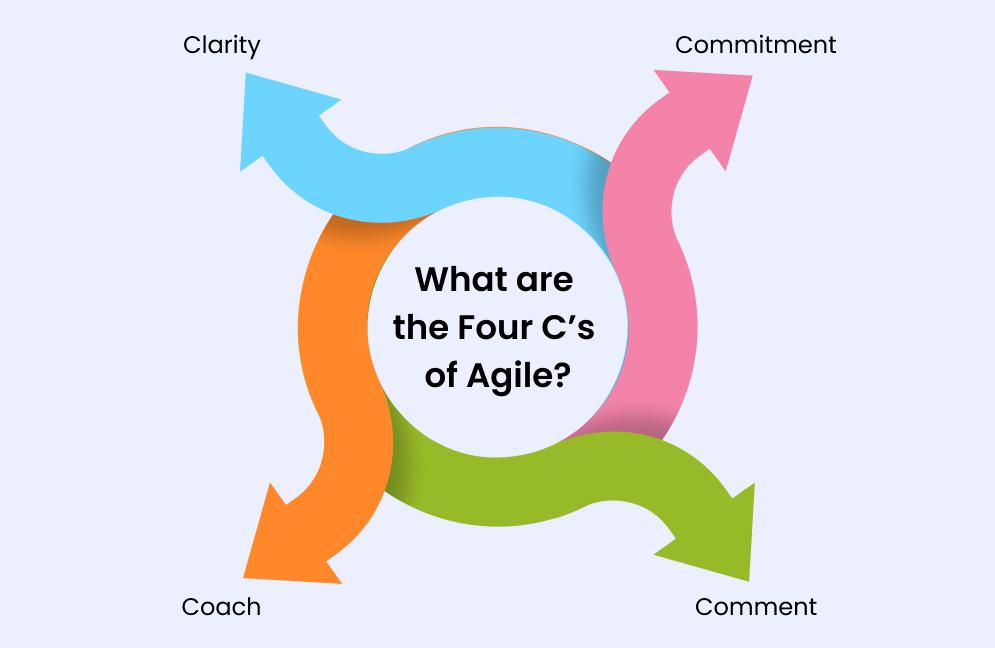
Traditional project management often struggles to ensure individual accountability within teams. However, Agile software development methodologies have addressed these challenges through a set of key principles known as the four C’s. It helps Agile project managers build a culture to hold people accountable for clarity, commitment, comment, and coaching.
1. Clarity
Initiation of each Agile iteration (sprint, Kanban cycle, etc.) includes essential clear and concise communication. This involves:
- Clearly define project goals and objectives – Everyone needs to understand the ’what’ and ‘why’ of their efforts.
- Outline individual roles and responsibilities – Avoid confusion and duplication of efforts in the team.
- Ensure everyone grasps the project vision and roadmap – Understanding the bigger picture keeps everyone motivated and focused on delivering value.
2. Commitment
Motivating team members can help them stay focused on Agile SDLC goals.
- Team commitment – Team members must commit to their assigned tasks as discussed during daily stand-up meetings. This practice of taking ownership contributes to the team’s success.
- Client commitment – You should be actively involved and committed to providing timely feedback. Your feedback is crucial to ensure business alignment in the direction of success.
3. Comment
Open communication channels are the lifeblood of the Agile life cycle. This includes:
- Active listening – Software development teams must have members who actively listen to one another’s concerns and feedback throughout the development process.
- Constructive feedback – Regular feedback helps keep everyone on track and identify areas for improvement.
4. Coach
Incorporate a coach in your Agile SDLC; this individual can continuously adapt and optimize approaches within the SDLC, helping with:
- Providing guidance and support – The team can navigate challenges, adopt best practices, and continuously improve with the coach’s guided direction.
- Facilitating retrospectives – The coach can help development teams identify areas where accountability could be strengthened and implement changes for future iterations.
- Promoting continuous learning – The coach can encourage development team members to continuously learn and develop new skills to stay up-to-date.
Get a Competitively Priced Quotation for Your Project
Share your requirements with Space-O’s Agile software development team, and get a competitive quotation.
Frequently Asked Questions
How can the duration of an Agile project be measured?
Agile teams use story points to gauge and monitor the complexity and advancement of projects. These metrics aid in estimating delivery timelines and team velocity. Despite the possibility of errors, story points offer a helpful foundation for monitoring development and fine-tuning upcoming schedules.
Whom should I get in touch with to understand the progress of my Agile software development project?
To understand the progress of your Agile software development project, contact your project manager. They will provide timely updates and proactively conduct a root-cause analysis if the project slows. They will also focus on key performance indicators (KPIs) to address any issues. This will ensure the project keeps its momentum and aligns with your objectives.
Who leads Agile planning, design, and requirements gathering?
Depending on the circumstances, leadership in Agile environments can originate from a variety of roles. By setting priorities for the backlog, removing obstacles, and offering assistance to the team, the Scrum Master makes sure everything runs well. To direct development initiatives, the Product Owner or Champion—who usually speaks for the business side—integrates the viewpoints of the business, the customer, and technology. To promote quality or decide on development strategies, QA specialists or development leads may assume leadership in the interim. In Agile projects, leadership is dynamic and frequently changes according to team roles and project requirements.
What is the Agile Manifesto?
Four fundamental principles underpin Agile development cycle, according to the Agile Manifesto, which was drafted in February 2001 by 17 software professionals.
Responding to Change Over Following a Plan: Be open to new ideas and adjust more readily to change.
Individuals and Interactions Over Processes and Tools: Prioritize transparent interactions over technology.
Working Software Rather Than Detailed Documentation: Put more effort into developing immediately usable software so that users can provide comments more quickly.
Customer Collaboration Over Contract Negotiation: Encourage Business and IT to work together to secure marketable visibility and customer buy-in.
Conclusion
Finally, you’ve reached the end of our Agile software life cycle tour. We have provided a comprehensive understanding of the Agile methodology, its core stages, the powerful tools, and Agile’s four C’s to make your projects shine. Agile methodology’s flexibility and focus on collaboration can prove to be valuable in today’s fast-paced and ever-changing software development landscape.
Encompassing your project around Agile stages can provide a robust framework for ensuring high-quality software development efficiency. Aligning interactive approaches allows you to course-correct quickly and stay success-centric with evolving needs. Agile software development is your safest bet to be well-positioned in your industry and deliver high-quality software that thrives in the evolving world of technology.
So, what are you waiting for? you can contact Space-O Technologies for nearshore software development, offering Agile teams that seamlessly integrate with your business. Our proximity to the USA ensures minimal time zone differences, fostering efficient collaboration and rapid problem-solving. Whether you require full-time dedicated teams or hourly support, we provide the scalability and expertise to drive your project forward.


Unlock the Power of Agile Development
 All our projects are secured by NDA
100% Secure. Zero Spam
*All your data will remain strictly confidential.
Trusted by


Bashar Anabtawi 
Canada
“I was mostly happy with the high level of experience and professionalism of the various teams that worked on my project. Not only they clearly understood my exact technical requirements but even suggested better ways in doing them. The Communication tools that were used were excellent and easy. And finally and most importantly, the interaction, follow up and support from the top management was great. Space-O not delivered a high quality product but exceeded my expectations! I would definitely hire them again for future jobs!”

Canada Office
2 County Court Blvd., Suite 400,
Brampton, Ontario L6W 3W8
Phone: +1 (602) 737-0187
Email: sales@spaceo.ca