

Web Development Outsourcing: Complete Guide to Costs, Challenges, and Benefits
Struggling to build a high-performing website or web application without inflating costs or overloading your in-house team? You’re not alone. That pressure is exactly why businesses increasingly rely on web development outsourcing to speed up delivery, optimize budgets, and access specialized expertise that may not exist internally.
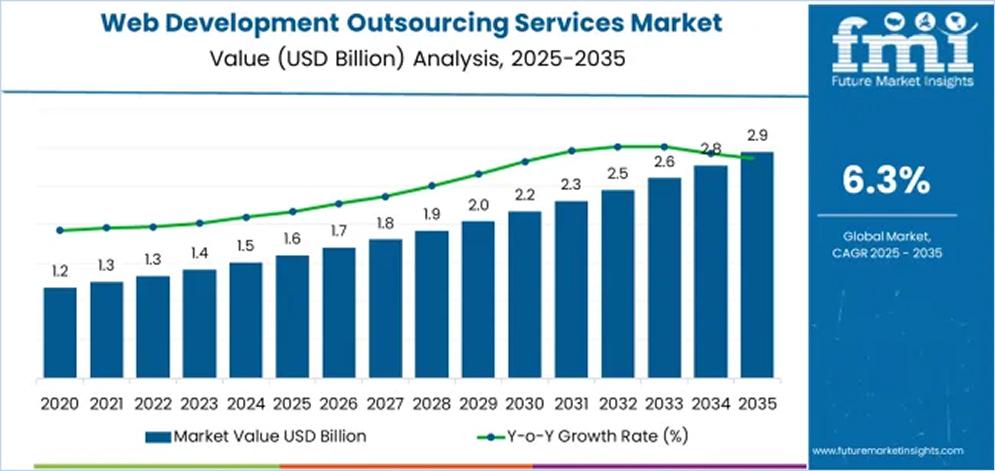
The market reflects this shift clearly. According to Future Market Insights, the web development outsourcing services market is projected to grow from USD 1.6 billion in 2025 to USD 2.9 billion by 2035, expanding at a 6.3% CAGR.
From startups launching MVPs to enterprises scaling complex platforms, outsourcing can fundamentally change how teams build and grow. However, success depends on strategy, clear requirements, the right engagement model, and a dependable development partner.
This guide breaks down web development outsourcing in practical terms. You’ll learn which services you can outsource, what it really costs, how to choose the right model, and how to collaborate effectively with a partner who delivers consistent, measurable results.
What is Web Development Outsourcing?
Web development outsourcing means hiring an external team or company to handle your website or web application development instead of building everything in-house. You’re essentially bringing in specialized talent to design, develop, test, and deploy your web solution while your internal team focuses on core business operations.
Unlike freelancing (where you hire individuals for specific tasks) or traditional in-house development (where you employ full-time developers), outsourcing web development gives you access to a complete team with diverse skill sets, established processes, and proven project management systems.
With the core concept established, let’s explore the strategic motivations—discover why leading companies choose outsourcing for their web projects.
Why Do Companies Outsource Web Development?
The decision to outsource web development isn’t just about saving money (though that’s definitely part of it). It’s about making strategic choices that help your business move faster, scale smarter, and compete more effectively.
Here are the 5 reasons why companies across industries are choosing to outsource their web development projects.
1. Access to specialized expertise
Your in-house team might be great at running your day-to-day operations, but do they have experience building PIPEDA-compliant healthcare portals? Or fintech platforms with complex payment integrations? Probably not.
When you outsource web development, you get immediate access to developers who’ve already solved the exact challenges you’re facing. They know the latest frameworks, follow security best practices, and understand industry-specific compliance requirements.
2. Significant cost savings
Let’s talk numbers. Hiring a full-time senior developer in Canada typically costs CAD $101,500 – $145,000, plus benefits, office space, equipment, and training. And that’s just one developer—most projects need an entire team. When you outsource web developers, you eliminate those overhead costs. You’re paying for the exact resources you need, when you need them, without the long-term commitment.
But here’s what really matters: it’s not just about spending less—it’s about spending smarter. Outsourcing web development lets you allocate your budget toward growth initiatives instead of operational overhead.
3. Faster time-to-market
Speed matters in today’s digital landscape. Your competitor is probably working on something similar right now, and whoever launches first often captures the market advantage.
Outsourced web development teams can hit the ground running. They have established workflows, proven processes, and all the infrastructure in place to start building immediately. No lengthy recruitment cycles, no onboarding delays, no learning curve.
4. Scalability and flexibility
Your development needs aren’t static. You might need a large team during the build phase, a smaller team for maintenance, and then scale back up for new feature releases.
With outsourced web development, you get that flexibility. Scale your team up or down based on project phases without the complexity of hiring and firing employees. Need a specialized developer for just two months? Done. This scalability is especially valuable for startups and growing businesses where needs change rapidly.
5. Focus on core business operations
Here’s a truth many business owners learn the hard way: building and managing a development team is a full-time job in itself. It pulls leadership attention away from product strategy, customer relationships, sales, and all the other things that actually drive revenue.
When you outsource web services, you’re buying back that time and mental bandwidth. You still provide direction and feedback, but you’re not managing daily standups, debugging technical issues, or mediating developer conflicts. The outsourcing partner handles all of that while you focus on strategic decisions that move your business forward.
These motivations become actionable through specific services—here are the key web development areas you can effectively outsource.
What Services Can You Outsource for Web Development?
One of the biggest advantages of website development outsourcing is the range of services available. You’re not limited to just hiring developers—you can outsource specific parts of your project or the entire end-to-end development process.
Here’s what’s typically on the table.
1. Custom web application development
Custom web apps are built specifically for your business needs—no templates, no compromises. Think enterprise resource planning (ERP) systems, customer relationship management (CRM) platforms, or any web-based software that solves a specific business problem.
When you outsource web development for custom applications, you get teams experienced in building scalable, secure, and performance-optimized solutions.
2. E-commerce development
Online stores require more than just good design. You need payment gateway integration, inventory management, order processing, shipping calculations, and seamless checkout experiences.
Outsourcing ecommerce website development gives you access to developers who understand platforms like Shopify Plus, WooCommerce, Magento, or custom-built solutions. They know how to optimize for conversion, integrate with your existing business systems, and ensure your store can handle traffic spikes during peak seasons.
| Do you know? The e-commerce website development cost varies significantly based on complexity, but outsourcing typically delivers better ROI than trying to build these sophisticated systems internally. |
3. Frontend development
Your website’s frontend is what users see and interact with. It needs to be fast, responsive, intuitive, and visually appealing across all devices.
When you outsource web developers for frontend work, you get specialists in modern frameworks like React, Angular, Vue.js, or emerging technologies like progressive web apps. They’ll ensure your interface isn’t just pretty—it’s built on solid foundations that are maintainable, accessible, and optimized for performance.
4. Backend development
While users don’t see the backend, it’s the engine that powers everything. Server architecture, databases, APIs, authentication systems, business logic—this is where the heavy lifting happens.
Outsourced backend developers handle technologies like Node.js, Python, PHP, Ruby on Rails, and .NET. They design database schemas, build RESTful or GraphQL APIs, implement security protocols, and ensure your application can scale as your user base grows.
The right web development teams understand how frontend and backend need to work together seamlessly, which is why many businesses outsource both sides of development to the same partner.
5. Web Portal development
Web portals serve as centralized platforms for specific user groups. Customer portals let clients access their accounts, track orders, or submit support tickets. Employee portals provide access to internal resources, HR systems, and collaboration tools. B2B portals enable partners and vendors to manage transactions and communications.
Web portal development requires careful planning around user authentication, role-based permissions, data security, and integration with existing business systems. Outsourcing this work to experienced teams ensures you get a secure, scalable portal that serves your specific business needs.
Scale Web Development Without Hiring Delays
Work with experienced web developers to accelerate delivery, expand your development capacity, and meet aggressive launch timelines without adding permanent headcount.
Knowing which services to outsource leads to selecting the best delivery model—compare the main outsourcing approaches to find your ideal fit.
Web Development Outsourcing Models: Choosing the Right Fit
Not all outsourcing arrangements work the same way. The model you choose affects everything from cost structure to team dynamics to project control. Here’s how to pick the right approach for your situation.
1. Project-based outsourcing
This is the most straightforward model: you define a project with clear scope, timeline, and deliverables, and the outsourcing partner quotes a fixed price to complete it.
Best for: Well-defined projects where requirements are unlikely to change. Think redesigning an existing website, building a specific feature, or migrating to a new platform.
Pros: Predictable costs, clear timeline, minimal management overhead on your end. You know exactly what you’re paying and what you’re getting.
Cons: Less flexibility for changes mid-project. If you realize halfway through that you need different functionality, it often means renegotiating scope and budget. Also not ideal for long-term products that evolve based on user feedback.
When to choose this: You have a clear vision, documented requirements, and confidence that your needs won’t shift significantly during development. Many businesses use this model for their first outsourcing experience because it feels lower-risk.
2. Dedicated team model
With this model, you essentially build an external team that works exclusively on your projects. They integrate with your processes, attend your meetings, and function as an extension of your in-house team.
Best for: Long-term projects, ongoing product development, or situations where you need consistent resources but don’t want to build an in-house team. This is popular with companies building complex web applications that require continuous development and iteration.
Pros: Full control over priorities and direction, deep product knowledge within the team, better collaboration and communication, ability to pivot quickly based on market feedback. You’re building a real team relationship, not just hiring contractors.
Cons: Requires more management involvement from your side. You’ll participate in sprint planning, daily standups, and other agile ceremonies. Also typically requires longer commitment periods (3-6 months minimum).
When to choose this: You’re building a product that will evolve over time, you value team continuity, and you have the bandwidth to actively manage the collaboration. This model works exceptionally well for startups and growing companies developing their core products.
Dedicated development teams offer the best balance between cost efficiency and control for most complex web development projects.
3. Staff augmentation
Staff augmentation means temporarily adding specific skills to your existing team. Need a React specialist for three months? A DevOps engineer to handle deployment? This model lets you fill specific gaps without hiring full-time employees.
Best for: Filling temporary skill gaps, handling workload spikes, or adding specialized expertise for specific project phases. Your in-house team remains in control, and the augmented staff work under your direction.
Pros: Quick scaling, precise skill matching, maintains your existing workflows and culture, and flexible duration. You keep full control over day-to-day work.
Cons: Requires strong in-house technical leadership to manage the augmented team effectively. Not ideal if you lack internal technical expertise or project management capabilities.
When to choose this: You have a solid technical foundation in-house, but need additional bandwidth or specific expertise temporarily. Nearshore staff augmentation is particularly popular for this model due to time zone alignment.
Model selection directly impacts budgeting—here’s what you can realistically expect to invest in web development outsourcing.
How Much Does It Cost To Outsource Web Development?
Outsourcing web development in Canada typically costs between $60 and $80 per hour, depending on the developer’s experience and location within the country.
But let’s get specific about costs because “it depends” doesn’t help you budget. While every project is unique, understanding the factors that drive pricing and typical rate ranges helps you set realistic expectations.
1. Factors that affect outsourcing costs
Several variables determine how much you’ll pay when you outsource web development:
Project complexity and scope: A simple five-page marketing website costs dramatically less than a custom e-commerce platform with inventory management, payment processing, and customer portals. The more features, integrations, and custom functionality you need, the higher the cost.
Technology stack requirements: Some technologies are more expensive than others. Cutting-edge frameworks or specialized platforms (like building HIPAA-compliant healthcare applications) require more experienced developers who command higher rates.
Team size and seniority level: Junior developers cost less but may need more oversight and take longer. Senior developers and technical architects cost more but deliver higher-quality code and better architectural decisions. Most projects need a mix.
Geographic location: As discussed earlier, where you outsource dramatically affects hourly rates. The same quality work can cost 2-3x more depending on location.
Project timeline: Rush jobs cost more. If you need something delivered in half the typical timeframe, expect to pay premium rates for expedited delivery.
2. Regional pricing breakdown
Here’s what you can expect to pay per hour based on where you outsource web developers:
North America (US & Canada): $100-$250/hour
- Highest rates globally
- Excellent for projects requiring frequent real-time collaboration
- Cultural alignment and language fluency
- Strong understanding of North American business practices
Western Europe (UK, Germany, France): $80-$200/hour
- High-quality standards
- Strong technical education systems
- Good English proficiency
- Similar business culture to North America
Eastern Europe (Ukraine, Poland, Romania): $40-$100/hour
- Excellent technical talent
- Strong education in STEM fields
- Good English proficiency
- Significant cost savings with quality work
- Popular choice for many US and European companies
Asia (India, Philippines, Vietnam): $20-$80/hour
- Maximum cost savings
- Large talent pool
- Growing tech ecosystems
- Time zone challenges for North American companies
- Best suited for well-documented projects
Latin America (Mexico, Brazil, Argentina): $30-$90/hour
- Good time zone alignment with North America
- Growing tech talent
- Cultural similarities with North American business practices
- Increasingly popular for nearshore outsourcing
Want to dive deeper into which countries offer the best value? Check out our guide on the best countries to outsource software development.
3. Project-based cost estimates
Here’s what different types of web projects typically cost when you outsource web development. These are ballpark figures—your actual costs depend on specific requirements and the chosen partner.
Simple Business Website (5-10 pages):
- Basic design, CMS integration, contact forms
- Timeline: 4-8 weeks
- Cost: $5,000-$15,000
Medium Complexity Website (Custom features, integrations):
- Custom design, user authentication, database integration
- API connections, payment processing
- Timeline: 8-16 weeks
- Cost: $15,000-$50,000
Custom Web Application (SaaS, complex features):
- Multi-user systems, advanced functionality
- Custom business logic, third-party integrations
- Timeline: 3-6 months
- Cost: $50,000-$150,000
E-commerce Platform (Custom build):
- Product catalog, shopping cart, payment gateways
- Inventory management, order processing
- Timeline: 3-6 months
- Cost: $40,000-$120,000
Enterprise Web Solution (Large-scale, complex):
- Multiple user roles, advanced security
- Complex integrations, scalable architecture
- Timeline: 6-12+ months
- Cost: $150,000-$500,000+
For more detailed breakdowns, see our comprehensive guides on website development cost and cost of web application development.
Cost clarity sets the stage for execution—follow this proven step-by-step guide to outsourcing web development effectively.
| Important note: The cheapest option isn’t always the best value. A $20/hour developer who takes three times longer and delivers buggy code costs more than a $100/hour developer who delivers clean, maintainable code on schedule. Focus on value, not just hourly rates. |
Step-by-Step Guide: How to Outsource Web Development Successfully?
Knowing you should outsource is one thing. Actually doing it successfully is another. Here’s a proven process for how to outsource web development without the common pitfalls.
Step 1: Define your project requirements clearly
Before you contact a single outsourcing partner, get crystal clear on what you’re building and why. Start with your business goals. What problem does this website or application solve? Who are your users? What success metrics matter? Don’t just think about features—think about outcomes.
Document your functional requirements. What must the application do? List core features, user flows, and critical functionality. Set realistic timeline and budget expectations. Determine technical specifications where you have preferences.
Do you need specific integrations? The clearer your requirements, the more accurate quotes you’ll receive and the smoother your project will run. Many failed outsourcing relationships start with vague requirements and misaligned expectations.
Step 2: Research and shortlist potential partners
Now it’s time to find candidates. Start with these sources:
B2B review platforms: Clutch, GoodFirms, and UpCity provide verified reviews, portfolio examples, and detailed company profiles. Look for partners with experience in your industry and relevant technical expertise.
Referrals: Ask your network. Other entrepreneurs, colleagues, or business contacts who’ve outsourced successfully can recommend reliable partners. Personal referrals often lead to better fits than cold outreach.
Industry directories: Check out curated lists like our web development companies guide that break down companies by specialization, location, and expertise.
Step 3: Evaluate technical expertise and cultural fit
Schedule discovery calls with your shortlisted partners. This isn’t just about their technical chops—it’s about whether you can work together effectively.
Review their portfolio thoroughly: Don’t just glance at pretty screenshots. Ask to see live applications they’ve built. Click around. Test functionality. Check if sites load quickly and work on mobile devices. Look for projects similar in complexity to yours.
Assess technical expertise: Ask about their development process, tech stack preferences, and how they handle common challenges. Do they understand your requirements? Can they suggest improvements? Are they asking smart questions? Technical competence shows in how they discuss your project.
Evaluate communication capabilities: How responsive are they? Do they explain technical concepts clearly? Are they proactive in identifying potential issues? Good communication is non-negotiable for successful outsourcing.
Step 4: Request proposals and compare options
Send detailed RFPs (Request for Proposal) to your top 3-4 candidates. Include your requirements document, timeline expectations, and any technical specifications. Ask for:
- Detailed project timeline with milestones
- Team composition (who works on what)
- Technology stack and architecture recommendations
- The development methodology they’ll use
- Communication plan and reporting structure
- Total cost breakdown (fixed price or hourly with estimates)
- Payment terms and schedule
- Post-launch support options
Compare proposals objectively: Create a simple scorecard evaluating each proposal on technical approach, timeline, cost, team expertise, and communication clarity. The best choice isn’t always the cheapest or fastest—it’s the one offering the best value for your specific needs.
Key questions to ask during proposal review:
- How do they handle changes to scope mid-project?
- What happens if timelines slip?
- How do they ensure code quality?
- What’s included in their quoted price (design? testing? deployment?)?
- What happens after launch (support period, maintenance options)?
Step 5: Start with a small project or trial period
If this is your first time working with a partner, consider starting small. Hire them for a clearly defined piece of work before committing to your full project.
This trial period lets you evaluate:
- Work quality and attention to detail
- Communication effectiveness
- Adherence to timelines
- Problem-solving capabilities
- Cultural fit and working relationship
Think of it as a dating period before marriage. A two-week trial project costing $5,000-$10,000 can save you from a $100,000 mistake on your main project.
Many smart companies follow software development outsourcing models that include trial periods or phased approaches to minimize risk.
Step 6: Establish clear communication channels
Once you’ve selected your partner, set up the communication infrastructure before development starts.
Choose your tools:
- Project management: Jira, Asana, or Trello for task tracking
- Communication: Slack or Microsoft Teams for daily updates
- Video calls: Zoom or Google Meet for meetings
- Code repository: GitHub, GitLab, or Bitbucket for version control
- Documentation: Confluence, Notion, or Google Docs for shared knowledge
Define meeting schedules:
- Daily standups (15 minutes)
- Weekly progress reviews
- Bi-weekly sprint planning and retrospectives
- Monthly stakeholder updates
Establish escalation processes: What happens when issues arise? Who do you contact? How quickly should they respond? Clear escalation paths prevent small problems from becoming big ones.
Create documentation standards: How will decisions be documented? Where are requirements tracked? What format for progress reports? Good documentation prevents misunderstandings and creates accountability.
Step 7: Monitor progress and maintain quality control
Outsourcing doesn’t mean set-it-and-forget-it. Stay involved throughout development.
Participate in regular sprint reviews: See working demos of completed features. Test functionality yourself. Provide feedback early and often—it’s cheaper to adjust course early than to rebuild later.
Track progress against milestones: Are they hitting deadlines? If not, why? What’s the recovery plan? Early warning signs of trouble include missed milestones, inconsistent communication, or vague status updates.
Maintain feedback loops: Provide clear, constructive feedback on deliverables. The better your feedback, the better the final product. Don’t wait until the end to share concerns.
Test thoroughly: Don’t assume everything works perfectly. Test edge cases. Try to break things. Get potential users to test. Quality assurance shouldn’t be an afterthought.
Step 8: Plan for post-launch support
Your relationship with your outsourcing partner shouldn’t end at launch. Plan for what comes next.
Negotiate maintenance agreements: Websites need updates, bug fixes, and ongoing optimization. Many partners offer retainer-based support packages that give you X hours per month for maintenance.
Arrange knowledge transfer: If you plan to eventually manage the application internally, ensure proper documentation and training. You should understand how everything works and how to make basic updates.
Set documentation requirements: Insist on comprehensive technical documentation, API documentation, deployment procedures, and user guides. Future developers (or your team) will thank you.
Consider a long-term partnership: If the relationship worked well, keep them engaged. They already understand your business and codebase. It’s often more efficient to continue with the same team than to onboard new developers for future enhancements.
For ongoing maintenance considerations, check out our guide on types of software maintenance to understand what you’ll need post-launch.
Reduce Development Costs Without Cutting Corners
Work with Space-O Technologies to outsource web development efficiently while maintaining code quality, security compliance, and predictable delivery.
Even with a solid process, obstacles arise—learn the most common challenges and practical solutions for successful outsourcing.
What are the Common Challenges in Web Development Outsourcing and Ways to Overcome Them?
Let’s be honest—outsourcing web development isn’t always smooth sailing. Understanding potential challenges upfront helps you navigate them successfully instead of getting blindsided. Here are the most common issues and practical solutions.
1. Communication barriers
The Challenge: Misunderstandings happen, especially when working across cultures and languages. A feature you described one way gets built differently because of interpretation gaps. Technical jargon doesn’t translate well. Emails lack tone and context.
The solution: Communicate visually and frequently. Use wireframes, mockups, and short video walkthroughs to reduce interpretation gaps. Schedule regular video calls, maintain a shared glossary, and confirm understanding by asking teams to restate requirements in their own words.
2. Time zone differences
The Challenge: When you’re awake, they’re asleep, and vice versa. Questions sit unanswered for hours. Real-time collaboration becomes nearly impossible. Decision-making slows down because you’re playing email tag across 12-hour time differences.
The Solution: Find overlap hours and protect them religiously. Use asynchronous communication effectively—detailed status updates at the end of their day that you can review at the start of yours.
Consider nearshore development teams if real-time collaboration is critical to your project. A few hours of time zone difference is manageable; 12 hours is challenging.
Set clear expectations about response times. If questions need answers within 2 hours, that’s different than 24-hour turnaround expectations. Clarity prevents frustration.
3. Quality control issues
The Challenge: Code works but isn’t maintainable. Features function but aren’t optimized. The final product looks fine on the surface but has technical debt lurking underneath. You discover quality issues months later when it’s expensive to fix.
The Solution: Build quality checks into your process from day one. Insist on code reviews, automated testing, and continuous integration. Ask to see their quality assurance processes during the evaluation phase.
Define quality standards upfront. What coding standards will they follow? What test coverage percentage do you expect? How will performance be measured? These aren’t optional extras—they’re fundamental requirements.
Consider having an independent technical advisor periodically audit the codebase, especially if you’re not technical yourself. Catching quality issues early saves massive headaches later.
4. Security and IP protection concerns
The Challenge: You’re sharing sensitive business information, proprietary ideas, and potentially customer data with an external team. What if they leak information? What if they reuse your code for other clients? Who owns the intellectual property?
The Solution: Legal protections are non-negotiable. Always sign comprehensive NDAs (Non-Disclosure Agreements) before sharing any sensitive information. Your NDA for software development should cover confidentiality, IP ownership, and non-compete clauses.
For security, verify their data protection practices. How do they handle sensitive information? What security certifications do they hold? Do they follow secure development practices? Use code repositories you control (not their private repos). This ensures you always have access to your code and can monitor what’s happening.
5. Hidden costs and scope creep
The Challenge: The initial quote looked great, but then “unexpected” costs start appearing. That integration you assumed was included? Extra charge. Testing? Extra charge. Deploying to production? You guessed it. Or requirements keep expanding without corresponding budget adjustments, and suddenly you’re way over budget.
The Solution: Get extremely detailed quotes that itemize everything. Ask specifically what’s included and what’s not. Assume nothing. If deployment, testing, design revisions, or specific integrations matter to you, ensure they’re explicitly listed in the contract.
Define a clear change management process upfront. How will changes to scope be handled? What’s the process for requesting new features? How will additional costs be estimated and approved? This prevents “but you never told us that would cost extra” arguments later.
For insights into realistic budgeting, see our guide on the cost of outsourcing software development.
Overcoming hurdles requires timing—discover the key scenarios when outsourcing web development delivers maximum value.
When Should You Outsource Web Development?
Outsourcing isn’t always the right answer. Sometimes building in-house makes more sense. Here’s when outsourcing web development is typically your best bet.
1. You lack in-house technical expertise
If your team consists primarily of marketers, salespeople, and business strategists, building a complex web application in-house is a recipe for disaster. You’d need to hire developers, which takes months. Then you’d need to manage them, which requires technical leadership you don’t have. Outsourcing gives you immediate access to technical expertise without the learning curve of building that capability internally.
2. You’re working with limited budget or resources
Startup budgets are tight. Every dollar counts. When you can get the same quality development for 40-60% less by outsourcing, that’s money you can invest in marketing, sales, or product validation.
Even established companies face budget constraints. Maybe you have a fixed budget for a new initiative and building in-house would exceed it. Maybe you need to show ROI quickly and can’t wait 12 months to hire and train a team. Outsourcing provides cost predictability and efficiency.
3. You need to meet tight deadlines
Your competitor is launching in three months. You promised a client delivery in six weeks. You have a trade show where you need to demo your product. Tight deadlines require experienced teams that can hit the ground running. Outsourcing partners have established workflows, pre-built components, and the experience to move quickly without sacrificing quality. They’ve done similar projects before and know the shortcuts and pitfalls..
4. You want to scale quickly
Maybe you’re testing multiple product ideas and need development capacity for all of them. Maybe you’re growing rapidly, and your development needs are expanding faster than you can hire. Maybe seasonal demand requires temporary scaling. Outsourcing provides elasticity. Need five developers this month and fifteen next month? No problem.This flexibility is particularly valuable for startups in growth mode or enterprises launching multiple digital initiatives simultaneously.
5. You need access to latest technologies
Technology evolves rapidly. That hot new framework released last year? Your in-house team hasn’t had time to learn it yet. But it’s perfect for your project. Established outsourcing partners invest heavily in keeping their teams trained on emerging technologies. They have developers specialized in React, Vue, Angular, Node.js, Python, and whatever else you need. They’ve used these technologies in production projects, not just tutorials.
Right timing plus the right partner equals success—here’s your checklist for evaluating top web development outsourcing providers.
What to Look for in a Web Development Outsourcing Partner
Choosing the right partner makes or breaks your outsourcing experience. Here’s what separates excellent partners from mediocre ones.
1. Validate a proven track record
Review portfolios that match your industry, project complexity, and scale. Explore live applications to evaluate performance, mobile responsiveness, and user experience. Strengthen confidence by checking client testimonials, speaking with references, and assessing the company’s long-term stability.
2. Confirm strong technical expertise
Evaluate hands-on experience with your required technology stack, supported by relevant certifications. Ensure the team follows agile development, uses CI/CD pipelines, conducts regular code reviews, and applies best practices to build scalable, maintainable solutions.
3. Prioritize transparent communication
Judge responsiveness and clarity from the first interaction. Look for structured project management, regular progress updates, clear documentation, and a dedicated project manager who simplifies coordination and keeps you informed.
4. Enforce security and compliance standards
Verify strong data protection measures, secure access controls, and routine security audits. Confirm experience with industry regulations such as healthcare or fintech compliance, supported by clear NDAs and well-defined IP ownership terms.
5. Ensure post-launch support readiness
Clarify ongoing maintenance options, bug-fix warranties, and support availability after launch. Confirm thorough documentation, effective knowledge transfer, and a long-term partnership approach for future enhancements and scaling.
Build Web Products With a Proven Outsourcing Partner
Leverage Space-O’s web development expertise to manage architecture, development, integrations, and quality assurance while you focus on strategic growth.
Among qualified partners, Space-O Technologies excels—discover why businesses worldwide trust us for their web outsourcing needs.
Why Choose Space-O Technologies for Web Development Outsourcing
Here is a list of reasons that will help you understand why choosing Space-O would be your best decision for outsourcing web development services.
1. Align seamlessly with Canadian time zones and business needs
We work closely with Canadian clients to ensure smooth collaboration through overlapping working hours, clear communication, and flexible engagement models. This alignment helps accelerate decision-making, reduce delays, and keep your web development project moving forward without friction.
2. Bring deep industry expertise
We build secure, compliant, and scalable web solutions for healthcare, fintech, enterprise platforms, and eCommerce. Our teams understand regulatory expectations, complex workflows, and performance demands relevant to Canadian businesses.
3. Offer true end-to-end development
We manage everything from discovery and UX design to development, testing, deployment, and ongoing support. This single-partner model eliminates vendor friction and ensures accountability from start to finish.
4. Maintain transparent, agile communication
We follow agile delivery with regular demos, sprint reviews, and clear reporting. A dedicated project manager keeps you informed, aligned, and in control throughout the engagement.
5. Build quality and security by default
We enforce code reviews, automated testing, performance optimization, and security best practices in every project—helping Canadian companies launch reliable, future-ready web applications.
Making the Right Web Development Outsourcing Decision With Space-O Technologies
Web development outsourcing helps you access specialized expertise, reduce development costs, and scale faster without stretching your in-house team. However, results depend entirely on choosing the right partner and staying involved throughout the project lifecycle.
At Space-O Technologies, we help businesses outsource web development with clarity and confidence. Our teams start by defining clear technical requirements, aligning architecture with business goals, and setting measurable quality benchmarks from day one. When you outsource web development to Space-O, you accelerate time-to-market, build scalable and secure web solutions, and focus your internal teams on growth-driven priorities—not execution challenges.
Ready to outsource with a partner that delivers measurable results? Let’s discuss your web development goals and map the right execution strategy. Schedule a free consultation to discuss your project, or explore our web development services to see what’s possible.
Frequently Asked Questions
How much does it cost to outsource web development?
Simple websites typically cost $5,000–$15,000, while custom web applications range from $50,000–$150,000 or more. Hourly rates average $20–$80 in Asia, $30–$90 in Latin America, $40–$100 in Eastern Europe, and $100–$250 in North America. Balance cost with quality to avoid expensive rework later.
How do I ensure quality when outsourcing web development?
Ensure quality by choosing a partner with proven portfolios and relevant experience. Define coding standards, testing requirements, and performance benchmarks upfront. Enforce code reviews, automated testing, and regular sprint demos. Stay actively involved through reviews and hands-on testing. Consistent collaboration and clear expectations prevent quality issues more effectively than minimal oversight.
What’s the difference between outsourcing and staff augmentation?
Outsourcing assigns full project responsibility to an external team that manages delivery and technical decisions. Staff augmentation adds developers to your internal team under your direction. Choose outsourcing for turnkey execution or limited in-house expertise. Choose staff augmentation when you need extra capacity or specific skills while retaining technical control.
How long does an outsourced web development project take?
Timelines vary by complexity. Simple websites take 4–8 weeks, medium web applications require 8–16 weeks, and custom platforms need 3–6 months. Enterprise solutions often take 6–12 months or longer. Clear requirements, quick feedback, and defined priorities speed delivery. Accurate timelines come from detailed scoping during the discovery phase.
Is it safe to outsource web development?
Outsourcing is safe when you apply proper safeguards. Sign NDAs, define IP ownership in contracts, and choose partners with strong security practices and certifications like ISO or SOC 2. Control code repositories and access permissions. Established vendors with verified track records significantly reduce security and operational risks.
How do I protect my intellectual property when outsourcing?
Protect your IP by signing NDAs early and using work-for-hire clauses that assign ownership to you. Add non-compete terms when needed. Use repositories you control and request regular code deliveries. For sensitive projects, involve legal counsel. Reputable outsourcing partners expect and support these protections.
Can I outsource just part of my web development project?
Yes, partial outsourcing works with clear coordination. Many teams outsource frontend development, UI/UX design, integrations, or specific features while keeping core logic in-house. Define responsibilities, integration workflows, and communication processes upfront. Partial outsourcing offers flexibility and cost control but requires strong collaboration to succeed.

 All our projects are secured by NDA
100% Secure. Zero Spam
*All your data will remain strictly confidential.
Trusted by


Bashar Anabtawi 
Canada
“I was mostly happy with the high level of experience and professionalism of the various teams that worked on my project. Not only they clearly understood my exact technical requirements but even suggested better ways in doing them. The Communication tools that were used were excellent and easy. And finally and most importantly, the interaction, follow up and support from the top management was great. Space-O not delivered a high quality product but exceeded my expectations! I would definitely hire them again for future jobs!”

Canada Office
2 County Court Blvd., Suite 400,
Brampton, Ontario L6W 3W8
Phone: +1 (602) 737-0187
Email: sales@spaceo.ca