

Web Portal Development Cost in 2026: A Complete Breakdown
Every portal development quote seems to tell a different story – from $5,000 offshore promises to $500,000 enterprise proposals. If you’re trying to budget for a web portal, this wide range makes planning nearly impossible.
Here’s the truth: web portal development costs vary dramatically because no two portals serve the same purpose. Your industry, compliance requirements, and specific features all play crucial roles in the final investment.
According to our analysis of 300+ portal projects, the average web portal development cost in Canada ranges from $25,000 to $150,000, with enterprise solutions exceeding $500,000. As a leading web portal development company, we help you cut through the confusion with real 2025 pricing data, industry-specific breakdowns, and hidden costs most developers won’t mention upfront.
How Much Does It Cost to Build a Web Portal?
There are various types of web portals available, each serving different business needs and user requirements. To give you a quick answer regarding web portal development costs in 2025, here’s a breakdown based on complexity:
| Portal Complexity | Examples of Web Portals | Timeline | Cost |
|---|---|---|---|
| Basic Portals |
| 3-4 months | $15,000 – $30,000 |
| Business Portals |
| 4-8 months | $30,000 – $100,000 |
| Enterprise Portals |
| 8-12+ months | $100,000 – $500,000+ |
So, have you got a basic idea of different web portal development costs? Great.
Want to Build a Custom Web Portal?
Get accurate cost estimates and a development roadmap from our web portal development experts. We’ll help you plan within budget while maximizing ROI.
Now, before diving into costs, it’s crucial to understand that web portal costs cannot be a good factor to judge your website development cost.
Websites vs Web Portals: Key Differences
| Aspect | Website | Web Portal |
|---|---|---|
| Primary Goal | Share public information, promote, or market | Offer personalized access to tools, resources, or data |
| Access | Open to everyone; no login typically required | Restricted; requires user login and role-based permissions |
| User Experience | Same content for all visitors | Content and features adapt to each user’s profile |
| Interactivity | Limited (e.g., forms, comments) | Highly interactive (dashboards, self-service, integrations) |
| Examples | News site, company homepage, blog | Employee portal, client dashboard, student portal |
| Security | Basic security, public-facing | Robust security (authentication, data protection) |
Tip: If you simply need to inform or attract a broad audience, a website is ideal. For delivering secure, role-specific content or services, a web portal is the better choice.
6 Factors That Affect Web Portal Development Cost
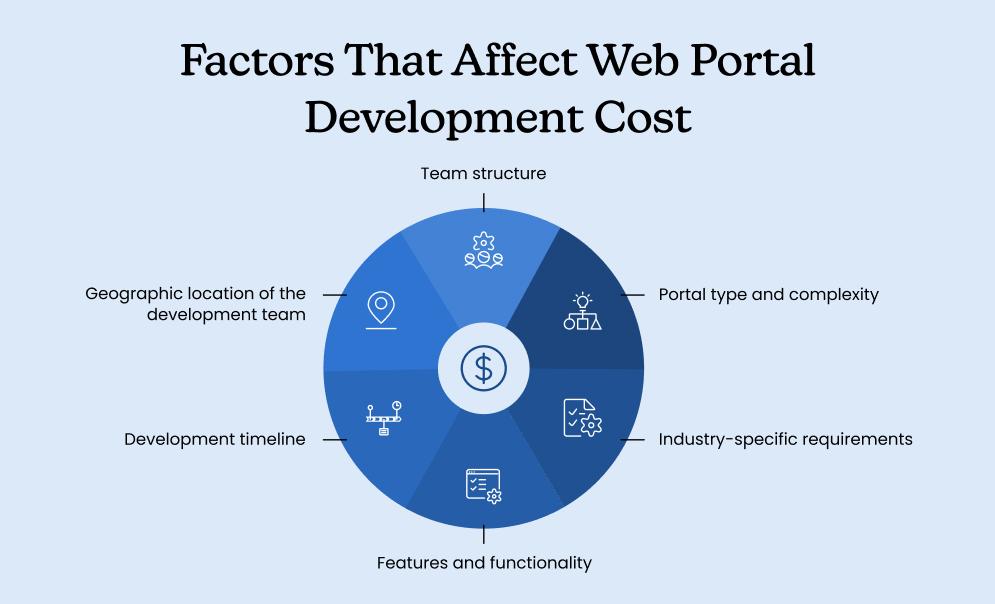
Understanding what drives portal development costs helps you make informed budgeting decisions. Based on our experience of developing 300+ custom portals, several critical factors influence your final investment.
Let’s dive into the key factors that affect the cost of web portal development.
1. Portal type and complexity
The type of custom web portal you need significantly impacts development costs. Each portal category serves different purposes and requires varying levels of complexity. Check this table out to see how different types of portals cost:
| Portal Type | Description | Key Features | Cost Range |
|---|---|---|---|
| Customer Portals | Provide clients with self-service capabilities, reducing support tickets while improving satisfaction |
|
Basic: $15,000 Advanced: $60,000 |
| Employee Portals | Streamline internal operations by centralizing HR services, company resources, and collaboration tools |
|
Small Business: $20,000 – $40,000 Enterprise: $50,000 – $100,000 |
| Partner/Vendor Portals | Facilitate B2B relationships through inventory management, order processing, and performance tracking |
| $35,000 – $80,000 |
| Community Portals | Enable user interaction through forums, content sharing, and networking features |
|
Basic: $25,000 Advanced: $75,000+ |
Customer Portals
Customer Portals start at $15,000 for basic features and can reach $60,000 for advanced versions with real-time data and personalization. These self-service solutions reduce support tickets while improving client satisfaction through features like account management, order tracking, and support systems. Most businesses see a 30-40% reduction in support costs within six months.
Employee Portals
Employee Portals range from $20,000-$40,000 for small businesses to $50,000-$100,000 for enterprise versions with multiple department access. By centralizing HR services, company resources, and collaboration tools, these portals typically save 10-15 hours per employee monthly on administrative tasks.
Partner/Vendor Portals
Partner/Vendor Portals typically cost $35,000-$80,000, reflecting the robust security requirements and ERP system integrations they need. These B2B relationship facilitators include inventory management, order processing, and performance tracking features that usually increase order accuracy by 90% and cut processing time in half.
Community Portals
Community Portals begin at $25,000 for basic communities and exceed $75,000 for platforms supporting thousands of active users. The investment covers forums, content sharing, networking features, and crucial moderation tools that help build valuable business assets while reducing customer acquisition costs.
2. Industry-specific requirements
Different industries face unique compliance and feature requirements that significantly impact web portal development cost:
Healthcare Portal Requirements
Expect to dish out a minimum of $75,000 for a basic HIPAA-compliant healthcare portal, with comprehensive solutions exceeding $200,000 when EHR integration is required.
These compliance requirements add 25-40% to base development costs. Still, they are non-negotiable for healthcare web apps such as patient portals that handle secure messaging, appointment scheduling, prescription management, and medical records.
The investment typically pays off within 12-18 months through reduced administrative burden.
Financial Services Portal Requirements
$60,000 for basic client portals to $400,000+ for full-service banking platforms – financial portals command premium prices due to stringent security requirements, including PCI DSS compliance, multi-factor authentication, and encryption.
The higher investment reflects the critical nature of financial data and severe consequences of security breaches, though most institutions recover costs within 8-12 months through operational efficiencies.
E-commerce Portal Requirements
Expect around $30,000 for simple vendor portals to $200,000+ for multi-vendor marketplaces with advanced features. The wide cost range reflects varying business models – B2B marketplaces requiring vendor management, bulk ordering, and custom pricing engines sit at the higher end.
Essential integrations with top payment gateways, inventory systems, and shipping providers add complexity but typically deliver 20-30% increases in average order values.
Education Portal Requirements
The usual cost of educational portals starts from $25,000 for basic learning management portals, reaching $300,000 for comprehensive university systems with admissions functionality.
This range reflects the vast difference between a small training company’s needs and a major university serving tens of thousands of users.
The investment covers course management, assignment submission, grade tracking, and communication tools for diverse user groups, including students, faculty, parents, and administrators.
3. Features and functionality
The features you choose directly impact both development time and cost. Here’s how standard functionalities affect your portal development budget:
User Management and Authentication
Basic login functionality costs $2,000-$5,000, but modern portals often require more sophisticated systems.
- Single sign-on (SSO) integration adds $2-5/user/month licensing fee for major providers
- Multi-factor authentication increases costs by $3,000-$7,000
- Role-based access control requires an additional $10,000-$30,000
These investments in security pay dividends by preventing data breaches and building user trust.
Content Management Systems
A basic CMS for static content costs $3,000-$6,000. However, dynamic content management with version control, workflow approval, and multi-language support can reach $15,000-$25,000.
If you need user-generated content capabilities with moderation tools, budget another $8,000-$15,000.
Communication Features
These features enhance user engagement but add to development costs.
- Simple contact forms and email notifications: $2,000-$4,000
- Real-time messaging: $25,000+
- Video conferencing integration: $10,000-$18,000
- Push notifications for mobile devices: $3,000-$6,000
Analytics and Reporting
Basic activity logging and standard reports cost $3,000-$6,000. Custom dashboards with visual analytics run $10,000-$18,000.
On the other hand, advanced features like predictive analytics or AI-powered insights can add $20,000-$40,000 to your budget.
Third-Party Integrations
Integration complexity varies significantly. Simple API connections cost $3,000-$8,000 each, while complex ERP or CRM integrations can reach $15,000-$30,000.
Payment gateway integration typically costs $1,000-$3,000, depending on the number of payment methods supported.
4. Development timeline
The timeline for web portal development directly correlates with cost. Longer projects require sustained team involvement, increasing your investment:
Phase 1: Planning and Discovery (2-4 weeks)
This crucial phase involves requirements gathering, competitor analysis, and technical architecture planning. Rushing this phase often leads to costly changes later. Investment: $3,000-$8,000.
Phase 2: Design (3-6 weeks)
Creating user-friendly interfaces for different user types takes time. This includes wireframing, prototyping, and user testing. Complex portals may require 100+ unique screens. Investment: $5,000-$20,000.
Phase 3: Development (8-24 weeks)
The bulk of your timeline and budget goes here. Simple portals need 400-600 development hours, while enterprise solutions require 1,500-2,500+ hours. At $50-$150 per hour, this phase represents 60-70% of total costs.
Phase 4: Testing and Launch (2-6 weeks)
Comprehensive testing ensures your portal works flawlessly across devices and browsers. Security testing is particularly crucial for portals handling sensitive data. Investment: $5,000-$15,000.
Let’s understand how timeline impacts cost with a real example:
A medium-complexity B2B portal requiring 1,000 development hours at $75/hour would cost $75,000 for development alone. Add design, testing, and project management, and the total reaches $95,000-$110,000.
5. Geographic location of the development team
When you hire web developers, you get various benefits such as expertise in different technologies and quick team scaling. But the location significantly impacts costs. Here’s how hourly rates vary globally:
| Location | Hourly Rate (USD) | 1,000-Hour Project Cost |
|---|---|---|
| United States | $100 – $200 | $100,000 – $200,000 |
| Canada | $60 – $120 | $60,000 – $120,000 |
| Western Europe | $80 – $150 | $80,000 – $150,000 |
| Eastern Europe | $40 – $80 | $40,000 – $80,000 |
| Asia | $25 – $50 | $25,000 – $50,000 |
However, choosing based solely on rates can be shortsighted. Consider communication barriers, time zone differences, and quality standards.
Many successful projects use a hybrid approach – combining North American project management with offshore development teams.
6. Team structure (In-house vs outsource vs freelance)
Your choice of team structure significantly impacts both cost and project success:
In-house Development Team
Building a web development team provides maximum control but requires significant investment. You’ll need to hire developers ($80,000-$150,000 annually), designers ($60,000-$100,000), and project managers ($70,000-$120,000).
Add infrastructure, benefits, and training costs, and a 6-month portal project could cost $200,000-$400,000.
Outsourcing to Development Agencies
Outsourcing web development offers access to experienced teams without long-term commitments. Agencies handle project management, provide diverse expertise, and can scale resources as needed.
While hourly rates are higher than freelancers, the structured approach often results in faster delivery and fewer issues.
Freelance Developers
Hiring freelancers can reduce costs by 40-60%, but requires more hands-on management. You’ll need to coordinate multiple specialists, handle project management yourself, and accept a higher risk of delays or quality issues.
Hiring freelance developers is best suited for simple portals or specific tasks within larger projects.
Hire Dedicated Portal Developers
Work with our experienced team of 50+ developers who specialize in building secure, scalable portals for various industries.
6 Hidden Costs in Portal Development You Should Watch Out for
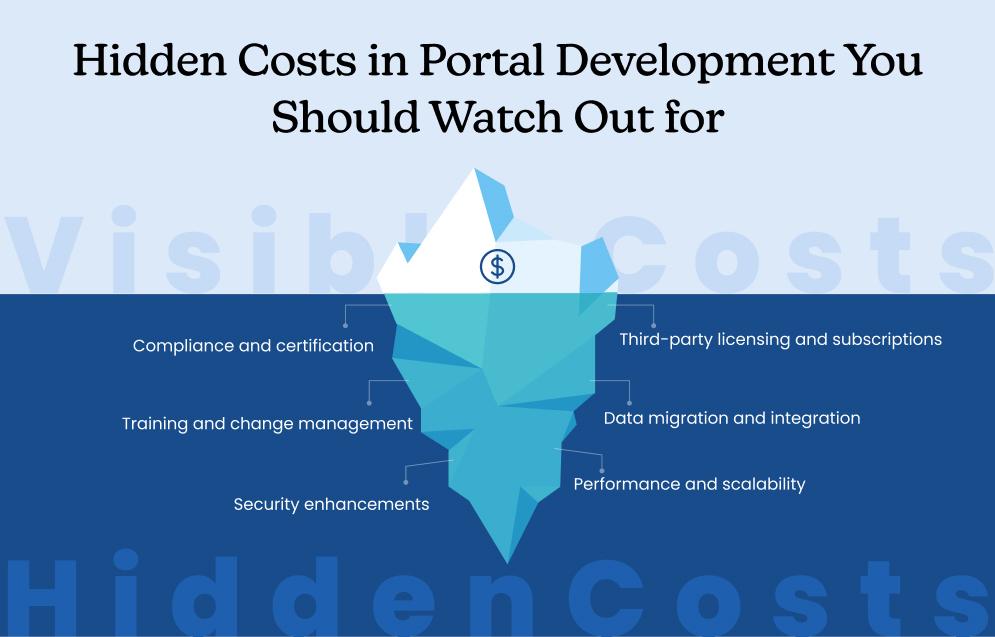
Many businesses face budget overruns due to overlooked expenses. Here are costs that often surprise portal buyers:
1. Third-party licensing and subscriptions
While open-source technologies reduce costs, most portals need some commercial services.
- Payment processing fees – 2.9% + $0.30 per transaction
- E-mail services – $50-$500 monthly
- SMS notifications – $0.01-$0.05 per message
- Analytics platforms $100-$1,000 monthly
2. Compliance and certification
Regulated industries face significant compliance costs.
- HIPAA compliance audits – $5,000-$25,000
- PCI DSS certification – $10,000-$50,000
- SOC 2 compliance – $30,000-$75,000
Moreover, these aren’t one-time expenses; most require annual recertification.
3. Data migration and integration
Moving data from legacy systems often proves more complex than expected.
- Simple data imports cost $3,000-$8,000
- Complex migrations involving data transformation, deduplication, and validation can reach $50,000+
Each system integration usually adds anywhere between $5,000-$25,000, depending on API availability and complexity.
4. Training and change management
User adoption determines portal success.
- Creating training materials – $2,000-$5,000
- Conducting training sessions – $3,000-$10,000
You also need to factor in ongoing support during the transition period. Change management for large organizations can cost $10,000-$30,000.
5. Performance and scalability
Initial deployments often underestimate usage growth. Upgrading infrastructure, optimizing databases, and improving caching mechanisms cost $5,000-$20,000.
Pro Tip: Planning for scalability from the start adds 10-15% to development costs but prevents expensive retrofitting, saving money in the long run.
6. Security enhancements
Security threats evolve constantly to stay ahead of data breaches and modern cyberattacks.
- Annual security audits – $5,000-$15,000
- Penetration testing – $10,000-$25,000
- Implementing new security measures – $5,000-$20,000
However, these costs are necessary to protect your investment and user data.
How to Optimize Portal Development Costs?
Here are 5 smart strategies that can reduce costs without compromising quality or functionality:
1. Start with an MVP (Minimum Viable roduct)
Instead of building every feature upfront, start with developing an MVP and expand based on user feedback.
This approach typically saves 40-60% on initial costs while validating your portal concept. A phased approach might look like:
- Phase 1: Core user authentication and basic features ($20,000-$40,000)
- Phase 2: Advanced features based on user feedback ($15,000-$30,000)
- Phase 3: Integrations and automation ($10,000-$25,000)
2. Choose the right technology stack
Open-source technologies significantly reduce licensing costs. Popular stacks like MEAN (MongoDB, Express, Angular, Node.js) or LAMP (Linux, Apache, MySQL, PHP) provide enterprise-grade capabilities without licensing fees.
However, consider long-term support and developer availability when choosing technologies.
3. Leverage existing components
Don’t reinvent the wheel. Using proven components for common functionality like authentication, payment processing, or content management saves development time. Quality commercial components cost $500-$5,000 but can save weeks of custom development.
4. Optimize team structure
A hybrid team that combines onshore project management with the perks of offshore development strikes a balance between quality and cost. Here’s what a typical structure looks like:
- North American project manager and architect – Allocate 20% of total team hours
- Offshore senior developers for complex features – Allocate 30% of total team hours
- Offshore junior developers for routine tasks – Allocate 50% of total team hours
This approach can reduce costs by 30-40% compared to fully onshore teams while maintaining quality standards.
5. Focus on User Experience
Investing in proper UX design might seem expensive initially, but it pays dividends. Well-designed portals require fewer support tickets, achieve higher user adoption, and need fewer post-launch modifications.
Spending an extra $5,000-$10,000 on UX research and testing often saves $20,000-$50,000 in future rework.
ROI Timeline for Different Web Portals
Understanding when your portal investment pays off helps justify the expense and set realistic expectations:
| Portal Type | ROI Timeline | Key Benefits | Annual Savings Example |
|---|---|---|---|
| Healthcare | 12-18 months | 30-40% call center reductionAutomated appointment schedulingPrescription refill automation | $50,000+ for 1,000 monthly calls |
| Financial Services | 8-12 months | 60-70% process automation for cost reductionAutomated account openingSelf-service transactions | $75,000+ for 500 monthly applications |
| E-commerce B2B | 6-10 months | 15-25% increase in order values40-50% reduction in sales involvementSelf-service ordering | Fastest ROI through increased revenue |
| Education | 18-24 months | Increased enrollment capacityImproved student retentionReduced administrative overhead | $200,000+ for 10,000 students |
Why these timelines matter
The table above shows that while initial investments vary, most web portals pay for themselves within the first two years. B2B e-commerce portals typically see the fastest returns due to immediate revenue increases, while educational portals require more patience but deliver substantial long-term value.
How to measure portal ROI
Track these metrics to measure your portal’s business impact:
- Cost per transaction (before vs. after portal implementation)
- Support ticket volume reduction
- User adoption rates and engagement metrics
- Process completion times
- Revenue per user increases
- Customer satisfaction scores
Build Cost-Effective Web Portals with Space-O Today!
Web portal development costs in 2025 range from $15,000 for basic solutions to over $ 500,000 for enterprise platforms. Your specific investment depends on portal complexity, industry requirements, chosen features, and development approach.
Successful portal development balances functionality with budget constraints while focusing on user needs and business value. Whether you need a simple customer portal or a complex enterprise solution, understanding these cost factors helps you make informed decisions.
As a leading web application development company in Canada, Space-O has delivered 300+ custom portals that provide measurable business value. Our transparent approach ensures you understand exactly where your investment goes and when to expect returns.
Want to Develop a Custom Web Portal for Your Business?
Let’s discuss your portal requirements and create a detailed development roadmap that fits your budget and timeline. Our experts will help you maximize ROI while minimizing costs.
Frequently Asked Questions about Web Portal Development Cost
What’s the difference between web portals and websites?
Websites are public storefronts designed to attract visitors, while portals are secure, personalized workspaces behind login screens. In websites, only admins modify content; in portals, users can create and manage their content based on permissions. Think Facebook’s homepage (website) versus your personalized feed (portal). This architectural difference explains why portals cost significantly more to develop.
How much does a website cost? And can I start with a website and upgrade to a portal later?
Website costs usually range from $1000 to $150,000. You can start with a website first, but this approach typically costs 40-50% more than building a portal from scratch. It’s like converting a house into an apartment building – you’ll need to rebuild authentication, database structure, and most code. Better to start with a basic portal ($15,000-$20,000) and add features over time.
What ongoing costs should I budget for after launch?
Beyond 15-20% annual maintenance, budget for:
- SSL certificates: $100-$500/year
- Security audits: $5,000-$15,000/year
- Server scaling: $200-$2,000/month
- Feature requests: $10,000-$30,000/year
- Compliance updates: $5,000-$20,000 as regulations change
Why do some companies quote $5,000 for a portal while others quote $100,000+?
The so-called “portals” with $5,000 quotations are typically WordPress sites with login plugins. They often lack proper security and customization. True portals with a value of $100,000 or more include enterprise security, custom architecture, extensive testing, and support for thousands of users. It’s the difference between a prefab shed and a custom home.
Should I build a mobile app instead of a web portal?
Web portals cost 50-70% less than native apps and work on all devices. Choose mobile apps only if users need offline access or device features (camera, GPS). Most businesses start with a responsive portal and add mobile apps after validating demand, saving $50,000-$100,000.
How do I know if my portal idea is worth the investment?
To calculate potential ROI, ask these questions: Will your portal save 10+ hours weekly on manual tasks? Reduce support tickets by 30%+? Enable new revenue streams? A good portal should achieve 100%+ ROI within 18-24 months. If your math doesn’t support this, start with a smaller MVP to test assumptions.

 All our projects are secured by NDA
100% Secure. Zero Spam
*All your data will remain strictly confidential.
Trusted by


Bashar Anabtawi 
Canada
“I was mostly happy with the high level of experience and professionalism of the various teams that worked on my project. Not only they clearly understood my exact technical requirements but even suggested better ways in doing them. The Communication tools that were used were excellent and easy. And finally and most importantly, the interaction, follow up and support from the top management was great. Space-O not delivered a high quality product but exceeded my expectations! I would definitely hire them again for future jobs!”

Canada Office
2 County Court Blvd., Suite 400,
Brampton, Ontario L6W 3W8
Phone: +1 (602) 737-0187
Email: sales@spaceo.ca