
- Onshore vs Nearshore vs Offshore: Which Model is Right for You?
- How to Outsource Mobile App Development to an Offshore Partner
- Offshore Mobile App Development Cost
- Top Offshore Regions for Mobile App Development
- 5 Best Practices for Offshore Mobile App Development
- Engagement Models for Offshore Mobile App Development
- 5 Core Challenges to Consider When Outsourcing Mobile App Development
- Future Trends in Offshore Mobile App Development
- Case Study: How Space-O Delivered SkillHub — Canada’s First Professional Networking Platform
- Where to Find a Reliable Offshore Mobile App Development Company?
- Frequently Asked Questions
- Outsource Your Mobile App Development Project to Space-O Technologies
Offshore Mobile App Development: A Complete Guide

 Last Updated: March, 2 2026
Whether you are looking to build a mobile app from scratch or upgrade your existing application, outsourcing to offshore mobile app development companies is a reliable and cost-effective approach.
According to Grand View Research, the global IT services outsourcing market was valued at USD 744.6 billion in 2024. It is projected to reach USD 1,219.31 billion by 2030, growing at a CAGR of 8.6%.
This growth confirms that outsourcing is a proven strategy for businesses seeking cost optimization in software development. Companies across industries are choosing offshore partners to access global talent at competitive rates.
Offshore mobile app development means hiring an external development team from another country to build your iOS, Android, or cross-platform applications. Businesses increasingly choose offshore mobile apps development to reduce costs, access global talent, and accelerate product launches. In this blog, we’ll learn about the process of outsourcing work to a reliable mobile app development partner, and related challenges, best practices, and costs and how to hire offshore mobile app developers successfully.
Key Takeaways
- Offshore mobile app development can reduce your project costs by 40–60% compared to in-house development in the US or Canada.
- The average cost ranges from $10,000 to $200,000, depending on complexity, features, and team size.
- Choosing the right engagement model — dedicated team, staff augmentation, or project-based — directly impacts your project’s success and budget.
- Canada-based offshore partners like Space-O Technologies combine competitive rates with compliance expertise, including PIPEDA and GDPR.
- Structured communication, Agile methodologies, and clear documentation are the foundation of a successful offshore partnership.
Onshore vs Nearshore vs Offshore: Which Model is Right for You?
Before selecting an offshore mobile app development partner, it helps to understand how the three main outsourcing models compare. Each model has trade-offs in cost, communication, and talent access.Here is a quick comparison of onshore, nearshore, and offshore software development models.
| Factor | Onshore | Nearshore | Offshore |
|---|---|---|---|
| Factor | Onshore | Nearshore | Offshore |
| Location | Teams are based in the same country as the business | Teams operate from neighboring or nearby countries | Teams are located in geographically distant countries |
| Cost | Highest cost due to local salaries and compliance expenses | Moderate cost, balancing affordability and proximity | Lowest cost, offering significant savings on development and operations |
| Time zone overlap | Full working-hour alignment, enabling real-time collaboration | Partial overlap (2–5 hours) for daily syncs and quick feedback | Limited overlap (6–12+ hours), often requiring async workflows |
| Communication ease | Seamless communication with minimal cultural or language barriers | Manageable communication, usually with similar work culture | Requires structured planning, clear documentation, and async processes |
| Talent pool size | Limited to local market availability | Access to a regional talent pool | Access to a global talent ecosystem with diverse skill sets |
| Best for | High-security, regulated projects | Agile collaboration with cost balance | Long-term scaling, cost optimization |
When to choose onshore development
Onshore development works best for projects that require real-time collaboration without time zone delays. It is ideal when data must remain within your country’s borders for compliance reasons.
However, onshore development comes with the highest cost. Hiring locally in the US or Canada typically costs $100–$150+ per hour for experienced mobile developers.
When to choose nearshore development
Nearshore mobile app development is a strong choice when you want overlapping work hours for daily standups. It provides moderate cost savings while maintaining cultural and time zone proximity.
For US-based companies, Latin American partners offer 4–6 hours of overlap. Hourly rates in LATAM typically range from $30–$60 per hour.
When to choose offshore development
Choose offshore mobile app development when you want maximum cost savings combined with access to a global talent pool. This model is ideal for long-term projects, MVP development, and scaling your development capacity.
Offshore app development works well for companies that need niche skills like AI, cross-platform frameworks, or enterprise application development. Hourly rates in offshore regions range from $20–$50 per hour.
This model works especially well for offshore android development and offshore android application development projects that require scalable teams and long-term technical expertise.
Pro Tip: Many successful companies use a hybrid model. They keep project management onshore while outsourcing core development to an offshore mobile app development company.
How to Outsource Mobile App Development to an Offshore Partner
1. Project planning and requirements gathering
Begin by conducting an in-depth analysis of your app idea, considering your target market and unique selling points (USPs). Create a project brief that includes information such as purpose, target audience demographics, core features, and functionality requirements of your mobile app idea.
- Be specific about technical specifications, such as whether you need an iOS, Android, or cross-platform app.
- Describe any integration requirements with existing systems or third-party services.
- Consider localization requirements for different markets.
- Prepare a budget that accounts for exchange rates and potential additional costs.
- Set a timeline that considers differences in holidays and working hours between countries when hiring offshore mobile developers.
2. Researching and selecting an offshore partner
Selecting the right offshore mobile app development partner is critical to your project’s success. Search on industry directories, tech forums, and professional networks for firms with expertise in your app category.
Look for companies that have experience working with clients from your country or region, as they would be better equipped to understand your market requirements.
Check whether the offshore team has obtained relevant certifications, such as ISO 27001 for data security, which are particularly important for clients from countries with strict data protection laws.
Scrutinize their data protection measures and ensure they comply with regulations such as GDPR for EU countries or PIPEDA for Canadian businesses.
Measure and learn about the familiarity with your local market regulations, especially if your app falls under regulated industries like finance or healthcare.
Check if mobile app development offshore firms can handle intellectual property laws across different jurisdictions to ensure your app is protected by all important regulations.
Partner With Space-O Technologies for Your Mobile App Project
We are a leading mobile app development company in Canada and have a team of 140+ software developers to build small to larger enterprise software solutions.

3. Requesting for proposal (RFP) and evaluation
Creating a detailed request for a proposal plan is important to attract the right outsourced mobile app development partners for your project. RFP helps set clear expectations when you outsource app development as it includes detailed information about your project scope, objectives, expected deliverables, and milestones.
Specify your preferred project management methodology, whether it’s Agile Software Development, Scrum Software development, or another approach. Outline your reporting and communication expectations by considering the geographical distance.
Request information on the outsourced partner’s development stack and why it’s suitable for your project; make sure it aligns with your technical requirements. Ask for examples of similar mobile app projects completed by them for clients in your country or industry. All this information helps you get insights about their relevant experience.
Enquire about the selected offshore mobile application development firm’s approach to overcoming language barriers and cultural differences, as well as their strategy for handling time zone differences.
4. Negotiating contract and conducting thorough check
Before finalizing your partnership with an offshore mobile apps development firm, conduct thorough due diligence. Perform background checks to finalize the stability and legal standing of your chosen mobile development offshore firm.
Request and contact references from clients in your country or neighboring regions to get first-hand accounts of their performance.
When negotiating the contract, cover all important aspects including detailed project specifications, acceptance criteria, pricing structure, intellectual property rights, data protection, confidentiality agreements, and dispute resolution mechanisms.
Discuss the governing law for the contract, considering the international nature of the partnership. Address tax implications and any relevant trade agreements between your country and the country you’re outsourcing to.
5. Setting up a project plan and quality assurance processes
You have already defined your mobile app project’s scope and objectives, from the app’s core functionality to the need for specific compliance. Discuss all these requirements with your offshore mobile app development outsourcing company.
Next, discuss how your project can be broken down into manageable phases with milestones. Typical milestones for a mobile app development process include the following.
- Project kickoff and requirements finalization
- Design approval, prototype completion, and alpha version release
- Beta testing initiation, final quality assurance, app store submission
- Official launch of your mobile application
Here are the pointers to keep in mind for quality assurance.
- For each phase, get a detailed timeline for the differences in working days and holidays between your country and the location of the offshore app development agency. Also consider factors like time zone differences, longer communication cycles, and buffer time for unexpected delays or additional feedback rounds.
- Speak to the team about implementing Agile methodologies and adapting them to suit the offshore nature of the project.
- Adjust Agile practices, such as longer sprints or modified daily stand-up times, to accommodate time zone differences.
- Schedule bi-weekly stand-ups instead of daily ones if there is a significant time difference (e.g., between Australia and Canada).
- Establish clear communication protocols, including regular video conferences, instant messaging channels, and project management tools.
- Ensure communication tools are accessible and comply with data protection laws in both countries.
- Set up quality assurance processes, including code reviews, automated testing, and user acceptance testing to suit your brand. For example, if you are a Japanese company known for high-quality products, you might request additional QA steps to ensure the app meets the exacting standards of the Japanese market.
- Implement a system for tracking progress and reporting to ensure transparency throughout the development process. This could include burndown charts, regular status reports, and demo sessions scheduled at times convenient for both teams.
- Establish a clear change management process and risk management strategy, identifying potential challenges specific to offshore app development.
Next, let’s understand the costs of outsourcing mobile app development to offshore partners. Check the following section to learn more.
Offshore Mobile App Development Cost
The average cost of mobile app development in Canada ranges from $10,000 to $200,000 and more.
The cost of developing mobile apps depends on multiple factors such as:
- Features
- Complexity
- UI/UX design
- Size of mobile apps
- Hourly rates of developers
- Offshore mobile development team size
- App developers’ location
To understand the cost better, let’s consider an example. Imagine you want to develop a healthcare application for your organization. The hourly rate of a mobile app developer ranges from $30 to $120 per hour. Let’s calculate the cost if you hire a mid-senior level mobile app developer at $35 per hour for 3 months.
Cost of mobile application development to offshore outsourcing agencies
| Description | Cost |
|---|---|
| Hourly rate of developer | $35 to $40 per hour |
| Monthly working hours | 176 hours |
| Monthly cost for one developer | $6,160 to $7,040 |
| Total cost for the team (4 developers, 3 months) | $73,920 – $84,480 |
So, the total cost for a 3-month offshore development project is $73,920 – $84,480, which is more cost-effective compared to onshore development. Here’s why.
In-house mobile app development (Considering USA region)
| Description | In-house App Development (USA) |
|---|---|
| Team size | 4 developers |
| Project duration | 3 months |
| Total working hours (3 months) | 528 hours per developer (176 hours/month * 3 months) |
| Base cost (4 developers, 3 months) | $120,000 ($30,000 * 4 developers) |
| Benefits (15% of base cost) | $18,000 ($4,500 * 4 developers) |
| Federal and state employment taxes (10%) | $12,000 ($3,000 * 4 developers) |
| Management overhead (10%) | $12,000 ($3,000 * 4 developers) |
| Facilities and tools | $6,000 ($1,500 * 4 developers) |
| Total project cost (4 developers, 3 months) | $168,000 |
For a three-month mobile app development project with a team of four developers, offshore development in Canada costs between $73,920 and $84,480, whereas, an on-shore or in-house development team in the USA costs $168,000.
This comparison represents a cost difference of approximately 50-56%, making offshore development a better cost-effective option for companies looking to minimize expenses while still accessing skilled development resources.
However, you should also consider factors such as communication ease, time zone differences, and potential cultural disparities when deciding between an offshore and onshore development agency.
Note: All the above calculation is done by using the formula present in the Accelerance report of outsourcing rates in 2024.
Now, how do you ensure that your mobile app projects are on track while outsourcing to an offshore mobile app development company? To help you, we have listed the best practices in the following section.
Top Offshore Regions for Mobile App Development
The location of your offshore mobile app development team directly impacts cost, talent quality, and communication. Here is how the major offshore regions compare.
Hourly rate comparison by region
| Region | Junior Developer | Mid-Level Developer | Senior Developer |
|---|---|---|---|
| South Asia (India, Bangladesh) | $15–$25 | $25–$50 | $35–$70 |
| Southeast Asia (Vietnam, Philippines) | $18–$30 | $35–$55 | $50–$80 |
| Eastern Europe (Poland, Ukraine, Romania) | $25–$40 | $40–$70 | $70–$120 |
| Latin America (Brazil, Colombia, Mexico) | $30–$45 | $45–$70 | $60–$90 |
| Western Europe (Germany, UK) | $40–$60 | $65–$100 | $90–$150 |
| North America (Canada, USA) | $50–$80 | $80–$130 | $120–$160+ |
How to select the right offshore region
When choosing a region for offshore android development, offshore android application development, iOS development, or cross-platform offshore mobile apps development projects, consider these factors.
Cost vs quality: South Asia and Southeast Asia offer the lowest rates. However, Eastern Europe and Latin America provide a stronger balance of cost savings and technical quality.
Time zone alignment: Latin American teams work well for North American companies due to overlapping work hours. Eastern European teams suit European businesses.
Compliance and regulations: Canada-based firms like Space-O Technologies understand North American compliance requirements including PIPEDA and CCPA. This makes them a strong choice for businesses that need regulatory alignment.
Pro Tip: Choosing a Canadian offshore partner gives you the cost advantages of offshore development with the regulatory familiarity of a nearshore relationship.
5 Best Practices for Offshore Mobile App Development
1. Define roles and set clear expectations
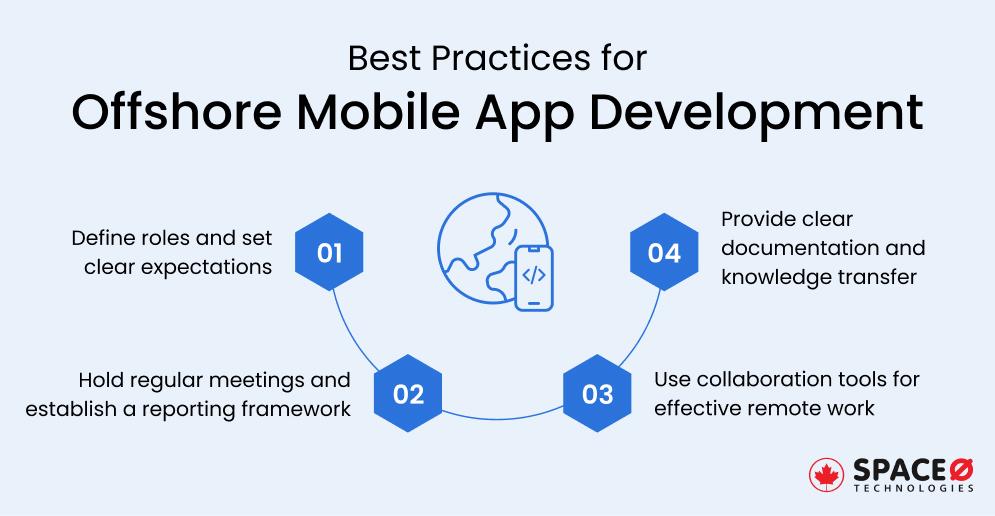
Define the roles of each team member involved in the project, from developers, designers, and project managers to quality assurance engineers. Use a RACI (Responsible, Accountable, Consulted, Informed) matrix to outline who is responsible for specific tasks and deliverables.
Next, set expectations and communicate regularly regarding work quality, deadlines, and communication protocols. So, you need to define what success looks like for each role and how performance will be measured.
Set clear KPIs for your software project and individual team members. These might include metrics like code quality scores, on-time delivery rates, or user satisfaction ratings for delivered features.
Further, use a structured onboarding process for all team members to familiarize them with project goals, tools, and workflows. This allows us to ensure everyone is aligned from the start.
2. Hold regular meetings and establish a reporting framework
Set up regular check-in meetings on a weekly or bi-weekly basis to discuss progress, address challenges, and adjust plans as required. You can even use video conferencing tools like Zoom, Google Meet, or Microsoft Teams for better, faster, and real-time collaboration.
Further, prepare a reporting framework consisting of regular status updates of tasks, milestone achievements, and any blockers. You can prepare it as a shareable document, or sheet, or use a project management tool like Trello, or Basecamp, where team members can update their progress.
Additionally, you should implement a structured onboarding process for all team members to familiarize them with project goals, tools, and workflows. As a result, everyone in the team is aligned from the start of your mobile app development project.
3. Use collaboration tools for effective remote work
Use and adopt a powerful project management tool like Jira, Asana, or Microsoft Project for task tracking and progress monitoring. Make sure all team members are trained to use these tools accurately without facing any issues.
Besides, you can ask team members to use communication tools like Slack or Microsoft Teams for quick questions and information communications. You can create dedicated challenges for different aspects of the project (e.g. #design-feedback, #bug-reports, #general-questions).
Next, use a secure, cloud-based file-sharing system like Google Drive or Dropbox for easy access to project documents across time zones.
During development, if you want to explain any complex issues or challenges faced while testing your mobile apps, you can use platforms like Loom to record the sessions and send the recorded videos to your team.
4. Provide clear documentation and knowledge transfer
Defining roles, establishing regular communication, using collaboration tools, and making thorough documentation help teams work more and build high-quality mobile applications that meet your business requirements. Let’s see how to do it.
Create detailed documentation of your project:
- Include technical specifications
- Outline user journeys
- Provide design guidelines
- Document testing procedures
Providing a base standard helps your offshore mobile software development team follow the guidelines and provide answers.
Request the following from your offshore app developers team:
- Develop and regularly update detailed API documentation.
- Adhere to a code documentation standard and demonstrate it in code reviews.
- Record important meetings and technical discussions, and make them available for team members’ reference.
These best practices help you make your offshore software development partnership successful.
5. Implement security protocols from day one
When you hire offshore mobile app developers, data security should be a priority from the start. Ensure your offshore partner signs a comprehensive NDA for app development before any project discussion begins.
Implement role-based access controls so that team members only access the data they need. Use encrypted communication channels and secure code repositories.
For projects in regulated industries like healthcare or finance, verify your partner’s compliance certifications. Confirm they follow standards like ISO 27001, HIPAA, or PCI-DSS based on your industry.
If you hire offshore mobile app developers, ensure your contract clearly defines data ownership, IP protection, and security responsibilities.
While outsourcing, there are chances you’ll face some challenges in the process. Read this next section to understand the core challenges and how to tackle them.
Engagement Models for Offshore Mobile App Development
Selecting the right engagement model impacts your budget, team control, and project outcomes. Here are the three primary models used in software development outsourcing.
Dedicated development team
A dedicated development team works exclusively on your project for an extended period. This model works best for long-term projects with evolving requirements.
Many enterprises hire offshore mobile app developers through this model to ensure long-term product ownership and faster iteration cycles.
Best for: Enterprise apps, ongoing product development, projects lasting 6+ months.
Pricing: Monthly retainer based on team size. Typically 160 hours/month per developer.
Staff augmentation
Staff augmentation lets you add skilled offshore mobile app developers to your existing in-house team. You retain full project control while filling specific skill gaps.
Best for: Teams that need extra capacity for sprints or specific features.
Pricing: Hourly or monthly rates per developer. Offers part-time (80 hrs/month) or full-time flexibility.
Project-based outsourcing
In this model, the offshore mobile app development company handles the entire project from start to finish. You define the scope, timeline, and deliverables upfront.
Best for: Startups building MVPs, well-defined projects with clear specifications.
Pricing: Fixed price agreed before development begins. Based on project scope and complexity.
Which model should you choose? If you have an evolving product, go with a dedicated team. If you need to fill skill gaps, use staff augmentation. If you have a well-defined scope, choose project-based.
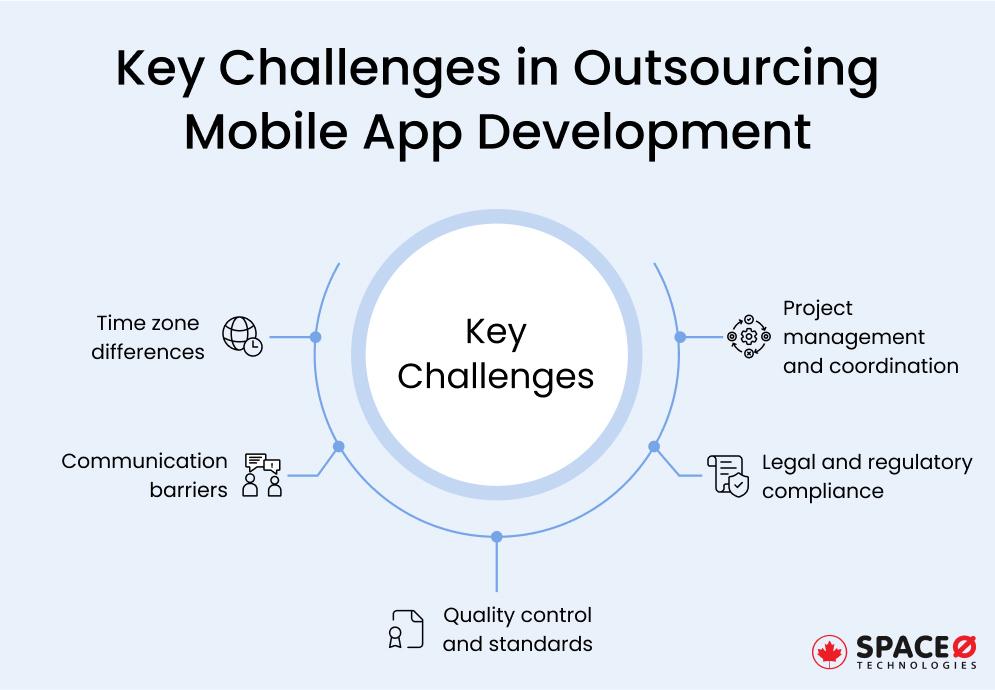
5 Core Challenges to Consider When Outsourcing Mobile App Development
1. Time zone differences
When your hired development team operates in different time zones, it can impact real-time communication, project milestones, and decision-making processes.
For example, if you are from Japan, South Korea, or Australia, you might face delays in receiving updates and feedback as you might be ahead of Canada.
This lag slows down the mobile app development process and results in an extension of project deadlines.
Solution: When you partner with Space-O Technologies, our developers help mitigate such an issue by establishing overlapping working hours where both teams can communicate with ease.
We also arrange daily stand-up meetings at overlapping times to ensure that both teams remain aligned with detailed documentation and clear communication protocols.
2. Communication barriers
Communication between a mobile app development team and a client is the backbone of making any project successful. In Canada, while English is spoken majorly, subtle differences in language usage and cultural context can lead to misunderstandings, especially if you’re from non-native English-speaking countries such as Germany, France, and Mexico.
This is why clear and precise communication plays an important role in avoiding any confusion or losses.
Solution: At Space-O, we conduct regular video calls, carry out detailed documentation, and use collaborative tools like Microsoft Teams or Slack to enhance communication. Additionally, providing your managers with language training or hiring bilingual project managers can help bridge the gap and ensure smooth interactions.
3. Quality control and standards
Your ultimate goal in developing your mobile application is to provide value to your end users. Without quality control and processes, it is not possible to ensure your developed applications meet varying standards and expectations.
Solution: Space-O Technologies helps mitigate this risk. We have regular code reviews, implement automated testing, and adhere to international standards like ISO and CMMI. Also, we provide regular updates and transparent reporting on QA activities to ensure the quality of mobile applications.
4. Legal and regulatory compliance
As a project owner, you need to ensure your project complies with local and international laws, especially data protection. For EU businesses, applications must comply with GDPR. For US businesses, CCPA applies. For Canadian businesses, PIPEDA governs data protection.
To avoid legal repercussions, you need to have powerful data protection measures within your mobile app by conducting regular compliance audits. You also might need to work with legal experts especially if you have developed mobile applications for healthcare or finance segments.
Solution: At Space-O Technologies, our team has experience developing mobile apps that comply with GDPR, CCPA, and PIPEDA. Being based in Canada, we understand North American compliance requirements firsthand.
5. Project management and coordination
Managing a team of multiple professionals like developers, designers, and project managers, across different locations and time zones requires structured approaches and dedicated resources.
Your in-house managers communicating with the offshore mobile app developers team should be skilled in using tools like Jira, Trello, and Asana to track progress and manage tasks.
Solution: Regular meetings, clear communication on requirements and project status updates, and setting realistic deadlines are important practices—all followed by Space-O.
Above all, have a contingency plan in place for potential delays or issues to keep projects on track. Exercise transparency and accountability in all project management stages to ensure both parties are aligned on goals and expectations.
These are the core challenges that you might face during outsourcing your mobile app development project. Below we have described a few ways to find a reliable offshore mobile application development team for your project.
Future Trends in Offshore Mobile App Development
The offshore development landscape continues to evolve with emerging technologies and changing business needs. Here are the key trends shaping the industry in 2026.
AI and machine learning integration
Offshore teams are increasingly embedding AI and ML capabilities into mobile applications. This includes personalized user experiences, predictive analytics, voice recognition, and intelligent automation.
Companies seeking AI software development through offshore partners can access specialized talent that may be scarce locally.
Rise of cross-platform development
Cross-platform mobile app development with Flutter and React Native is reducing costs and accelerating time-to-market. Businesses can deploy on both Android and iOS using a single codebase.
Offshore teams skilled in Flutter app development and React Native development offer faster delivery with lower costs. This trend is especially popular for offshore android development and iOS projects.
Increased focus on cybersecurity and compliance
Data security is a top priority as breaches become more common. Offshore mobile app developers are investing in encryption, secure authentication, and DevSecOps pipelines.
Regulatory compliance is tightening across markets. Businesses must ensure their offshore partners understand GDPR, HIPAA, CCPA, and PIPEDA requirements before development begins.
Case Study: How Space-O Delivered SkillHub — Canada’s First Professional Networking Platform
Space-O Technologies was approached to build SkillHub, a professional networking platform for the Canadian market. The client needed a cross-platform mobile app with real-time messaging, profile matching, and a scalable backend.
Project scope:
- Platform: iOS and Android (cross-platform)
- Duration: 16 weeks
- Team: 6 developers, 1 project manager, 2 QA engineers
- Technologies: React Native, Node.js, AWS
Challenges addressed:
- Real-time messaging at scale with minimal latency
- PIPEDA-compliant user data handling
- Complex matching algorithm for professional connections
Results delivered:
- App launched on time across both app stores
- Scalable architecture handling 10,000+ concurrent users
- Full compliance with Canadian data protection regulations
- Positive app store ratings within the first quarter
This project demonstrates how offshore mobile apps development with Space-O helps businesses hire offshore mobile app developers to deliver production-ready applications with end-to-end project management.
Where to Find a Reliable Offshore Mobile App Development Company?
Finding a reliable offshore mobile app development company requires research. Here are ways you can identify trustworthy partners in Canada.
| Category | Sources | Description |
|---|---|---|
| B2B websites | Clutch | B2B ratings and reviews platform with detailed company profiles and client feedback. |
| GoodFirms | Directory offering reviews and ratings for IT service providers, helping assess company credibility. | |
| Freelancing platforms | Upwork | Freelancing site with developer and team profiles, which include their ratings and portfolios. |
| Developer communities | GitHub | Code hosting platform where you can review developer contributions and expertise. |
| Stack Overflow | Q&A platform for software and mobile app developers. This platform is useful for finding top-rated professionals based on community activity. | |
| Professional networks | Networking site providing company profiles and professional endorsements. | |
| Local business directories | Local Chambers of Commerce | Directories of local businesses having a list of established tech companies. |
| Industry events | Tech conferences | Events like Collision and Web Summit are used to network and discover tech companies. |
| Meetups and local events | Local tech meetups for networking with developers and companies. | |
| Referrals and recommendations | Industry contacts | Recommendations from peers and colleagues based on direct experience. |
| Outsourcing agencies | Software development agencies | Agencies that connect businesses with vetted offshore development teams. |
Hire Experienced App Developers From Space-O Technologies
Tell us about your mobile app project requirements. We have an experienced team of 140+ app and software developers with expertise in Java, Kotlin, Swift, Flutter, and React Native.
If you have any more questions or doubts, please continue to the following section for more.
Frequently Asked Questions
How can I manage offshore mobile app developers?
To manage an offshore mobile app development team, you need clear communication, structured processes, and the right tools. Establish regular video meetings to maintain face-to-face interaction. Use project management software like Jira or Trello to track progress and assign tasks. Set clear expectations and deadlines for each development phase. Implement a reliable system for code sharing and version control.
Why is it important to take a trial period of offshore developers before signing a contract?
A trial period allows you to assess the offshore team’s capabilities, work ethic, and cultural fit before committing long-term. You can evaluate work quality and adherence to deadlines, assess communication skills and responsiveness, identify potential collaboration challenges, and confirm the team’s technical skills meet your project requirements. Most reputable offshore mobile app development companies welcome trial engagements.
How does the cost of offshore mobile app development compare to hiring a team locally?
Offshore outsourcing typically offers significant cost savings compared to local development. Labor costs in offshore locations are 40–60% lower than in Western countries. Companies also save on overhead expenses for office space and equipment, benefits and taxes, and management overhead. However, it is important to balance cost savings with quality considerations and potential hidden expenses like communication tools, travel, and legal fees.
How do you secure my software project information?
Reputable offshore mobile app development companies protect your data through multiple measures. These include signing NDAs before any project discussion, implementing role-based access controls, using encrypted communication and secure repositories, conducting regular security audits, and following international standards like ISO 27001. At Space-O, all projects are secured by NDA from day one. We comply with PIPEDA, GDPR, and other applicable regulations.
What technologies are commonly used in offshore mobile app development?
Offshore mobile app developers typically work with Swift and Kotlin for native iOS and Android development. For cross-platform projects, Flutter and React Native are the most popular frameworks. Backend technologies commonly include Node.js, Laravel, Ruby on Rails, and Python. Cloud platforms like AWS, Azure, and Google Cloud support scalable infrastructure. The right technology stack depends on your project requirements, budget, and performance expectations.
How long does it take to build a mobile app with an offshore team?
A simple mobile app or MVP typically takes 3–4 months with an offshore team. Mid-complexity apps with custom features and integrations require 4–8 months. Enterprise-level applications with complex backends and compliance requirements may take 8–12+ months. Factors like team size, scope clarity, and communication efficiency directly influence delivery timelines.
What is offshore android development and how does it differ from iOS?
Offshore android development involves hiring an external team from another country to build Android applications using languages like Kotlin or Java. The development process is similar to offshore iOS development, but Android projects often take longer due to device fragmentation and testing across multiple screen sizes. Many businesses choose cross-platform frameworks like Flutter or React Native to build for both Android and iOS simultaneously, reducing cost and time-to-market.
Outsource Your Mobile App Development Project to Space-O Technologies
In this blog post, we have covered the entire process of outsourcing mobile app development projects to offshore firms. From defining requirements to setting up roles and quality assurance standards, you have learned about each step in detail.
By following the steps outlined in this guide, you can successfully navigate the outsourcing process. Space-O Technologies is a leading mobile app development firm, having 7+ years of experience in mobile app, software, and web app development projects.
We have skilled mobile app developers with an average of 5+ years of experience. Let’s discuss your project requirements today and get started. Contact us to get insights from expert mobile app developers.


Hire Offshore Mobile App Developers
 All our projects are secured by NDA
100% Secure. Zero Spam
*All your data will remain strictly confidential.
Trusted by


Bashar Anabtawi 
Canada
“I was mostly happy with the high level of experience and professionalism of the various teams that worked on my project. Not only they clearly understood my exact technical requirements but even suggested better ways in doing them. The Communication tools that were used were excellent and easy. And finally and most importantly, the interaction, follow up and support from the top management was great. Space-O not delivered a high quality product but exceeded my expectations! I would definitely hire them again for future jobs!”

Canada Office
2 County Court Blvd., Suite 400,
Brampton, Ontario L6W 3W8
Phone: +1 (602) 737-0187
Email: sales@spaceo.ca