
- What Does 10DLC Stand For?
- 10DLC vs Short Code vs Toll-Free: Which Is Right for Your Business?
- Who Sets and Enforces 10DLC Rules?
- Where Does 10DLC Apply? Geography and Networks
- Why 10DLC Exists: Consumer Protection and Business Benefits
- 10DLC Rules and Regulations in 2026 (Latest Updates)
- Who Needs 10DLC? ICPs and Industries
- 10DLC Registration Requirements
- How to Register Your Brand and Campaign: Step by Step
- How Long Does 10DLC Registration Take?
- 10DLC Campaign Types: Standard, Special, and Restricted Use Cases
- 10DLC Registration Costs: Brand Fees, Campaign Fees, and Per-Message Charges
- How to Prove Opt-In Consent
- 10DLC Compliance Rules You Must Follow
- What Happens If You Don’t Register?
- How to Stay Compliant After Registration
- How TextBolt Keeps Your Business Texting Compliant
- Frequently Asked Questions
Send Compliant Business Texts in Minutes
10DLC Registration & Compliance: The Complete Guide for U.S. Business SMS 2026

TL;DR: 10DLC (10-Digit Long Code) registration is mandatory for any U.S. business sending automated SMS. Industry costs run roughly $4 to $15 upfront plus about $10 per month per campaign. Brand registration takes 2 to 5 business days; full campaign approval takes 1 to 4 weeks. Since February 2025, unregistered messages have been blocked by every major U.S. carrier.
If your business sends text messages to customers in the United States, 10DLC compliance is no longer optional. As of February 2025, every major U.S. carrier blocks unregistered business texting traffic entirely. No throttling, no warnings. Just blocked messages that never reach your customers.
Whether you send appointment reminders, order confirmations, or two-way customer conversations, understanding 10DLC registration and compliance requirements is essential to keeping your business texting operational.
This guide covers everything you need to know: what 10DLC is, how to register, what it costs, the 2026 regulatory changes you need to watch, and how to stay compliant after registration.
What Does 10DLC Stand For?
10DLC stands for 10-Digit Long Code. It is a standard 10-digit U.S. phone number registered with The Campaign Registry (TCR) so businesses can send Application-to-Person (A2P) SMS at scale, with carrier-approved trust scoring and throughput.
What Is 10DLC in Simple Terms?
10DLC refers to standard 10-digit phone numbers (like 555-867-5309) that businesses use to send text messages. In 2020, U.S. carriers including AT&T, T-Mobile, and Verizon introduced the 10DLC registration system through The Campaign Registry (TCR). The goal was simple: verify that businesses sending automated or bulk text messages are legitimate and that recipients have consented to receive those messages.
Before 10DLC, anyone could send business texts from a regular phone number without verification. This led to a flood of spam, scams, and unwanted messages. The 10DLC framework puts an end to that by requiring every business to register its identity and describe how it plans to use texting.
What Is A2P 10DLC?
The “A2P” in A2P 10DLC stands for Application-to-Person, which means a software application or business system sends the message to a consumer’s phone. P2P (Person-to-Person) covers the texts a human composes one at a time, like the messages you send friends from your personal phone.
If your business uses a CRM, scheduling tool, alerting system, email-to-text service for business, or any software that triggers a text, that traffic is A2P and falls under 10DLC, even when the daily volume is small. Our A2P vs P2P messaging guide explains the distinction in detail.
How Is 10DLC Different From P2P Texting?
The number itself is identical. A 10-digit number used for A2P looks the same as one used for P2P. The difference is intent and pattern. A2P is automated, recurring, or sent at higher volume from a business identity. P2P is manual and conversational. Carriers separate the two because A2P traffic carries different deliverability, throughput, and abuse risks.
10DLC vs Short Code vs Toll-Free: Which Is Right for Your Business?
There are three main ways businesses send text messages in the U.S., and each has different registration requirements, costs, and best-fit use cases. The table below compares them across the dimensions most teams care about when choosing.
| Channel | Format | Monthly Cost | Time to Set Up | Two-Way Messaging | Local Feel | Best For |
|---|---|---|---|---|---|---|
| 10DLC | Standard 10-digit | ~$10 to $30 | Days to weeks | Yes | Yes | Most business messaging |
| Short Code | 5 to 6 digits | $500 to $1,000 | Several months | Limited | No | High-volume marketing, alerts |
| Toll-Free | 1-800/888 | ~$15 to $30 | Days | Yes | No | Customer support, nationwide reach |
10DLC vs Short Code: Key Differences
Short codes are the legacy high-volume option: 5 to 6-digit numbers, expensive (often $500 to $1,000 per month plus one-time setup), and slow to provision (months of carrier review). They make sense for nationwide marketers blasting promotional messages to hundreds of thousands of subscribers.
For most everyone else, the math no longer works. 10DLC delivers the same compliance posture, supports two-way conversations, costs an order of magnitude less, and looks like a normal local number to the recipient. Our short code vs long code SMS guide breaks down the full comparison.
10DLC vs Toll-Free: When to Choose Each
Toll-free numbers (1-800, 1-888, and similar) are a separate track with their own verification process. They are not part of 10DLC. Choose toll-free when you need a nationwide identity (national support lines, brands without a local presence) or when you are running a single-number support desk. Choose 10DLC when you want a recognizable local number tied to a specific city or region, which generally drives higher reply rates for customer messaging.
Which Number Type Is Right for Your Business?
For most small and mid-sized businesses, 10DLC is the right choice. It is significantly cheaper than short codes, uses a familiar local number format, and supports the types of messaging most businesses need, including reminders, notifications, and customer replies. If you are starting from scratch and need to send business texts this week, 10DLC over a managed service like a business text messaging platform is the fastest sanctioned path. Our guide on how to get a business text number walks through the provisioning process from signup to first send.
Send 10DLC-Compliant Texts Straight From Your Inbox
TextBolt registers your business number during onboarding, with approval in up to 48 hours. Your team then sends and replies to texts from Gmail or Outlook.
Who Sets and Enforces 10DLC Rules?
10DLC is an industry-driven standard, not a single government regulation. U.S. mobile carriers (AT&T, Verizon, T-Mobile, and others) define and enforce the rules. They coordinate through The Campaign Registry (TCR), the central database of registered brands and campaigns.
1. The Campaign Registry (TCR): What It Does
TCR is the neutral broker that sits between businesses, their messaging providers, and the carriers. It stores every brand and campaign submission, runs vetting checks, assigns trust scores, and feeds those signals to carriers so each can independently decide on throughput tiers and content filtering. Most businesses never interact with TCR directly. Three layers handle registration on your behalf:
- Messaging providers and CPaaS platforms like Twilio, AWS End User Messaging, Azure Communication Services, Vonage, and Bandwidth submit brand and campaign data to TCR for their customers.
- Telecom aggregators route messages between carriers and senders, applying the registration metadata at delivery time.
- The Campaign Registry (TCR) stores the data, runs vetting checks, and feeds carriers the trust signals they use to assign throughput tiers and apply content filtering.
What Is a DCA in 10DLC?
A DCA (Direct Connect Aggregator) routes messages from your software provider to mobile carriers. DCAs must vet your campaign registration before your messages are approved for delivery. Some providers pass through additional DCA fees (typically $0 to $20 per campaign) on top of the TCR fees. If your provider is opaque about which DCA they route through, that is a useful question to ask before signing.
2. How Carriers Use TCR Data
Carriers use the registry data for four purposes: verify sender identity, assign trust scores, set throughput limits, and apply content rules or penalties when traffic violates policy. TextBolt operates inside this chain on your behalf. When you sign up, TextBolt submits your brand and campaign details so you do not have to manage TCR directly.
Where Does 10DLC Apply? Geography and Networks
10DLC is a U.S.-centric standard. It applies to A2P traffic sent to U.S. mobile networks using local 10-digit numbers with the +1 country code. The rules cover messages delivered to U.S. subscribers regardless of where the sender is physically located.
If You Are a Sender Outside the U.S.
A business based in Canada, the United Kingdom, India, Australia, or anywhere else that sends SMS to U.S. mobile numbers is subject to 10DLC registration. Carriers do not exempt foreign senders. The rule applies at the destination network, not the origin.
Canada and U.S. Territories
- Canada to Canada (domestic): Canadian mobile carriers have not fully adopted the same 10DLC framework for CA-to-CA messaging. Domestic Canadian A2P texting follows separate carrier guidelines and may evolve.
- Canada to U.S.: Canadian 10-digit numbers sending SMS to U.S. recipients are treated as A2P 10DLC traffic and must be registered.
- Puerto Rico and other U.S. territories: Messages delivered through U.S. carrier networks are subject to 10DLC requirements.
If your customer base includes any U.S. mobile numbers, plan for 10DLC registration regardless of where your business is incorporated.
Why 10DLC Exists: Consumer Protection and Business Benefits
10DLC was created to balance two goals: protect mobile subscribers from spam and fraud, and give legitimate businesses a sanctioned, high-throughput channel for SMS.
The Consumer Protection Side
Before 10DLC, carriers struggled to distinguish legitimate business messages from junk and fraud sent over unverified local numbers. The result was a flood of smishing (SMS phishing), spam, and scam campaigns that eroded consumer trust in text messaging. 10DLC adds identity verification and campaign vetting so carriers can see who is sending, what use cases they represent, and how recipients consented.
The Business Benefits Side
Compliance is not only about avoiding penalties. Registered 10DLC traffic gains:
- Higher throughput. Trust scores unlock messages-per-second and messages-per-day tiers far above unregistered traffic.
- Improved deliverability. Carriers prioritize registered traffic in routing and anti-spam systems.
- Predictable costs. Registered senders avoid the per-message surcharges of $0.006 to $0.017 per segment that carriers apply to unregistered traffic.
- Stable sender reputation. A clean compliance history compounds: better delivery rates, faster future approvals, fewer flagged campaigns.
- Reliable delivery for time-sensitive messages like 2FA codes, appointment reminders, and service alerts. Our SMS deliverability guide covers the full set of factors that determine whether your messages actually reach the recipient’s phone.
For most businesses, 10DLC is the only practical way to send recurring SMS to U.S. customers at scale without paying short-code fees of $500 to $1,000 per month.
10DLC Rules and Regulations in 2026 (Latest Updates)
If you registered in 2024 or early 2025 and think you are all set, think again. The regulatory landscape has shifted significantly heading into 2026.
1. Carrier Enforcement Is Absolute
Since February 1, 2025, carriers block 100% of unregistered A2P (Application-to-Person) 10DLC traffic. This is not partial filtering. If your business is not registered, your messages simply do not get delivered.
2. Fines Are Severe
According to published 10DLC non-compliance fine schedules, T-Mobile charges up to $10,000 per content violation and $1,000 per incident for 10DLC evasion.
3. TCPA Litigation Is Surging
According to the National Law Review, TCPA class action filings spiked 283% in September 2025 alone, with 224 class actions filed in a single month. Q1 2025 saw a 112% increase over Q1 2024. Non-compliant businesses are not just risking carrier fines. They are risking lawsuits. Understanding your obligations under SMS compliance laws is critical.
4. The FCC One-to-One Consent Rule (Vacated)
The FCC originally adopted a one-to-one consent rule in 2023 that would have required each business to obtain its own individual consent from recipients, eliminating shared lead-generation consent forms. However, the 11th Circuit Court vacated the rule, and in September 2025 the FCC formally eliminated the requirement. While this rule is no longer in effect, businesses should still obtain clear, direct consent from recipients as a best practice, since carriers and state laws continue to tighten consent standards independently.
5. New State-Level Laws
States are adding their own layers of regulation on top of federal rules:
- Virginia SB 1339: If a recipient replies STOP or UNSUBSCRIBE to a marketing text, the business must honor that opt-out request for at least 10 years. Violators face fines of $500 to $5,000 per violation
- Texas SB 140 (effective September 2025): Now classifies text messages as telephone solicitations. Consumers can sue directly, with statutory penalties up to $1,500 per violation and treble damages for willful violations
What 10DLC News to Watch in 2026
Three trends to track through the rest of 2026: carrier policy refreshes (TCR and individual carriers typically update throughput and content rules mid-year), additional state proposals modeled on the Virginia and Texas templates, and the post-vacatur FCC consent landscape, where individual carriers may set their own one-to-one consent expectations independent of the federal rule. Subscribe to your provider’s policy updates and revisit your campaigns at least quarterly.
Who Needs 10DLC? ICPs and Industries
Any organization that uses software to send recurring or automated SMS from local U.S. numbers needs 10DLC registration. Company size and message volume are not the deciding factors. The deciding factor is whether the texts are application-triggered (A2P) rather than person-to-person.
Common Sender Profiles
- SaaS and CPaaS platforms that enable SMS features for their customers, including marketing automation, support tools, and booking platforms.
- Local service businesses that text customers about appointments, confirmations, or visits, including clinics, salons, dental practices, law firms, and field service providers.
- E-commerce and direct-to-consumer brands that send order updates, shipping notifications, and promotional campaigns.
- Enterprise organizations that send 2FA codes, security alerts, fraud warnings, and transactional updates over SMS.
Industries Most Affected by 10DLC
10DLC is industry-agnostic, but it is operationally critical in verticals that depend on SMS as a core communication channel:
- Retail, e-commerce, and quick-service restaurants: Marketing blasts, flash sales, loyalty updates, and order notifications.
- Healthcare and wellness: Appointment reminders, telehealth links, and care-plan reminders. Healthcare senders also face additional content restrictions on protected health information that sit alongside (and separate from) 10DLC registration.
- Financial services and fintech: Transactional alerts, fraud warnings, account updates, and authentication codes. A formal bank text message policy helps institutions document which staff can send, what content is permitted, and how messages are retained for regulatory review.
- Real estate, home services, and field service: Lead follow-up, showing confirmations, technician dispatch, and job-status updates.
- Education and public sector: Emergency notifications, schedule changes, and informational alerts to students, parents, residents, or staff.
- Construction and manufacturing: Shift change notifications, safety alerts, job site updates, and equipment maintenance reminders.
- Insurance and claims: Policy renewal reminders, claim status updates, premium payment alerts, and adjuster scheduling notifications.
- Telecommunications: Service outage notifications, installation appointment reminders, billing alerts, and technician dispatch updates.
These sectors share two traits: high SMS read rates make texting commercially valuable, and loss of deliverability has direct operational or revenue consequences.
10DLC Registration Requirements
Registration happens in two phases: Brand Registration and Campaign Registration. Both go through The Campaign Registry (TCR), which acts as the intermediary between your business and the carriers.
1. What You Need Before You Start
Gather these documents and details before beginning the registration process:
- EIN (Employer Identification Number) or Tax ID
- Legal business name (must exactly match your website, email domain, and government filings)
- Business address and phone number
- Website URL with a live, accessible site
- Published Terms of Service that includes SMS-specific language covering message frequency, HELP/STOP instructions, and consent disclosures
- Privacy Policy accessible on your website
- 3 to 5 sample messages that closely match what you actually send, each including your business name and STOP instructions
- Your opt-in method (website form, keyword, verbal script, or point-of-sale) with records showing how customers consented
One of the most common reasons for rejection is a mismatch between your legal business name on TCR and the name on your website or email domain. Double-check these before submitting.
2. Brand Registration
Brand registration verifies your business identity with the carrier networks. You submit your company details and TCR assigns a Trust Score based on factors like your EIN validity, business age, and online presence.
Your Trust Score directly affects your messaging throughput:
| Trust Score | Throughput (T-Mobile) | Type |
| Sole Proprietor | 1,000 messages/day | Basic |
| Low-Volume Standard | Up to 2,000 messages/day | Small business |
| Standard | Unlimited | Established business |
Timeline: Brand registration typically takes 2 to 5 business days.
3. Campaign Registration
After your brand is approved, you register one or more campaigns. A campaign describes a specific type of messaging your business sends.
You will need to provide: Use case category, 3 to 5 sample messages, opt-in proof, and Privacy Policy / Terms of Service URLs.
Standard vs Special Use Campaigns
Standard campaigns cover the most common business messaging: marketing, customer service, 2FA, appointment reminders, account notifications, and order updates. Special and restricted campaigns cover higher-risk categories (financial services, political messaging) and may face additional carrier scrutiny.
Writing a Compliant Campaign Description (Good vs Bad)
Vague descriptions are one of the top reasons campaigns get rejected. Be specific about what you send, who receives it, and how they opted in.
Good example: “TextBolt sends appointment reminder text messages to customers who opt in through our website booking form. Messages include the appointment date, time, and location. Recipients can reply STOP at any time to opt out.”
Bad example: “Customer notifications and updates.”
Sample Messages: What Carriers Want to See
Submit 3 to 5 sample messages that closely match what you actually send in production. Carriers now use AI filtering to compare live messages against registered samples, and significant drift triggers flags. Every sample should include your business name and opt-out instructions.
4. The 10DLC Registration Form: What to Expect
If you submit directly through TCR or a CPaaS platform, you will encounter two structured forms: a brand form (company identity, EIN, address, contact, website) and a campaign form (use case, sample messages, opt-in description, terms and privacy URLs). With TextBolt, customers do not fill in the TCR form directly. The TextBolt onboarding flow collects the required fields and submits them on your behalf, so you stay in a simple guided checklist instead of a multi-tab carrier portal.
How to Register Your Brand and Campaign: Step by Step
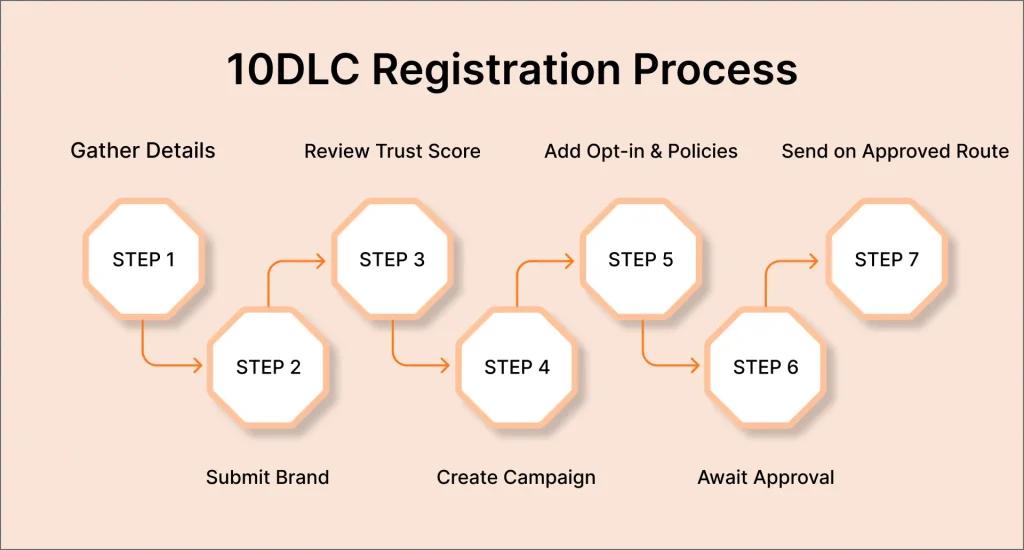
Most businesses register through their messaging provider rather than through The Campaign Registry (TCR) directly, but the underlying flow is the same:
- Gather your business details: Have your legal business name, EIN or Tax ID, business address, website URL, and a contact person ready before you start (see the checklist above).
- Submit your brand: Enter your company identity so TCR can verify it and assign a Trust Score. Brand review typically takes 2 to 5 business days.
- Review your Trust Score: Your score sets your starting throughput tier. A valid EIN, an established business age, and a live, matching website all help.
- Create your campaign: Choose a use case category (marketing, appointment reminders, 2FA, order updates, and so on) and add 3 to 5 sample messages that closely match what you actually send.
- Provide opt-in proof and policy URLs: Describe exactly how recipients consent, and link your Terms of Service and Privacy Policy pages with SMS-specific language.
- Submit and await approval: Campaign approval typically takes 1 to 4 weeks depending on the carrier and how complex your use case is.
- Send only on the approved route: Once approved, send exclusively over your registered 10DLC route and keep your live messages aligned with your registered samples.
With TextBolt, you do not fill in the TCR forms yourself. The onboarding flow collects these fields and submits your brand and campaign on your behalf, typically within 48 hours.
How Long Does 10DLC Registration Take?
The honest answer: it depends on your brand profile, your use case, and how clean your documentation is. Here is the realistic breakdown.
- Brand registration: 2 to 5 business days for most standard submissions.
- Campaign registration: 1 to 4 weeks depending on carrier and use case complexity.
- Industry average end-to-end: roughly 2 weeks for standard use cases.
What Causes Delays
- Mismatches between your legal business name, EIN, and website domain.
- Vague campaign descriptions that do not clearly state what is sent, to whom, and how they opted in.
- Sample messages that do not match the stated use case.
- Higher-risk industries (lending, debt collection, cannabis, gambling) that face additional vetting.
- Missing or inaccessible Terms of Service or Privacy Policy pages.
What to Do While Registration Is Pending
Use the wait time to finalize opt-in flows on your website, draft your sample message library, and train any staff who will be sending texts on STOP and HELP handling. With TextBolt, brand and campaign details are submitted during onboarding, so customers can prepare their contact lists and consent records in parallel with the carrier review.
10DLC Campaign Types: Standard, Special, and Restricted Use Cases
Every 10DLC campaign you register has a use case category. The category determines which content rules apply, how aggressively carriers filter, and in some cases whether you are eligible to send at all.
Standard Campaign Use Cases
1. Marketing and Promotional Messages
Sales announcements, loyalty offers, new product launches, and event invitations. Marketing campaigns face the strictest consent requirements (express written opt-in) and the tightest content rules around frequency disclosure.
2. Appointment Reminders
Reminders for upcoming appointments, confirmations, and reschedule prompts. Common in healthcare, dental, salons, automotive service, and any business with scheduled visits.
3. Two-Factor Authentication (2FA)
Time-sensitive verification codes for account login, password reset, and transaction confirmation. Carriers prioritize 2FA traffic and it generally moves through review faster, since the use case is unambiguous.
4. Account Notifications
Account balance alerts, plan renewals, contract expirations, and general status updates to existing customers. Transactional in nature and tied to a specific account relationship.
5. Customer Service and Support
Two-way messages for support inquiries, ticket updates, and follow-up. Conversational by design and a strong fit for 10DLC’s two-way capability.
6. Order and Shipping Notifications
Order confirmations, shipment tracking updates, delivery windows, and pickup alerts. E-commerce and direct-to-consumer brands lean heavily on this category.
Special and Restricted Campaign Types
1. SHAFT Categories (Sex, Hate, Alcohol, Firearms, Tobacco)
SHAFT content faces heavy restrictions or outright blocking. Alcohol and tobacco can sometimes proceed with age-gated opt-in flows; sex, hate, and firearms typically do not.
2. High-Risk Financial Products
Payday loans, debt collection, and get-rich-quick offers face additional carrier scrutiny and often require specialized campaign types. Many providers will not register these at all.
3. Cannabis and Hemp
Cannabis (and in many cases CBD and hemp) messaging is broadly restricted by carriers regardless of state legalization. Work with your messaging provider before assuming you can send.
4. Gambling
Gambling content requires specialized campaign approval and is restricted to licensed operators in jurisdictions where it is legal. Sports betting promotions are heavily filtered.
Mixed-Use Campaigns: What They Cover
A mixed-use campaign lets you send more than one type of message from a single registered campaign (for example, both appointment reminders and the occasional promotional offer to the same opted-in audience). Mixed-use is convenient but it inherits the strictest consent and content rules of all the message types you include. If your texts are split cleanly between marketing and transactional, two separate campaigns often perform better than one mixed-use campaign.
One 10DLC number is typically linked to one active campaign per provider. If you need to send fundamentally different types of messages, most providers will provision a second number rather than overload one number with two campaigns.
10DLC Registration Costs: Brand Fees, Campaign Fees, and Per-Message Charges
10DLC costs break down into three buckets: one-time registration fees, recurring monthly campaign fees, and per-message carrier surcharges. The exact numbers vary by messaging provider and use case, but the industry ranges below are a reliable starting point.
1. Brand Registration Fees
Brand registration is typically a one-time fee of around $4 (standard brand) submitted through TCR. Sole proprietor brand registrations may run slightly different. Some providers absorb this into their own onboarding fee rather than passing it through.
2. Campaign Registration Fees
Campaign registration usually runs $10 to $15 as a one-time setup, plus a recurring fee of around $10 per campaign per month. If you run multiple campaigns (for example, separate transactional and marketing campaigns), each carries its own monthly fee.
3. Per-Message Carrier Surcharges
For registered 10DLC traffic, carriers add per-message surcharges of roughly $0.003 to $0.005 per message segment. These are passed through to your messaging provider, who then either absorbs them or itemizes them on your bill.
4. Unregistered Traffic Surcharges (What Non-Compliance Costs)
Unregistered or improperly-routed traffic faces carrier surcharges of $0.006 to $0.017 per segment, on top of the risk of being blocked outright. The cost-per-message gap between registered and unregistered traffic is the single clearest financial argument for completing registration.
5. How 10DLC Costs Compare to Short Codes and Toll-Free
| Channel | Setup Fee | Monthly Cost | Per-Message Cost |
|---|---|---|---|
| 10DLC | ~$4 brand + $10 to $15 per campaign | ~$10 to $30 | ~$0.003 to $0.005 per segment |
| Short Code | $650 to $1,500 one-time | $500 to $1,000 | Varies by carrier and volume |
| Toll-Free | Toll-free verification fee | ~$15 to $30 | Standard SMS rates |
For most small and mid-sized businesses, the 10DLC math is decisive. Short codes are 20 to 50 times more expensive on monthly cost alone, with multi-month provisioning.
TextBolt pricing note. TextBolt uses a transparent credit-based model. Brand and campaign registration is handled during onboarding, and outgoing message costs are deducted from your credit balance with no hidden carrier surcharges added on top.
How to Prove Opt-In Consent
Consent documentation is the single most important factor in 10DLC compliance. Missing or unclear consent details are the number one cause of registration rejections.
Here are the most effective ways to prove opt-in consent, ranked by reliability:
1. Website Form Opt-In (Best Practice)
Contact forms, booking forms, or signup forms on your website are the strongest proof of consent. Include an unchecked checkbox with clear disclosure language.
Sample Opt-In Language for Contact Forms
“By submitting this form, you agree to receive text messages from [Business Name]. Message frequency varies. Message and data rates may apply. Reply STOP to opt out.”
2. Terms of Service Page
Your Terms of Service or Terms and Conditions page should include a dedicated texting section that covers consent, frequency, and opt-out instructions.
3. SMS Keyword Opt-In
Allow customers to text a keyword like “JOIN” or “SUBSCRIBE” to your business number to opt in. This creates a clear, timestamped record of consent.
4. Verbal Consent
For businesses that onboard customers over the phone or in person, verbal consent is acceptable. Use a consistent script:
“May I send you text message reminders about your appointments at [Business Name]? Standard message and data rates apply, and you can reply STOP at any time to opt out.”
5. Point-of-Sale or In-Person Signup
Physical signup forms at your business location work as well. Keep copies or digital records of signed consent forms.
Why Consent Logging Matters
Regardless of which method you use, keep a record of every opt-in.
What to Include in Your Consent Audit Trail
- Timestamp of when consent was given
- Method of consent (web form, keyword, verbal, and so on)
- The specific language the customer agreed to
This creates an audit trail that protects your business if a carrier, the FCC, or a plaintiff’s attorney ever questions your compliance.
Need a Built-In Audit Trail?
Every text message you send through TextBolt is timestamped and logged automatically. Built-in STOP keyword support helps you manage opt-outs.
10DLC Compliance Rules You Must Follow
Registration is just the first step. Ongoing compliance requires following carrier content and behavior rules with every message you send.
1. Message Content Rules
Required Elements in Every Message
- Always include your business name so recipients know who is texting them.
- Always include opt-out instructions like “Reply STOP to opt out.”
- Match your actual messages to your registered samples. Carriers use AI filtering to compare live messages against what you submitted during registration.
Forbidden Content (SHAFT and Beyond)
- Avoid SHAFT content: Sex, Hate, Alcohol, Firearms, and Tobacco.
- Watch for forbidden content categories beyond SHAFT: high-risk financial products (payday loans, debt collection), illegal substances, gambling without proper licensing, and adult content.
- Avoid excessive capitalization, special characters, and symbols.
URL Shortener Rules
Do not use public URL shorteners (like bit.ly). Carriers flag these as potential phishing. Use your own branded domain or your messaging provider’s tracked-link feature instead.
2. Opt-Out Handling
STOP, HELP, and INFO Keyword Requirements
- Honor STOP requests immediately. There is no grace period.
- Send a single confirmation message after opt-out.
- Never message someone who has opted out, even if they are a current customer.
- Support HELP and INFO keywords: auto-reply with business name, program description, support contact, and opt-out instructions.
Opt-Out Confirmation Message Examples
“You have been unsubscribed from [Business Name] alerts. You will not receive further messages. For help, reply HELP.”
3. Throughput Limits
Your messaging speed depends on the Trust Score assigned to your brand during 10DLC registration. A higher Trust Score means you can send more messages per day. Most registered businesses start at a default tier and can request a review through their messaging provider to increase their limits over time. Consistent compliance and a clean messaging history are the best ways to improve your throughput.
4. Route Integrity: Stay on the Sanctioned Path
Your A2P traffic must travel over registered 10DLC routes, not over P2P routes or “grey routes” that bypass 10DLC controls. Some senders or providers attempt to mask A2P traffic as P2P to avoid registration costs or throughput limits. Carriers detect these patterns and respond with fines, campaign termination, and long-term reputation damage that follows the brand across multiple numbers and campaigns.
If you use a messaging provider, confirm they route through registered, sanctioned channels. Reputable A2P messaging providers route through carrier-approved paths by default. Cheap rates that look too good often signal a grey-route operator, and the long-term cost (delivery failures, blocked campaigns, blacklisted numbers) far exceeds the short-term savings.
What Happens If You Don’t Register?
The consequences of skipping 10DLC registration are severe and immediate:
- Messages blocked entirely. Since February 2025, unregistered 10DLC messages are not delivered. Your customers never see them.
- Carrier fines. T-Mobile fines up to $10,000 per violation. AT&T and other carriers have their own penalty structures.
- Per-message surcharges. Unregistered traffic incurs carrier surcharges of $0.006 to $0.017 per message segment, adding up quickly.
- Campaign suspension. Carriers can suspend your messaging campaigns entirely.
- Phone number blacklisting. Your business number can be permanently flagged, meaning even after registration, your delivery rate may suffer.
- Legal exposure. With TCPA lawsuits up 95%, non-compliant businesses are prime targets for litigation. Working through a step-by-step TCPA compliance checklist helps you close the consent, opt-out, and record-keeping gaps that trigger those suits.
The bottom line: the cost of non-compliance far exceeds the cost of registration.
How to Stay Compliant After Registration
Registration is not a one-time event. Ongoing compliance requires regular attention.
1. Monthly Compliance Checks
Delivery Rate Monitoring
Watch your overall delivery rate and per-carrier breakdowns weekly. A sudden drop, especially on a single carrier, may indicate filtering or a compliance flag. Healthy registered campaigns typically run above 95% delivery to the major carriers.
Error Code Reference (e.g., 30007)
Familiarize the person responsible for SMS with common error codes. 30007 (carrier filtered) is the most common signal of a content or reputation issue and is worth investigating any time it spikes.
2. Quarterly Compliance Reviews
Every quarter, review your campaign descriptions, sample messages, and opt-in flows. If your messaging has drifted from what you registered, update the campaign before carrier AI filtering does it for you.
3. When to Update Your Campaign Registration
Update or create a new campaign registration whenever you add a new use case (for example, adding promotional messages alongside appointment reminders) or materially change your sample messages.
4. Maintaining Your Opt-Out and Consent Records
Keep opt-in and opt-out logs with timestamps, consent method, and the exact disclosure language. Treat them as legal records, not as marketing data.
If your business uses email-to-SMS for automated notifications or allows multiple staff members to text from one business number, make sure every team member understands basic compliance rules. A single non-compliant message from one employee can trigger penalties for your entire campaign.
How TextBolt Keeps Your Business Texting Compliant
TextBolt is built for businesses that need simple text messaging without dealing with complex API integrations or technical setups. With TextBolt’s email-to-text service, your team sends texts directly from Gmail or Outlook.
What TextBolt Provides
- 10DLC registration handled during onboarding. TextBolt processes your brand and campaign registration, typically within 48 hours
- Built-in STOP keyword support. The platform includes STOP keyword handling to help you manage opt-outs
- Full message audit trail. Every message is timestamped and logged, giving you records if a carrier or regulator ever asks
- Up to 98% delivery rate* with 10DLC compliant carrier-approved routing
- Up to 10 team members on Standard and Professional plans, with no per-user fees inside that limit.
- Transparent credit-based pricing. Each outgoing text segment costs 1 credit. No hidden carrier surcharges
What You Are Responsible For
As outlined in TextBolt’s terms of service, the platform provides the infrastructure, but as a user you are responsible for:
- Obtaining proper consent from recipients before sending any messages
- Complying with TCPA, CAN-SPAM, and A2P 10DLC requirements for your specific use case
- Honoring opt-out requests promptly and keeping records of opt-outs
- Using the service for legitimate business purposes only
- Maintaining the security of your account and connected service credentials
- Complying with the terms of service of each connected third-party service (Google Calendar, Google Contacts, and others)
For full details, review TextBolt’s terms of service before getting started.
Start your free 7-day trial and send your first compliant text message in minutes.
Ready to Start Sending?
TextBolt handles 10DLC registration when you sign up. Your team sends texts from Gmail or Outlook. 7-day free trial with 10 message credits included.
*Delivery rates vary based on carrier policies, message content, and compliance factors.
Frequently Asked Questions
Is 10DLC mandatory for all businesses?
Yes. Any business sending automated or application-generated text messages to U.S. phone numbers through a 10-digit long code must register. This applies regardless of company size or messaging volume.
Does 10DLC apply to toll-free numbers?
No. Toll-free numbers (1-800, 1-888, and similar) have their own separate verification process. 10DLC applies specifically to standard 10-digit local numbers.
Can I send messages while my registration is pending?
This depends on your messaging provider and the carrier. Some allow limited sending during the review period, but unregistered traffic may face surcharges or filtering. It is best to complete registration before sending any business messages.
Does 10DLC apply to my business if we are based outside the United States?
Yes. If your business sends SMS to U.S. mobile numbers, the messages must comply with 10DLC regardless of where your business is incorporated. Carriers enforce 10DLC at the destination network, not the sender’s location. Businesses based in Canada, the United Kingdom, India, Australia, or anywhere else that text U.S. recipients need brand and campaign registration.
What is the difference between A2P and P2P texting?
A2P (Application-to-Person) means a software application or business system sends the message. P2P (Person-to-Person) means a human composes and sends each text manually. The phone number can be the same; the difference is intent and pattern. Automated, recurring, or higher-volume texts from a business identity are A2P and fall under 10DLC, even at low daily volumes.
Do industries like healthcare or financial services have extra requirements beyond 10DLC?
Yes. 10DLC registration is the carrier-level requirement, but specific industries also follow content rules tied to their sector. Healthcare senders face restrictions on protected health information separate from 10DLC. Financial services and fintech face additional scrutiny on lending, debt collection, and credit-related content. If you operate in lending, cryptocurrency, gambling, cannabis, or debt collection, work with your messaging provider before registering, since some content categories require specialized campaigns and others are blanket-prohibited.
What is 10DLC compliance?
10DLC compliance means your business has registered its brand and campaign(s) with The Campaign Registry (TCR), follows carrier content and opt-out rules, and maintains proper consent documentation for every SMS recipient.
What is a 10DLC campaign?
A 10DLC campaign is a registered description of a specific type of messaging you send, such as appointment reminders, 2FA codes, or order notifications. Each campaign carries its own use case, sample messages, opt-in description, and monthly fee.
How long does 10DLC registration take?
Brand registration typically takes 1 to 5 business days. Campaign approval ranges from 1 to 4 weeks depending on carrier and use case complexity. The end-to-end industry average for standard use cases is roughly 2 weeks.
How much does 10DLC registration cost?
Industry ranges are roughly $4 for one-time brand registration, $10 to $15 one-time setup per campaign, and around $10 per campaign per month, plus per-message carrier surcharges of about $0.003 to $0.005 per segment for registered traffic.
What is the 10DLC registration form?
The 10DLC registration form is a structured submission to TCR with two parts: a brand form (legal name, EIN, address, website) and a campaign form (use case, sample messages, opt-in description, terms and privacy URLs). With TextBolt, the onboarding flow collects this information and submits it on your behalf.
What is The Campaign Registry (TCR)?
The Campaign Registry is the central database that stores every registered 10DLC brand and campaign. It runs vetting checks and feeds the trust signals carriers use to decide on throughput and content filtering.