
- What is A2P Messaging?
- Common A2P Messaging Use Cases
- 1. Order and Purchase Confirmations
- 2. Appointment Confirmations, Reminders, and Status Notifications
- 3. Shipping and Delivery Updates
- 4. Account and Security Alerts
- 5. Marketing Promotions and Announcements
- 6. Customer Retention and Re-Engagement
- 7. Two-Factor Authentication (2FA)
- 8. Feedback and Review Requests
- How Does A2P Messaging Work?
- How to Send A2P Messages Without Code or an API
- Understanding the Different Types of A2P Messaging
- A2P Messaging Sender Types: 10DLC, Toll-Free, and Short Codes
- Why A2P Registration Matters for Businesses
- A2P Messaging Compliance Requirements
- A2P Messaging vs. P2P Messaging: Key Differences Explained
- What are the Benefits of A2P Messaging for Businesses?
- Make A2P Messaging Work for Your Business
- Frequently Asked Questions
Send A2P-Compliant SMS With TextBolt
What Is A2P Messaging? A Complete Guide for Businesses

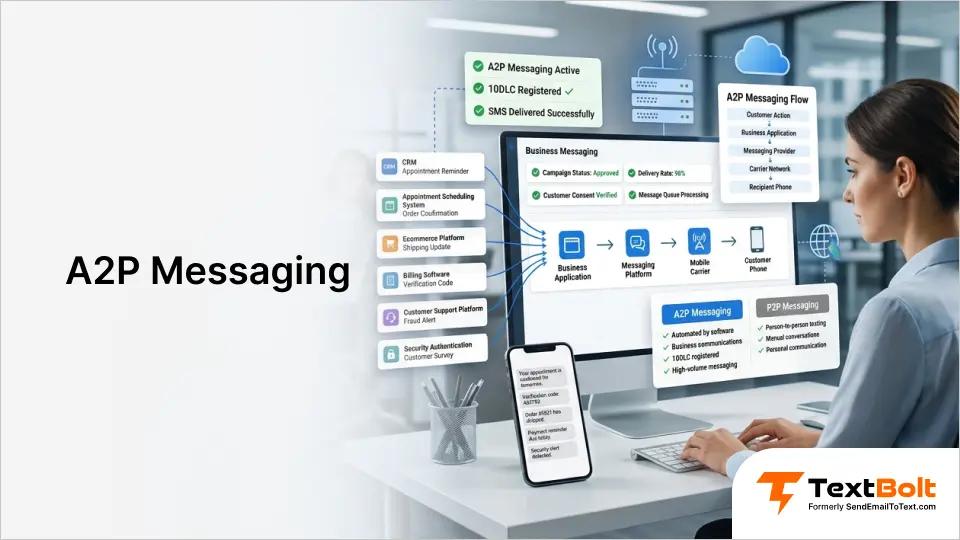
A2P (Application to Person) messaging is text sent from a business’s software, not a person’s phone, to a customer, like appointment reminders or verification codes. It requires 10DLC registration in the US and follows stricter carrier rules than personal texting.
A text message confirming your appointment. A verification code for logging in. A shipping notification that your order is out for delivery. These messages have become a routine part of daily life, and most are powered by A2P messaging.
Unlike personal text conversations, business messaging operates under stricter carrier requirements. Organizations must obtain customer consent, register their messaging traffic, and follow industry regulations designed to reduce spam and improve message reliability.
As business texting continues to grow, these requirements play an increasingly important role in determining whether messages reach their intended recipients. The way a business sends messages, the type of traffic it generates, and the regulations it follows can all impact deliverability, customer trust, and campaign performance.
Whether you’re evaluating an SMS platform, building automated workflows, or looking for a simpler way to send email-to-SMS messages with TextBolt, understanding the fundamentals can help you avoid common compliance and deliverability issues.
This guide covers what A2P messaging is, how it works, common use cases, A2P vs. P2P messaging, 10DLC requirements, compliance considerations, and best practices for sending business text messages at scale.
What is A2P Messaging?
A2P (application-to-person) messaging is any text message sent to a person’s mobile phone through a software application or business system, rather than from one personal phone to another. It is also called business SMS or enterprise SMS.
The application can be a scheduling platform, CRM, EHR, billing system, monitoring tool, ecommerce platform, or an email-to-SMS service like TextBolt. The recipient is always a person, such as a customer, employee, patient, driver, or subscriber.
A2P messages can be fully automated or written by a staff member. A password reset sent to one customer is A2P. A promotional campaign sent to a large subscriber list is also A2P. So is a reminder a front desk team types as an email in Gmail.
The route decides it, not the content or the audience size. If a message leaves through a business platform instead of a personal phone, carriers treat it as A2P.
The term is most associated with SMS, but A2P messaging now covers several channels:
- A2P SMS: Standard text messages sent from registered 10DLC numbers, toll-free numbers, or short codes.
- A2P MMS: Multimedia messages that carry images, GIFs, video, or longer content.
- A2P RCS: Rich Communication Services, which adds branded sender profiles, buttons, and other interactive features.
- OTT channels: Over-the-top apps such as WhatsApp Business and Apple Messages for Business, which run over the internet instead of carrier networks.
SMS remains the foundation of A2P messaging because it works on virtually every mobile phone without an app or internet connection. It is also the channel TextBolt uses, so every message goes out as a standard text from your business number.
Common A2P Messaging Use Cases
At its core, A2P messaging falls into four categories that appear in nearly every business messaging program:
- Security: One-time passwords (OTPs) and two-factor authentication (2FA) codes.
- Notifications: Shipping and delivery updates, fraud alerts, account activity.
- Reminders: Appointment confirmations and status updates.
- Marketing: Promotions, offers, and product announcements to opted-in recipients.
Those four categories cover the bulk of the traffic. In practice, businesses use A2P messaging for a longer list of jobs:
1. Order and Purchase Confirmations
Businesses use A2P messaging to confirm transactions and keep customers informed after a purchase. These messages often contain order details, payment confirmations, or fulfillment updates.
2. Appointment Confirmations, Reminders, and Status Notifications
Healthcare providers, service businesses, hospitality companies, and other organizations rely on automated reminders to reduce no-shows and keep schedules running smoothly. You can try TextBolt’s email to send SMS services that help you reduce no-shows of your patients in clinics or customers at your store.
Automotive service centers use them for vehicle-ready pickups, restaurants for reservation confirmations, law firms for court date reminders, and real estate offices for showing appointments.
3. Shipping and Delivery Updates
Real-time delivery notifications help customers track orders and stay informed throughout the fulfillment process without needing to check a website or mobile app.
4. Account and Security Alerts
Banks and financial institutions, SaaS companies, and online A2P messaging platforms to notify users about account activity, suspicious logins, password changes, and other security-related events. When you use A2P business messaging service provided by TextBolt, IT departments can notify their team for any server downtime through SMS alerts.
5. Marketing Promotions and Announcements
Promotional A2P messaging helps businesses share special offers, product launches, seasonal campaigns, event invitations, and other marketing communications with opted-in customers.
Our bulk SMS messaging guide covers how to send at volume while staying compliant.
6. Customer Retention and Re-Engagement
Businesses often use automated text messaging to reconnect with inactive customers, recover abandoned carts, celebrate customer milestones, or encourage repeat purchases.
7. Two-Factor Authentication (2FA)
Authentication messages deliver one-time passcodes and verification codes that help secure user accounts and reduce unauthorized access. Telecommunications providers and SaaS platforms send millions of these daily to verify account access and confirm identity changes.
8. Feedback and Review Requests
Organizations frequently use A2P messaging to collect customer feedback, request reviews, and measure satisfaction after a purchase, appointment, or support interaction.
The exact use case may differ from one business to another, but the underlying principle remains the same: using automated messaging to deliver relevant information quickly, reliably, and at scale.
How Does A2P Messaging Work?
A2P messaging is a software application sending a message to a mobile phone through carrier networks. Whether the message is a login code, an appointment reminder, or a marketing offer, the delivery path is largely the same. The path is largely the same whether the message is a login code, an appointment reminder, or a marketing offer. It follows four steps:
- An event triggers your business system. A customer requests a password reset, an appointment is scheduled, a payment comes due. That action fires a workflow inside a CRM, ecommerce platform, scheduling tool, billing application, or support system.
- The system generates the message and sends it to a messaging provider. The provider handles routing, sender verification, and carrier connectivity.
- The provider passes the message to the mobile carrier.
- The carrier delivers the message to the recipient’s phone, after checking the sender’s registration and messaging profile.
A2P Messaging Flow
Customer Action ➡️Business Application (CRM, EHR, Ecommerce Platform, Billing System) ➡️ Messaging Provider ➡️ Mobile Carrier ➡️ Recipient’s Phone
Example: Password Reset Text Message
A password reset request is one of the simplest examples of A2P messaging in action:
Customer clicks “Forgot Password”
↓
Website generates verification code
↓
Code is sent to messaging provider
↓
Provider routes message to carrier
↓
Carrier delivers SMS to customer
The same workflow powers many of the messages people receive every day:
- Appointment reminders
- Two-factor authentication codes
- Order confirmations
- Shipping notifications
- Fraud alerts
- Billing reminders
- Customer surveys
- Marketing campaigns
The content may vary, but the underlying process remains the same: an application generates a message, a local A2P messaging provider routes it, and a carrier delivers it to the intended recipient.
Put A2P Messaging to Work for Your Business
Whether you’re sending appointment reminders, account alerts, shipping updates, or customer notifications, TextBolt makes it easy to deliver compliant A2P text messages through the tools you already use.
How to Send A2P Messages Without Code or an API
The simplest answer is email. Any person or system that can send an email can send a registered A2P text through an email-to-SMS gateway, without writing code or building an integration.
With TextBolt, each text starts as an email addressed to the recipient’s phone number in the format +1[PhoneNumber]@sendemailtotext.com. The subject and body become the SMS, and it goes out from your business number. The guide to sending email to text covers each step.
The sender can be a person or a system. A rep can write the email in Gmail or Outlook. A scheduling platform, monitoring tool, or alarm panel can send it automatically once the address is added as a recipient in its alert settings. Moving alerts to a new on-call person only means changing that address.
When the recipient replies, the reply comes back as a threaded email to the inbox that sent the original message, not a shared mailbox. Two-way conversations stay with the person who started them.
Email-to-SMS Gateway vs. SMS API
Both routes send the same kind of registered A2P message. The difference is who builds and runs the connection.
| Feature | Email-to-SMS gateway | SMS API |
|---|---|---|
| Setup | Change a destination email address | Developer build against an SDK |
| Who does it | Any team that can send email | Engineering team |
| Two-way replies | Threaded back to the sender’s inbox | Handled by your own code |
| Right when | Low-to-moderate volume, operational alerts, inbox workflows | High-volume custom apps that need analytics and programmatic control |
For A2P senders, TextBolt stands in for the shuttered carrier gateways (AT&T’s txt.att.net ended June 17, 2025; T-Mobile’s tmomail.net stopped in late 2024; Verizon’s vtext.com closes by March 31, 2027) without the code an SMS API demands. Since US A2P traffic requires 10DLC registration, TextBolt is a Verified A2P 10DLC sender and files each account’s brand and campaign, with approval running up to 48 hours.
Understanding the Different Types of A2P Messaging
Not every A2P message serves the same purpose. Some messages help customers complete a transaction or receive important updates, while others are designed to promote products, services, or events. Understanding the difference is important because carriers and regulators often apply different rules to each category.
1. Informational A2P Messaging
Informational messages support an existing customer relationship or provide information the recipient expects to receive. They are typically triggered by an action, account event, or business process.
Common examples include:
- One-time passwords (OTPs)
- Account verification codes
- Appointment reminders
- Order confirmations
- Shipping updates
- Billing notifications
- Fraud and security alerts
The primary purpose of these messages is to inform, notify, or assist the recipient rather than market a product or service.
2. Promotional A2P Messaging
Promotional messages are intended to drive awareness, engagement, or sales. Businesses use them to encourage customers to take a specific action, such as making a purchase, redeeming an offer, or attending an event.
Common examples include:
- Coupons and discount offers
- Flash sale notifications
- Product launches
- Event promotions
- Loyalty program campaigns
- Re-engagement and win-back messages
Because these messages have a marketing purpose, they generally carry stricter consent and compliance requirements than informational traffic.
Why the Difference Matters
The line between informational and promotional messaging is not always perfectly clear. An appointment reminder may include a promotional offer, and a transactional update may contain marketing content.
What matters is the primary purpose of the message.
Carriers, A2P messaging providers, and regulators often use that purpose when determining registration requirements, consent obligations, and delivery policies.
Promotional A2P messaging generally carries stricter consent requirements than informational traffic under both the TCPA principles and the CTIA Messaging Principles. In addition, the 2026 lead-generation consent changes apply primarily to promotional messaging, making accurate campaign classification increasingly important for businesses that use SMS for marketing.
Understanding this distinction makes it easier to navigate the compliance, registration, and deliverability requirements covered later in this guide.
A2P Messaging Sender Types: 10DLC, Toll-Free, and Short Codes
Once a business decides to use A2P rich text messaging, it must choose a sender type. In the United States, most A2P traffic is delivered through one of three options: 10DLC numbers, toll-free numbers, or short codes. Each offers different tradeoffs in cost, throughput, registration requirements, and brand visibility.
10-Digit Long Codes (10DLC)
10DLC numbers look like standard local phone numbers and are now the most common option for business texting. Messages sent from a 10DLC number appear to come from a familiar phone number, making them suitable for two-way conversations and ongoing customer communication.
Because 10DLC was designed specifically for business messaging, carriers require businesses to register their brand and campaigns before sending traffic at scale. Our 10DLC compliance guide covers what registration involves and the 2026 rules you need to follow. Once approved, businesses can use 10DLC numbers for both informational and promotional messaging.
For many organizations, 10DLC strikes the best balance between cost, deliverability, and scalability, making it a popular choice for customer support, appointment reminders, account notifications, and marketing campaigns.
Toll-Free Numbers
Toll-free numbers use familiar prefixes such as 800, 888, 877, 866, 855, 844, or 833. Like 10DLC numbers, they support both voice and text communication, allowing businesses to maintain a consistent identity across channels.
Toll-free messaging is often chosen by companies that already use toll-free numbers for customer service or sales. The number is recognizable, easy to remember, and can handle higher messaging volumes than many standard local numbers.
Businesses still need to complete verification requirements, but toll-free messaging remains a relatively simple way to launch A2P communications without investing in a dedicated short code.
Short Codes
Short codes are five- or six-digit numbers designed specifically for high-volume messaging. They are commonly used by large brands, national retailers, financial institutions, and organizations that send large amounts of traffic in a short period of time.
Unlike traditional phone numbers, short codes are easy to recognize and can become part of a company’s marketing identity. Consumers often encounter them in campaigns that encourage users to text a keyword to subscribe, enter a promotion, or receive updates.
Short codes generally involve higher setup costs and a longer approval process, but they provide the highest throughput and are built to support large-scale messaging programs where speed, volume, and deliverability are critical.
Which Sender Type Is Right for Your Business?
The right choice depends on messaging volume, budget, customer expectations, and business goals.
- 10DLC is often the best fit for small and mid-sized businesses that need a local presence and two-way communication.
- Toll-free numbers work well for organizations that already use a toll-free identity across customer-facing channels.
- Short codes are typically reserved for high-volume messaging programs where throughput and brand recognition are priorities.
For 90% of TextBolt’s customer base (clinics, IT teams, recruiters, schools, utilities), 10DLC is the right answer. Toll-free becomes attractive when the same number needs to handle both inbound calls and texts. Short codes only make sense once you are sending 50,000+ messages per month in a marketing-style cadence. For the full breakdown, see our short code vs long code SMS comparison.
Choosing a sender type is only part of the process. Whether a business uses a 10DLC number, toll-free number, or short code, carriers increasingly require organizations to identify themselves and register their messaging activity before sending traffic at scale. In the next section, we will learn why it is important to do A2P registration.
Need a 10DLC-Registered Route Without Hiring a Developer?
TextBolt handles brand and campaign registration on your behalf as part of business verification. Plans start at $29/month for 500 SMS.
Why A2P Registration Matters for Businesses
The sender type you choose determines how messages enter the carrier network, but it does not guarantee those messages will be delivered.
This shift reflects a broader effort by carriers to reduce spam, improve transparency, and ensure that legitimate business messages reach consumers. As a result, modern A2P messaging is built as much on trust and verification as it is on technology.
Deliverability is no longer determined solely by message content or sending volume. Sender identity, campaign registration, and customer consent all play a role in whether a message reaches its intended recipient.
To make this possible, carriers rely on a network of organizations and systems that help verify businesses, manage registrations, and monitor messaging activity. Understanding how these entities work together helps explain why registration has become a fundamental part of A2P messaging and business communications.
The Role of Campaign Service Providers (CSPs)
Most businesses do not connect directly to mobile carriers. Instead, they send messages through a messaging platform known as a Campaign Service Provider (CSP).
The CSP manages the infrastructure required to submit messages, maintain registration records, and route traffic through carrier networks. These A2P messaging service providers such as TextBolt, Twilio, Sinch, Bandwidth, SignalWire, and SimpleTexting all operate as CSPs.
For businesses, the CSP acts as the bridge between their messaging software and the carrier ecosystem. While the registration process often happens behind the scenes, the CSP is responsible for helping carriers identify who is sending the traffic and what type of messaging activity is taking place.
What is The Campaign Registry (TCR)?
For A2P 10DLC messaging in the United States, registration records are maintained through The Campaign Registry (TCR).
TCR serves as the industry’s system of record for A2P messaging campaigns. Businesses register their brand, describe the purpose of their messaging program, and provide sample message content that reflects the traffic they intend to send.
Carriers use this information to evaluate messaging traffic and determine whether it aligns with the approved campaign. Without an active registration, A2P messages may face filtering, throughput restrictions, or delivery failures.
Why Message Consistency Matters
Registration is only the starting point. Carriers increasingly compare live messaging traffic against the campaign details submitted during registration.
For example, a business might register a campaign for appointment reminders and provide message samples related to scheduling and confirmations. If that same campaign later begins sending promotional discounts or marketing offers, carriers may view the traffic as inconsistent with the registered campaign purpose.
This issue is often referred to as message sample drift. The further live traffic moves away from the campaign’s registered use case, the greater the risk of filtering or reduced deliverability.
The distinction becomes especially important when businesses mix informational and promotional messaging. A campaign registered for operational notifications may not be treated the same way as one registered for marketing communications, particularly when consent requirements differ.
A2P Messaging is Built on Trust
The modern A2P ecosystem is designed around accountability. Carriers want to verify who is sending messages, understand the purpose of those messages, and confirm that recipients have agreed to receive them.
For legitimate businesses, registration helps improve transparency, reduce spam, and support more reliable message delivery. For senders who fail to register properly or whose traffic does not match their registered campaign profile, filtering and delivery issues become much more likely.
The takeaway is straightforward: choosing the right sender type is only one part of a successful messaging program. Registration, consent, and ongoing campaign consistency are equally important for maintaining deliverability and reaching customers reliably.
A2P messaging is often compared to P2P (Person-to-Person) messaging, but the two serve very different purposes.
A2P Messaging Compliance Requirements
A2P messaging is governed by carrier policies, industry guidelines, and legal requirements built to protect consumers. Our TCPA compliance checklist breaks down the specific legal obligations. Three core principles apply to every A2P program.
- Obtain customer consent. Clearly disclose what recipients are signing up for and what messages they can expect. Promotional messaging generally requires stricter consent than informational.
- Provide a clear opt-out method. Support standard keywords such as STOP, QUIT, END, REVOKE, OPT OUT, CANCEL, and UNSUBSCRIBE to process opt-outs automatically, and honor every opt-out within 10 business days. TextBolt processes STOP replies automatically.
- Maintain registration and consent records. Retain documentation of when and how consent was collected, and keep your registration and message content consistent with the traffic you send.
This section is a general overview, not legal advice. For rules that vary by industry or state, see our guide to SMS compliance laws or speak with a lawyer.
A2P Messaging vs. P2P Messaging: Key Differences Explained
P2P messaging is what most people think of when they send a text. One individual writes a message and sends it directly to another individual using a mobile device. The conversation is personal, manual, and typically occurs between a small number of participants.
A2P messaging works differently. Messages are generated by software, business systems, or automated workflows rather than a person manually typing and sending each text. The communication is designed to reach customers, employees, patients, subscribers, or other recipients at scale.
The distinction matters because carriers treat these traffic types differently. The table below highlights the key differences between A2P and P2P messaging.
| A2P Messaging | P2P Messaging |
| Sent by applications, software, or business systems | Sent directly by individuals |
| Designed for automation and scale | Designed for personal conversations |
| Requires registration for many business use cases | No business registration required |
| Subject to carrier compliance and consent requirements | Governed by standard consumer messaging policies |
| Commonly used for notifications, alerts, support, and marketing | Commonly used for personal communication |
The line between A2P and P2P is not always obvious.
A customer support representative texting a customer from a shared business inbox may feel like a one-to-one conversation, but carriers often classify that traffic as A2P because it originates from a business communication system.
As carriers continue to crack down on spam and unauthorized messaging, properly classifying traffic has become increasingly important. Businesses that attempt to send A2P traffic through channels intended for personal messaging may face filtering, delivery issues, or account restrictions.
What are the Benefits of A2P Messaging for Businesses?
Businesses continue to invest in A2P messaging because it offers a direct and reliable way to communicate with customers.
- Fast Delivery: Messages are typically delivered within seconds, making A2P messaging well-suited for time-sensitive communications.
- Broad Reach: Unlike many communication channels, SMS works on virtually every mobile device without requiring users to install additional applications.
- Automation at Scale: Messages can be triggered automatically based on customer actions, schedules, workflows, or system events, reducing manual effort while maintaining consistent communication.
- Improved Customer Experience: Timely updates, reminders, and notifications help customers stay informed and reduce the need for follow-up calls or support requests.
Make A2P Messaging Work for Your Business
A2P messaging has become a core part of modern business communication. Whether you’re sending appointment reminders, account alerts, authentication codes, shipping updates, or promotional campaigns, the ability to reach customers directly on their mobile devices is now a competitive advantage.
But successful A2P messaging involves more than sending text messages. Businesses must choose the right sender type, register their campaigns, obtain proper consent, and follow carrier requirements that influence deliverability.
The good news is that you don’t need to build telecom infrastructure from scratch to take advantage of A2P messaging. Platforms like TextBolt simplify the process by handling business-grade SMS delivery while allowing teams to send and receive text messages through familiar tools like Gmail, Outlook, and other email-based workflows. Businesses can also use TextBolt to convert system-generated emails into SMS alerts without APIs, custom integrations, or code changes.
As carrier requirements continue to evolve, understanding the fundamentals of A2P messaging will help you build compliant, reliable, and scalable communication programs. Whether your goal is customer engagement, operational notifications, or automated alerts, a well-planned A2P messaging business strategy with a platform like TextBolt can improve both deliverability and customer experience.
Start Sending A2P Messages Without the Telecom Complexity
TextBolt handles the registration, compliance, and delivery infrastructure behind business texting, so your team can send and receive SMS using the tools you already use every day.
Frequently Asked Questions
What does the acronym A2P stand for?
A2P stands for application-to-person. It describes an automated text message sent from a software application or business system to a person’s mobile phone, rather than a message one human types to another.
Is A2P messaging the same as SMS?
No. A2P messaging is not the same as SMS while A2P SMS is the most common form because SMS works on nearly every phone without an app or internet connection, A2P messaging can also run over MMS, RCS, and OTT apps like WhatsApp Business and Apple Messages for Business.
Why does A2P messaging matter for businesses?
A2P messaging lets businesses deliver time-sensitive information fast, typically within seconds, across virtually every mobile device without a separate app. It automates messages triggered by customer actions, schedules, or system events at scale, and improves customer experience by cutting down follow-up calls and support requests.
What are the limitations and risks of A2P messaging?
A2P messaging carries compliance risks and tool-level limits. Promotional messaging faces stricter consent requirements than informational traffic, so accurate campaign classification matters. Unregistered messages can face filtering, throughput limits, or delivery failures. TextBolt, for example, shows delivery status but does not automatically retry failed messages or flag blocked numbers.
What happens if my A2P messages don’t match my registered campaign?
Messages that don’t match your registered campaign can be filtered or fail to deliver, even when you’re registered. Register a separate campaign for each distinct purpose, such as reminders and promotions, and refresh your sample messages when your content changes. A short approval wait costs less than ongoing filtering.
What is 10DLC in A2P messaging?
10DLC (10-Digit Long Code) is a standard local phone number approved for business messaging. It allows businesses to send registered A2P traffic while supporting two-way communication.
Do businesses need consent before sending A2P messages?
In most cases, yes. The level of consent required depends on the type of message being sent, with promotional messages generally requiring stricter consent than informational messages.
What is message sample drift?
Message sample drift occurs when live messaging traffic differs significantly from the examples submitted during campaign registration. This can increase the risk of carrier filtering and delivery issues.
Can I send A2P messages from email?
Yes. Some business messaging platforms, including TextBolt, allow users to send SMS messages directly from email through email-to-SMS workflows, making it easier to communicate without switching between multiple tools.