
- What is Short Code SMS?
- What is Long Code SMS?
- What is the Difference Between Short Code and Long Code SMS?
- What Are the Most Common Short Code vs. Long Code SMS Mistakes?
- 1. Prioritizing Cost Over Business Requirements
- 2. Using Long Codes for Mass Marketing
- 3. Underestimating Throughput Limits
- 4. Ignoring Registration and Compliance Requirements
- 5. Choosing the Wrong Long Code Type
- 6. Choosing a Shared Short Code
- 7. Confusing Throughput with Deliverability
- 8. Overlooking Delivery Receipts
- 9. Using Public URL Shorteners
- How Do You Choose Between Short Code, Long Code, and Toll-Free SMS?
- Which Number Type Performs Better?
- When is a Short Code Worth the Cost?
- How Has A2P 10DLC Changed Business SMS?
- Should You Switch from a Short Code to a Long Code?
- Sending Long-Code Texts From Your Inbox With TextBolt
- Short Code vs Long Code: Choose the Sender That Fits Your Sending Strategy
- Frequently Asked Questions
Need Business Texting?
Short Code vs Long Code SMS: Pick the Right Sender Number

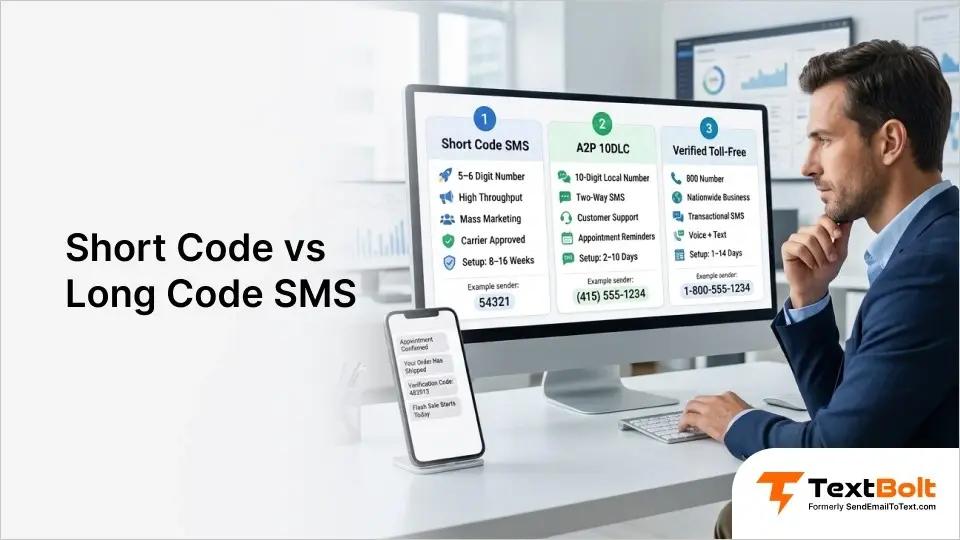
A flash sale has to land in minutes. A clinic reminder has to get a reply. An SMS short code is a 5- or 6-digit number built for high-volume mass messaging, while a long code (10DLC) is a standard 10-digit phone number. The two differ mainly in length, speed and cost.
Short codes deliver very high throughput. The trade-offs are cost, several weeks of carrier approval and no voice calls. Long codes have lower throughput, but they’re inexpensive, quicker to set up, and carry voice and text on the same number, which makes them the fit for two-way customer support and appointment reminders.
A long code can also be reached straight from an email client. With TextBolt email to SMS gateway, an email from Gmail, Outlook or an alerting tool goes out as a text from a registered long code.
What is Short Code SMS?
A short code is a 5- or 6-digit number leased for business texting through the US Short Code Registry. Short codes were built in the early 2000s for very high-volume marketing blasts, contest voting and consumer 2FA.
- Length. A 5- or 6-digit number, such as 938965.
- Speed and throughput. Very high, because carriers reserve dedicated infrastructure for short codes.
- Best use cases. Mass marketing, flash sales, voting, sweepstakes, emergency alerts and two-factor authentication sent to large audiences.
- Cost. Expensive. The US Short Code Registry lists leases at $500 a month for a random code and $1,000 a month for a vanity code, plus provider setup costs.
- Setup time. Several weeks of carrier approval, including CTIA campaign review.
- Voice and calls. Not voice-enabled. A short code sends SMS and MMS only and can’t receive inbound voice calls.
Carriers reserve dedicated infrastructure for short codes, which is why a single short code handles far more messages per second than a long code.
Short codes come with two further trade-offs.
- Replies are limited. Customers rarely start open replies to a five-digit sender, because it looks like a machine.
- The sender looks promotional. Buyers accept a slow, expensive setup and a promotional-looking sender in exchange for high throughput.
How Does Short Code SMS Work?
Businesses lease a dedicated short code and register their messaging campaign with mobile carriers before sending messages. Customers can receive alerts automatically or interact by replying with keywords, making short codes suitable for both one-way notifications and keyword-based two-way campaigns.
What Types of Short Codes Are There?
There are two main types:
- Random short code: A system-assigned number that’s less expensive but harder to remember.
- Vanity short code: A custom number selected to improve brand recognition or spell a memorable word on a phone keypad.
What Is Short Code SMS Used For?
Short code SMS is ideal for high-volume, time-sensitive messaging that needs to reach large audiences quickly, including:
- Promotional campaigns and flash sales
- Mass marketing and broadcast messaging
- Emergency alerts and critical notifications
- Two-factor authentication (2FA) and one-time passwords (OTPs)
- Account notifications and security alerts
- Appointment and payment reminders at scale
- Sweepstakes, polls, and text-to-win campaigns
- Keyword-based opt-ins and SMS subscription programs
What is Long Code SMS?
A long code is business text messaging sent from a standard 10-digit phone number, today either a registered A2P 10DLC local number or a verified toll-free number.
- Length: A long code is a standard 10-digit phone number, either an A2P 10DLC compliance local number or a verified toll-free number.
- Speed & Throughput: A long code has lower throughput, typically 1 to 75 messages per second on 10DLC, depending on carrier and trust score.
- Best Use Cases: A long code fits two-way customer support, appointment reminders, order updates and operational alerts where recipients are expected to reply.
- Cost: A long code is inexpensive, with small registration fees and low monthly costs compared with leasing a short code.
- Setup Time: A long code is quick to set up, taking days to a few weeks for 10DLC registration or toll-free verification.
- Voice & Calls: A long code supports voice and text on the same number, so a customer who calls instead reaches a working line.
In the U.S., businesses sending SMS over local long codes register through The Campaign Registry. Toll-free numbers go through a separate verification process to help ensure reliable delivery.
How Does Long Code SMS Work?
Long code SMS works by assigning your business a standard 10-digit phone number that customers can text just like any other mobile number. Messages are sent through an SMS platform, while replies return to the same number, enabling seamless two-way conversations.
For local business messaging in the U.S., these numbers are typically registered as A2P 10DLC with carriers, while toll-free numbers follow a separate verification process to improve message deliverability.
What Types of Long Codes Are There?
There are two main types:
- A2P 10DLC: A registered 10-digit local phone number designed for business messaging. Best for two-way customer conversations, appointment reminders, customer support, and localized SMS campaigns.
- Verified Toll-Free Number: A verified 10-digit toll-free number (800, 833, 844, 855, 866, 877, or 888) used for transactional messaging, customer support, and nationwide business communications while supporting both voice and text.
What Is Long Code SMS Used For?
Long code SMS is best suited for businesses that prioritize two-way conversations, personalized communication, and moderate messaging volumes, including:
- Appointment reminders and confirmations
- Customer support and live conversations
- Corporate phone numbers with SMS capabilities
- Direct client callbacks and follow-ups
- Order confirmations and shipping updates
- Automated notifications and status updates
- Internal team communication and operational alerts
- Chat applications and conversational messaging
What is the Difference Between Short Code and Long Code SMS?
While the most obvious difference is the number of digits, the real distinction lies in throughput, setup time, cost, compliance, and how customers perceive your messages. Short codes are built for high-volume, carrier-approved messaging, whereas long codes prioritize conversational business communication. Today, business long code messaging primarily uses A2P 10DLC or verified toll-free numbers, each serving different communication needs.
Comparing them on the six dimensions most searches ask about:
| Attribute | Short Code | A2P 10DLC Long Code | Verified Toll-Free |
| Number format | 5–6 digits | 10-digit local number | 10-digit 8XX number |
| Best for | Mass marketing, 2FA, emergency alerts, sweepstakes | Customer conversations, appointment reminders, support, transactional SMS | Transactional messaging, customer support, nationwide business communications |
| Typical throughput | 400–500 messages/second | 1–75 messages/second (carrier dependent) | 10–40 messages/second |
| Setup time | 8–16 weeks | 2–10 business days | 1–14 business days |
| Cost | Very high | Very low | Low |
| Voice support | No | Yes | Yes |
| MMS support | Yes | Yes | Yes |
| Two-way messaging | Supported (primarily keyword-based) | Fully supported | Fully supported |
| Delivery receipts | Yes | Platform dependent | Yes |
| Compliance | CSCA registration and carrier approval | The Campaign Registry (10DLC registration) | Toll-Free Verification |
| Customer perception | Promotional and brand-focused | Personal and local | Professional and business-friendly |
Key Differences to Consider
For most businesses, setup time and customer experience are the biggest deciding factors. Short codes require carrier approval and can take several weeks to provision, making them better suited for planned, high-volume campaigns. In contrast, A2P 10DLC and verified toll-free numbers can typically be approved within days, allowing businesses to launch customer messaging much faster.
Another important difference is how recipients perceive the sender. A short code is immediately recognizable as a business or marketing number, while a standard 10-digit number feels more personal and encourages natural two-way conversations. That’s why long codes are commonly used for customer support, appointment reminders, and transactional notifications.
Finally, consider message length and costs.
Standard SMS messages are limited to 160 GSM-7 characters (or 70 characters when using Unicode characters such as emojis or smart quotes).
Messages exceeding these limits are split into multiple segments, each billed separately by most messaging providers. Although recipients usually see a single combined message, segmentation can increase messaging costs regardless of whether you use a short code, A2P 10DLC, or a verified toll-free number.
What Are the Most Common Short Code vs. Long Code SMS Mistakes?
Selecting the right SMS number is about more than price. The wrong choice can increase costs, delay deployment, reduce message delivery, and create compliance issues that take weeks or months to resolve. These are the mistakes businesses make most often when evaluating short codes and long codes.
1. Prioritizing Cost Over Business Requirements
Many businesses choose a sender type based on monthly pricing instead of how they plan to use it. Leasing a dedicated short code for a few hundred appointment reminders each month is an unnecessary expense, while relying on a long code for high-volume campaigns can quickly expose throughput limits. Evaluate your expected message volume, communication style, and growth plans before comparing costs.
2. Using Long Codes for Mass Marketing
Long codes are intended for conversational business messaging, not large-scale promotional campaigns. Sending thousands of marketing messages from a standard 10DLC number increases the likelihood of carrier filtering, delayed delivery, and campaign throttling. If your business regularly sends flash sales, promotional broadcasts, or nationwide campaigns, a dedicated short code is the more suitable option.
3. Underestimating Throughput Limits
Every sender type has a practical sending capacity. Short codes are designed to process large message volumes within a short period, while 10DLC throughput depends on carrier approval and campaign trust scores. Businesses delivering one-time passwords, emergency notifications, or time-sensitive campaigns should account for throughput before selecting a sender.
4. Ignoring Registration and Compliance Requirements
Carrier approval is mandatory for business messaging. Local long codes must complete A2P 10DLC brand and campaign registration, while short codes undergo a separate carrier approval process before activation. Businesses must also maintain proper customer consent under the TCPA. Missing registration or consent requirements can result in blocked messages, suspended campaigns, and regulatory penalties.
5. Choosing the Wrong Long Code Type
Not every long code serves the same purpose. A2P 10DLC numbers are well suited for localized customer conversations, appointment reminders, and customer support. Businesses sending transactional notifications across the U.S. and Canada from a single business number often benefit more from a verified toll-free number, which offers broader reach while supporting both voice and SMS.
6. Choosing a Shared Short Code
Some providers still offer shared short codes as a lower-cost alternative, but they come with significant limitations. Since multiple businesses share the same number, keyword conflicts, misrouted replies, and inconsistent customer experiences become more likely. A dedicated short code provides complete control over branding, keywords, and messaging.
7. Confusing Throughput with Deliverability
Higher throughput only determines how quickly messages leave the platform. It does not guarantee successful delivery. For many businesses, a properly registered 10DLC number with a strong trust score delivers messages just as reliably as a short code at moderate volumes. The advantage of a short code becomes clear only when sustained, high-speed message delivery is required.
8. Overlooking Delivery Receipts
Delivery reporting is essential for applications such as one-time passwords, security notifications, and other time-sensitive communications. Short codes consistently support delivery receipts, while long code reporting varies depending on the carrier, provider, and messaging platform. If delivery confirmation is a business requirement, verify this capability before selecting a sender.
9. Using Public URL Shorteners
Public URL shorteners such as bit.ly and TinyURL have a long history of abuse by spammers. As a result, carriers often scrutinize or filter messages containing these domains, particularly when sent from long codes. A branded short domain improves both deliverability and customer confidence while maintaining a consistent brand identity.
How Do You Choose Between Short Code, Long Code, and Toll-Free SMS?
The right SMS number depends on four factors: message volume, communication style, deployment timeline, and budget. Answering these questions will help you identify the best fit for your business.
1. How Many Messages Will You Send?
Your expected message volume is the biggest deciding factor.
- A2P 10DLC is ideal for low to moderate daily messaging, such as appointment reminders, customer support, operational alerts, and follow-ups.
- Verified toll-free numbers support higher transactional volumes while providing a single nationwide business number.
- Dedicated short codes are built for enterprise-scale messaging, including mass marketing campaigns, emergency alerts, and millions of authentication messages.
If your campaigns regularly need to reach tens or hundreds of thousands of recipients within minutes, a short code is the right investment. Otherwise, most businesses will achieve better value with 10DLC or verified toll-free.
2. Will Customers Reply to Your Messages?
The way customers interact with your business should influence your choice.
Choose A2P 10DLC if customers are expected to:
- Reply to appointment reminders.
- Ask questions about orders or services.
- Request support.
- Continue conversations over SMS.
Choose Verified Toll-Free if you need:
- A nationwide business identity.
- Both voice calls and text messaging on the same number.
- High-volume transactional messaging with two-way conversations.
Choose Short Code if replies are limited to:
- Keyword opt-ins.
- Voting campaigns.
- Sweepstakes.
- Automated responses.
Although short codes support two-way messaging, they are primarily designed for automated interactions rather than ongoing customer conversations.
3. How Quickly Do You Need to Start Sending?
Deployment timelines vary significantly between sender types.
- A2P 10DLC: Typically approved within a few business days after registration.
- Verified Toll-Free: Usually verified within days to two weeks.
- Dedicated Short Code: Often requires several weeks or months because of carrier provisioning and approval.
If launching quickly is a priority, 10DLC or verified toll-free is usually the better option.
4. What Is Your Primary Business Goal?
Choose the sender type that aligns with how your business communicates.
| If your goal is | Choose |
| Appointment reminders and customer support | A2P 10DLC |
| Order updates and transactional notifications | Verified Toll-Free |
| Local customer conversations | A2P 10DLC |
| Nationwide business messaging | Verified Toll-Free |
| High-volume marketing campaigns | Dedicated Short Code |
| Two-factor authentication (2FA) at scale | Dedicated Short Code |
For most small and mid-sized businesses, A2P 10DLC provides the best balance of cost, deployment speed, and conversational messaging. Verified toll-free is a strong alternative for nationwide transactional communication and businesses that already use an 8XX number. Dedicated short codes are best reserved for organizations that require enterprise-scale throughput, such as national marketing campaigns, large authentication systems, and emergency alert platforms.
Need Business SMS Without the Long Setup?
Skip the weeks-long short code approval process. Send A2P-compliant SMS from Email with a registered 10DLC number.
Which Number Type Performs Better?
Choosing between a short code, A2P 10DLC long code, and a verified toll-free number comes down to four factors: marketing scale, cost, deliverability, and deployment speed. While all three can send business SMS, each is designed for a different type of communication.
Which Number Type is Better for SMS Marketing?
The answer depends on how many people you need to reach and how quickly those messages must be delivered.
If your business regularly sends promotional campaigns to hundreds of thousands of subscribers, a dedicated short code remains the strongest option. Its carrier-approved infrastructure supports extremely high throughput, making it suitable for flash sales, retail promotions, loyalty programs, emergency alerts, and large-scale two-factor authentication.
For most small and medium-sized businesses, however, a registered A2P 10DLC number or verified toll-free number is the better choice. These sender types cost less, provision much faster, and comfortably support appointment reminders, transactional notifications, customer engagement, and moderate-sized marketing campaigns without the overhead of a dedicated short code.
Which Number Type Offers the Best Value?
For most businesses, A2P 10DLC delivers the lowest total cost of ownership. Registration fees are relatively small, setup is measured in days rather than weeks, and monthly costs remain affordable even as messaging volume grows.
A verified toll-free number sits in the middle, offering broader coverage and higher transactional capacity while remaining cost-effective for customer support and nationwide business communications.
A dedicated short code is the most expensive option because it requires carrier leasing, provisioning fees, and ongoing monthly charges. Those costs are only justified when sustained message volume requires enterprise-scale throughput.
Which Number Type Has Better Deliverability?
Deliverability depends more on carrier compliance, sender reputation, and messaging practices than on the number itself.
A properly registered A2P 10DLC number, a verified toll-free number, and a dedicated short code can all achieve excellent delivery rates when used within their intended capacity.
Where they differ is scale.
- Short codes are optimized for high-volume campaigns and are less likely to experience throughput-related delays.
- Verified toll-free numbers provide reliable transactional messaging and support delivery receipts across participating carriers.
- A2P 10DLC delivers comparable performance for customer conversations, appointment reminders, operational alerts, and moderate-volume campaigns when registration and trust scores are in place.
For most businesses, maintaining compliance and obtaining customer consent has a greater impact on deliverability than choosing a higher-throughput sender.
When is a Short Code Worth the Cost?
Despite their advantages, dedicated short codes are unnecessary for many businesses. They become a worthwhile investment only when your messaging requirements exceed what registered long codes or verified toll-free numbers can comfortably support.
A short code is worth considering when:
- You consistently send more than 100,000 business SMS messages each month.
- Campaigns must reach recipients within minutes rather than over several hours.
- Marketing, consumer authentication, or emergency notifications are a core part of your communication strategy.
- Your deployment schedule can accommodate an approval process that may take 8 to 16 weeks.
If your primary use cases include appointment reminders, customer support, order updates, operational alerts, or localized marketing campaigns, A2P 10DLC or a verified toll-free number is usually the better investment. Our guide on how to get a business text number covers the provisioning steps once you’ve made that choice.
How Has A2P 10DLC Changed Business SMS?
Before A2P 10DLC, many businesses sent from standard long codes that were never registered for business traffic. As business texting grew, carriers began filtering unregistered traffic.
A2P 10DLC created a dedicated framework for business messaging. Companies now register their brand and campaigns through The Campaign Registry, and carriers assign trust scores that set approved throughput and messaging limits. For low to moderate volumes, a registered 10DLC number now delivers comparable reliability to a short code, with faster setup, lower cost and two-way conversations.
What Compliance Requirements Apply to Short Code and Long Code SMS?
Every U.S. business sender has to meet four sets of requirements:
- TCPA: The Telephone Consumer Protection Act requires consent before you send. Marketing generally needs prior express written consent, and informational or transactional messages need the permission level that fits their purpose. Keep accurate opt-in records.
- CTIA Messaging Guidelines: Industry standards followed by U.S. carriers, covering acceptable practices, opt-out requirements, disclosures and prohibited content.
- A2P 10DLC registration: Required for commercial messaging from local 10-digit numbers. Unregistered traffic is filtered.
- Toll-Free Verification: Verified 8XX senders get better carrier trust, higher limits and more consistent delivery than unverified ones.
Should You Switch from a Short Code to a Long Code?
Many businesses lease a short code expecting rapid growth, only to discover that their messaging needs never justify the additional expense.
It may be time to switch if:
- Your campaigns no longer require enterprise-scale throughput.
- Most customer interactions have shifted from one-way marketing to two-way conversations.
- You’re looking to reduce monthly messaging costs.
- Faster deployment and easier number management have become priorities.
A registered A2P 10DLC number or verified toll-free number can often provide the same customer experience while reducing operational costs and simplifying compliance.
Sending Long-Code Texts From Your Inbox With TextBolt
Any system that can send email can reach a registered long code. No API is needed.
The registration step from this comparison is handled for you. TextBolt files 10DLC registration for every US account, and approval can take up to 48 hours. Each account gets its own dedicated US 10DLC or toll-free number, registered for business use. TextBolt itself is a Verified A2P 10DLC business sender.
Here is how it works:
- Send SMS from email: Address the message to +1[PhoneNumber]@sendemailtotext.com from Gmail, Outlook or another client. Your long code sends the subject and body as the SMS, whichever system produced the email.
- Two-way replies: Replies thread back into the original sender’s inbox, not a shared catch-all, with no SDK and no code change.
- Your inbox is the record: Every text and reply is searchable, archivable and auditable. Delivery status appears in the TextBolt dashboard, so a failure is visible instead of assumed.
Against code-heavy SMS APIs, the difference is the work you skip. No SDK. No code. No integration project. You change a destination email address.
Short Code vs Long Code: Choose the Sender That Fits Your Sending Strategy
Choosing the right sender comes down to messaging goals, expected volume, and how customers interact with your business.
Short codes earn their cost only when campaigns push past 100,000 messages a month or need to fan out to hundreds of thousands of recipients inside a sending window measured in minutes. Below that, throughput stops being the binding constraint.
For everything else, including appointment reminders, two-way support, transactional notifications, operational alerts, localized marketing, a registered A2P 10DLC long code moves faster, costs less, and reads as a business rather than a broadcast. A verified toll-free number sits alongside it for teams that want one nationwide identity across voice and SMS.
The bottleneck for most small and mid-sized businesses isn’t picking the right sender. It’s getting a compliant one live without a two-month provisioning wait. That’s the gap TextBolt fills — a managed email-to-SMS service on a registered 10DLC or toll-free number, sending from the inbox the team already uses.
Skip the Short Code Wait and Start Sending Today
TextBolt helps you send compliant business SMS from Email using a registered 10DLC or verified toll-free number without months of provisioning.
Frequently Asked Questions
When should I use a long code for customer texting?
Use a long code for customer texting on appointment reminders, order updates, sales follow-ups, and two-way support conversations. Recipients reply to ten-digit local numbers naturally because they read as personal. Long codes also accept inbound voice, so a customer who prefers to call reaches a working line instead of a dead end.
Is a short code better for high-volume SMS campaigns?
A short code is better for campaigns above 100,000 messages per month with tight sending windows measured in minutes. Its 400 to 500 messages per second throughput on dedicated carrier infrastructure is the only viable path at that scale. Below that threshold, raw throughput stops being the binding constraint.
Is a long code good for two-way business texting?
A 10DLC-registered long code is the default sender for two-way business texting. Recipients dial back ten-digit numbers naturally, and reply throughput matches person-to-person SMS. Managed providers like TextBolt deliver replies to the sender’s email inbox, so conversation history lives inside the tool the team already uses.
What is A2P 10DLC and why does it matter for long code SMS?
A2P 10DLC (application-to-person, ten-digit long code) is the U.S. carrier compliance framework enforced universally as of February 2025. Any long code sending business SMS must register a verified brand and campaign through The Campaign Registry. Unregistered long codes are filtered by default, not delivered.
What is the difference between 10DLC and a short code for business texting?
The difference between 10DLC vs short code is primarily message volume, setup, and use case. A registered A2P 10DLC long code is ideal for appointment reminders, order updates, customer support, and two-way business conversations because it uses a familiar ten-digit phone number, costs less, and can be provisioned quickly. A short code is designed for very high-volume messaging, typically exceeding 100,000 messages per month, where businesses need to send large campaigns, one-time passwords (OTPs), or mass alerts within minutes. For most businesses, a registered 10DLC long code is the better choice, while short codes are reserved for enterprise-scale messaging.
Can I send SMS from Gmail using a long code without an API?
TextBolt sends A2P-compliant SMS from Gmail, Outlook, or Microsoft 365 through a registered 10DLC long code without any API. A staff member sends a normal email, and TextBolt delivers it as SMS. Replies arrive back in the sender’s inbox as ordinary email.
Does Canada require the same 10DLC registration as the US?
Canada operates a parallel A2P framework. U.S.-bound Canadian traffic still registers through The Campaign Registry or Toll-Free Verification. Domestic Canadian sending follows CASL and CRTC rules on consent and opt-out. Managed A2P providers handle both frameworks during onboarding, so Canadian businesses do not file separately.
What Is a 5 Digit SMS Code?
A 5-digit SMS code is a short code, a 5- or 6-digit sender number leased through the Common Short Code Administration instead of an ordinary phone number. Businesses use short codes for mass marketing, contest voting, consumer two-factor authentication and emergency alerts. They send SMS and MMS only and cannot receive voice calls.