
- What Are Text Abbreviations in SMS Texting?
- Why Do Text Abbreviations Matter for Business SMS in 2026?
- Which Business Text Abbreviations Are Safe for Customer-Facing SMS?
- Which Common Text Abbreviations Are Widely Understood Across Audiences?
- Which Casual Text Abbreviations and Internet Slang Should Stay Internal Only?
- Where Do Industry-Specific Text Abbreviations Cause the Most Confusion?
- How to Use Text Abbreviations in Business Text Messaging
- When Should You Avoid Text Abbreviations in Business SMS?
- How Do Text Abbreviations Affect SMS Character Limits and Billing?
- Can Your Team Use Text Abbreviations Consistently Across Email-to-SMS Workflows?
- Does Getting Text Abbreviations Right Actually Affect SMS Response Rates?
- Send Better Business Texts Without Adding Another Messaging Platform
- Frequently Asked Questions
Want to Send Business Texts without Learning a New App?
Text Abbreviations: 90+ SMS Acronyms Decoded for Business Texting

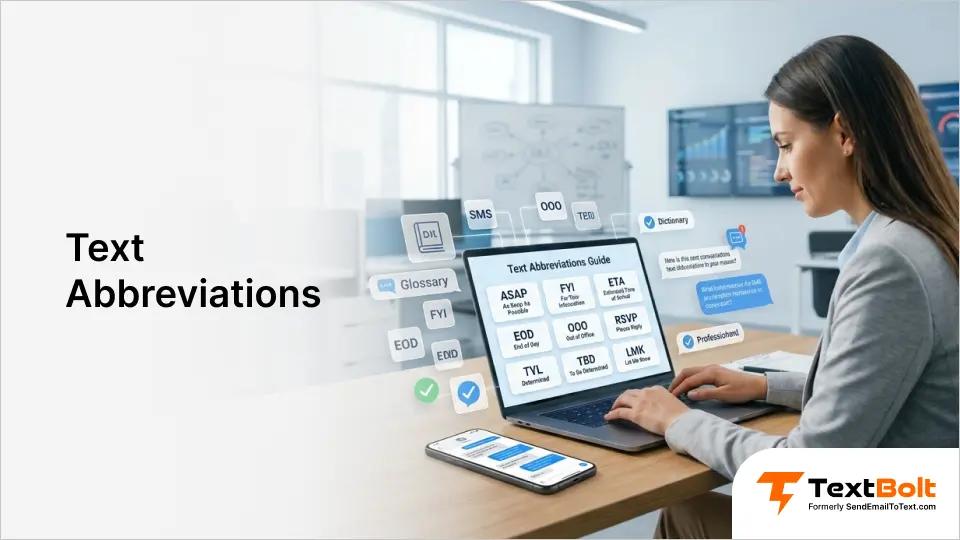
A recruiter messages a candidate: “OOO till EOD, ETA on offer letter ASAP.” The candidate replies: “NP, TY.” The exchange is fast, efficient, and perfectly clear.
Now imagine the same message sent by a clinic front desk to a 64-year-old patient. What reads as “quick shorthand” in one context becomes confusing, unclear, and easy to misinterpret in another.
That gap defines the real challenge with text abbreviations in business communication.
Used well, abbreviations save time, reduce typing effort, and add a human touch to automated SMS workflows. Used poorly, they reduce clarity, frustrate customers, and make professional communication feel like casual chat rather than a trusted business message.
This guide is built for teams who manage that balance every day: front-desk staff, sales representatives, recruiters, IT on-call teams, and small businesses using email-to-SMS systems like TextBolt to communicate with customers. If you’ve ever wondered what SMS abbreviations actually mean in a professional setting, this guide breaks it down clearly.
It includes 90+ commonly used text abbreviations grouped by context, shows which ones work in customer-facing messages, and highlights which ones should be avoided in professional communication.
What Are Text Abbreviations in SMS Texting?
Text abbreviations are shortened versions of words or phrases used in SMS communication. They typically appear as acronyms (ASAP, FYI), initialisms (TBD, EOD), contractions (thx, msg), or symbolic shortcuts (like /s for sarcasm).
In practice, they exist to make communication faster and more efficient. The meaning behind most SMS abbreviations is simple: reduce typing effort, compress common phrases, and sometimes convey a tone that plain text often loses. Their rise was strongly influenced by early SMS constraints, especially the 160-character limit and the difficulty of typing on numeric keypads before smartphones became standard.
The Four Structural Types of Text Abbreviations
Most SMS abbreviations used in business communication today fall into four main categories:
- Acronyms: These combine the first letters of multiple words into a pronounceable term. Examples include ASAP, NASA, and RSVP.
- Initialisms: These also use first letters, but are read letter by letter. Common examples include FYI, TBD, and EOD.
- Contractions: These shorten a single word by removing internal letters. Examples include thx (thanks), msg (message), and appt (appointment).
- Symbolic shortcuts: These use symbols or punctuation to represent meaning or tone. Examples include /s (sarcasm), @ (at), or > in comparisons.
Understanding these categories matters because each format is processed slightly differently by readers, and each carries a different level of clarity and interpretation risk in business messaging.
A Short History of SMS Slang and Texting Acronyms
Many commonly used abbreviations existed long before modern smartphones. ASAP originated in military communication in the 1950s, while FYI appeared in business writing as early as the 1940s.
Informal texting language such as BRB, LOL, and TTYL developed during the late 1990s on platforms like AOL Instant Messenger and IRC. These later transitioned into SMS as mobile phones became widely adopted. More recent shorthand such as NGL, TBH, and IYKYK emerged from social platforms like Twitter and TikTok rather than traditional texting.
This evolution is useful because familiarity varies widely across audiences. A senior operations manager may instantly understand EOD or ASAP, while newer social abbreviations may not be as universally recognized.
Three Purposes a Text Abbreviation Can Serve
Text abbreviations generally serve three distinct functions:
- Compression of frequent phrases: Used to save time and reduce repetition (EOD, OOO).
- Relationship signaling: Used to reflect familiarity or tone between sender and recipient (ILY, TY, NP).
- Tone and context signaling: Used to clarify emotion or intent that plain text might miss (/s, JK, LOL).
When these purposes are mixed without intention, business communication can feel inconsistent, either overly formal or too casual. Choosing abbreviations based on purpose helps maintain clarity while still keeping messages efficient.
Why Do Text Abbreviations Matter for Business SMS in 2026?
Business SMS usage continues to scale rapidly. Global messaging volumes are projected to rise from about 2.7 trillion messages in 2024 to over 3.5 trillion by 2026, according to Twilio State of Customer Engagement 2025. Most of this growth is coming from service-driven industries such as healthcare, recruiting, real estate, legal services, and home services, where communication has shifted from email-first to SMS-first over a short period.
Why Email Tolerance Doesn’t Carry Over to SMS
The core challenge is format mismatch. Email supports longer, structured communication without breaking readability. SMS does not. A message that feels normal at 80 to 100 words in email can become visually heavy and difficult to scan on a mobile screen.
This difference changes how messages need to be written. SMS requires compression, not just translation. Without it, even simple updates start to feel cluttered and harder to act on.
The Four Compression Tools Used in SMS Writing
Front-desk teams and customer-facing staff typically rely on four ways to reduce message length:
- Removing pleasantries: “Hi Sarah” becomes “Hi” or is removed entirely.
- Dropping small filler words: Phrases like “your order” become “order,” and “for your appointment” becomes “for appt.”
- Splitting messages into multiple parts: One long update is broken into two shorter SMS messages to improve readability.
- Using abbreviations: Common shorthand replaces full phrases (EOD, FYI, OOO).
Among these, abbreviations are often the most efficient option when both parties understand the terminology, because they preserve meaning without adding message length or extra billing.
Why Generational Recognition Patterns Matter
Audience expectations significantly influence how abbreviations are received. Research shows that 83% of Gen Z and 64% of Baby Boomers prefer receiving business texts, but they interpret tone very differently.
Younger audiences tend to reject overly formal language and expect faster, more compressed communication. Older audiences are more likely to interpret unfamiliar shorthand as unclear or unprofessional.
This creates a balancing act: the same abbreviation strategy cannot reliably serve all audiences. Over-standardized messaging often becomes the root cause of confusion or tone mismatch complaints.
Why Two-Way SMS Workflows Raise the Stakes
The stakes are even higher in two-way SMS conversations where customers are expected to reply. In these workflows, clarity directly affects response time and customer experience.
An unclear abbreviation can trigger unnecessary back-and-forth. A reply like, “What does OOH mean?” requires an extra message, takes up staff time, and interrupts the conversation. While a one-way notification can survive the occasional ambiguous abbreviation, every misunderstanding in a two-way thread slows the interaction and reduces confidence in the channel.
For that reason, two-way text messaging requires abbreviations to be used carefully. The objective is not simply to make messages shorter, but to make them instantly understandable.
Which Business Text Abbreviations Are Safe for Customer-Facing SMS?
Not every text abbreviation belongs in customer communication. The safest ones are already well established in business emails, workplace messaging, and customer service. Most have been in professional use for decades, making them familiar across different age groups.
The following abbreviations are commonly used for scheduling, status updates, appointments, and business workflows without causing confusion and these are safe-for-work (SFW) text abbreviations.
| Abbreviation | Stands for | Typical use |
| ASAP | As soon as possible | Time-sensitive requests |
| BAU | Business as usual | Status updates after an incident |
| DND | Do not disturb | Internal notice, after-hours flag |
| EOB | End of business | Same as EOD, slightly more formal |
| EOD | End of day | Deadlines, deliverables |
| EOM | End of message | Subject lines with no body |
| EOW | End of week | Soft deadlines |
| ETA | Estimated time of arrival | Service appointments, deliveries |
| FYI | For your information | Sharing information without requesting action |
| ICYMI | In case you missed it | Resending or highlighting earlier information |
| N/A | Not applicable or not available | Forms and status updates |
| OOH | Out of hours | After-hours contact attempts |
| OOO | Out of office | Auto-replies and availability updates |
| PTO | Paid time off | Vacation or leave status |
| RSVP | Répondez s’il vous plaît (please reply) | Event invitations and confirmations |
| T&C | Terms and conditions | Compliance and legal notices |
| TBA | To be announced | Information pending |
| TBC | To be confirmed | Awaiting confirmation |
| TBD | To be decided or determined | Decisions still pending |
| WFH | Work from home | Employee status and scheduling |
| WIP | Work in progress | Progress updates |
A practical rule is to use abbreviations that have long been part of everyday business communication. Terms such as ASAP, FYI, ETA, EOD, and RSVP are widely recognized and are generally safe in customer-facing SMS.
For example:
Your appt is confirmed for 9 AM Tue. Reply C to confirm or R to reschedule. Please reply by EOD.
Using appt instead of appointment keeps the message shorter without making it harder to understand. Well-known abbreviations improve readability while helping you stay within SMS character limits.
Which Common Text Abbreviations Are Widely Understood Across Audiences?
These text abbreviations are widely recognized and strike a balance between professional and conversational language. They are common in workplace communication, online messaging, and customer support, making them suitable for many business situations.
In general, they work well in B2B communication and are acceptable in many B2C conversations. However, they may feel too casual for first-time customer interactions or highly formal industries.
| Abbreviation | Stands for | Typical use |
| AFAIK | As far as I know | Qualified statements |
| AFK | Away from keyboard | Team availability |
| AKA | Also known as | Alternate names or aliases |
| DM | Direct message | Referring to a messaging channel |
| FAQ | Frequently asked questions | Help centers and support |
| FWIW | For what it’s worth | Offering an opinion |
| IMO / IMHO | In my opinion / In my humble opinion | Sharing personal views |
| LMK | Let me know | Requesting a response |
| LMGTFY | Let me Google that for you | Avoid in customer communication |
| N/A | Not applicable | Forms and status updates |
| NRN | No reply necessary | Closing a conversation |
| OMW | On my way | Field service and appointment updates |
| POC | Point of contact | Identifying a contact person |
| PTO | Paid time off | Availability updates |
| RE | Regarding | Email subjects and references |
| TBH | To be honest | Casual opinions |
| TIA | Thanks in advance | Polite request closer |
| TY / TYSM | Thank you / Thank you so much | Acknowledgments |
| W/ | With | Shortened writing |
| W/O | Without | Shortened writing |
| YTD | Year to date | Financial and performance reporting |
A few abbreviations deserve extra caution.
LMGTFY (“Let me Google that for you”) is widely recognized but often comes across as sarcastic or dismissive. It has no place in customer-facing communication because it can easily damage the relationship.
Likewise, TY and TYSM are perfectly natural in chats between colleagues or friends, but they can feel abrupt in customer conversations. In most business SMS, writing “Thanks!” or “Thank you for confirming.” creates a warmer, more professional experience while adding only a few extra characters.
Which Casual Text Abbreviations and Internet Slang Should Stay Internal Only?
These abbreviations belong to everyday texting and internet culture rather than professional communication. They work well in conversations between coworkers, friends, or long-term customers who already have an established relationship with your business.
For first-time customer interactions, appointment reminders, support messages, or other formal business texts, they’re usually best avoided because they can sound overly casual or unprofessional.
| Abbreviation | Stands for |
| BBL | Be back later |
| BC / B/C | Because |
| BFF | Best friend forever |
| BRB | Be right back |
| BTW | By the way |
| CYA | See ya |
| GN | Goodnight |
| GTG / G2G | Got to go |
| HBD | Happy birthday |
| IDC | I don’t care |
| IDK | I don’t know |
| IIRC | If I remember correctly |
| IKR | I know, right |
| IRL | In real life |
| JK | Just kidding |
| LOL | Laughing out loud |
| NBD | No big deal |
| NGL | Not gonna lie |
| NM | Not much |
| NP | No problem |
| NVM | Never mind |
| OIC | Oh, I see |
| OMG | Oh my God |
| OT | Off-topic |
| PLS | Please |
| RN | Right now |
| ROFL | Rolling on the floor laughing |
| SMH | Shaking my head |
| SO | Significant other |
| THX | Thanks |
| TL;DR | Too long; didn’t read |
| TMI | Too much information |
| TTYL | Talk to you later |
| YOLO | You only live once |
| YW | You’re welcome |
| /s | Sarcasm |
Some of these abbreviations have gradually become acceptable in informal customer conversations. For example, NP, or THX often appear naturally once a customer and representative have exchanged a few messages.
However, they are best avoided in the first message your business sends. Initial interactions should prioritize clarity and professionalism. As the conversation becomes more conversational and the relationship develops, a small amount of casual shorthand can make messages feel friendlier without reducing trust.
Where Do Industry-Specific Text Abbreviations Cause the Most Confusion?
While common abbreviations are widely understood, every industry has its own shorthand. Problems arise when internal acronyms are sent to customers, patients, or partners who don’t share the same vocabulary.
1. Healthcare and Clinics
Healthcare teams frequently abbreviate appointment types, departments, and patient statuses. Terms like Appt, F/U, and Rx are generally patient-friendly, but Pt, Dx, OB, and PCP may confuse recipients. Watch for acronyms with multiple meanings—for example, PT can mean physical therapy or paid time off, while NP may be read as nurse practitioner or no problem. When texting patients, spell these out.
2. Recruiting and HR
HR teams commonly use abbreviations such as JD, OL, TC, WFH, YOE, and PTO. These are usually fine when texting candidates already involved in the hiring process, but they may confuse executives, assistants, or external contacts. Outside recruiting, only well-known terms like NDA are generally safe. For templates that balance brevity with clarity at each hiring stage, see our recruiting text message examples.
3. Sales and Customer Success
Sales teams rely on acronyms like MQL, SQL, ICP, ARR, MRR, and EOQ. Some, such as POC and DM, have multiple meanings depending on context. Use these internally, but spell them out when communicating with prospects or customers.
4. IT, On-Call, and DevOps
Technical SMS alerts depend on abbreviations to stay concise. Terms like SEV1, P1, MTTR, SLA, RCA, NOC, and SOC are standard for engineering teams and should remain abbreviated, especially in automated alerts where every character counts.
5. Legal and Compliance
Legal professionals commonly use NDA, MSA, SOW, LOI, POA, and EOD. These work well in internal communication, but client-facing messages should spell out anything beyond widely recognized terms like NDA and EOD to avoid misunderstandings.
How to Use Text Abbreviations in Business Text Messaging
Text abbreviations work best when they improve clarity or save space without making the recipient stop and think. The goal is faster communication—not creating a message that feels cryptic or overly casual.
1. Match the Recipient’s Familiarity
The same abbreviation can be perfectly appropriate for one audience and confusing for another. Before shortening a phrase, ask whether the recipient is likely to recognize it.
For example, ETA, ASAP, and EOD are widely understood in most business settings. Internal abbreviations like MQL, SEV1, or MSA should generally stay within the teams that use them every day.
When you’re unsure, spell the term out.
2. Introduce Uncommon Terms Once
If you expect to use a business abbreviation several times in the same conversation, write the full phrase the first time followed by the abbreviation in parentheses.
For example:
- Your service level agreement (SLA) has been updated.
- Later in the conversation: We’ll review the SLA next week.
This keeps the first message clear while allowing you to save characters afterward.
3. Use Abbreviations to Save Space, Not to Sound Casual
Business abbreviations should make a message shorter without changing its tone.
Good:
- “Your order will ship EOD.”
- “Tech will arrive. ETA 2:30 PM.“
Less effective:
- “LOL your order ships tmrw.”
- “NGL we’re running late.”
If an abbreviation makes the message sound less professional than you intend, write the full phrase instead.
4. Avoid Stacking Multiple Abbreviations
One familiar abbreviation is easy to read. Several in the same sentence slow readers down.
Instead of:
ETA EOD. FYI, POC will review the MSA ASAP.
Write:
Your point of contact will review the master service agreement by the end of the day.
The second version is longer but far easier for anyone outside your organization to understand.
5. Keep Customer Messages Clear
Customers should never have to decode your company’s internal vocabulary. When sending appointment reminders, shipping updates, billing notifications, or customer support texts, prioritize plain language over brevity.
A good rule is simple:
- Internal team conversations: Use shared abbreviations freely.
- Existing customers: Use only widely recognized abbreviations.
- First-time customers: Keep abbreviations to an absolute minimum.
6. Best Practices for Sending Mass Texts with Abbreviations
In bulk SMS campaigns, clarity matters more than saving a few characters. A confusing abbreviation can trigger unnecessary replies and increase support requests.
Before sending, follow these guidelines:
- Use only widely recognized abbreviations like ETA, ASAP, and EOD.
- Write for the least familiar reader. If there’s any doubt, spell it out.
- Avoid internal acronyms such as MQL, SLA, or POC.
- Preview your message to check for clarity and character count.
- Keep abbreviation usage consistent across campaigns with an approved list.
- Test messages with someone outside your team before sending.
The best mass text campaigns prioritize clear communication over shortening every message.
When Should You Avoid Text Abbreviations in Business SMS?
Text abbreviations work best when they make messages shorter without making them harder to understand. Avoid them whenever clarity, professionalism, or compliance matters more than saving a few characters.
1. First-Time Customer Conversations
Your first text sets the tone for every message that follows. Writing “Hi Sarah, your appointment is tomorrow at 2 PM. Reply to C to confirm.” looks more professional than “Hi! Yr appt is tmrw at 2pm.”
2. Messages to New Leads or Prospects
When you’re texting someone for the first time, keep the language professional. Stick to complete words and only use universally recognized abbreviations such as ASAP or ETA if they genuinely improve readability.
3. Compliance and Regulated Communications
Healthcare, finance, legal, and other regulated industries often require precise wording. Avoid shortening approved language, as even small wording changes can create compliance issues.
4. Bad News or Sensitive Updates
Service delays, billing issues, cancellations, and apologies deserve clear, respectful language. Full words show professionalism and reduce the chance that your message sounds dismissive.
5. Abbreviations With Multiple Meanings
Some abbreviations are easily misunderstood. For example, NP can mean no problem or nurse practitioner, while PT may mean physical therapy or part-time. If there’s any chance of confusion, spell it out.
6. Multilingual Audiences
Many internet abbreviations don’t translate well. While terms like ASAP and ETA are widely recognized, abbreviations such as NGL, TBH, or IYKYK can confuse recipients who speak English as a second language.
The simplest rule is this: if an abbreviation could make even a small percentage of recipients pause or guess, use the full word instead.
Stop Missing Messages Because Email Wasn’t Seen
Your team already lives in Gmail or Outlook. Turn any email into an instant SMS without building integrations, learning new software, or involving IT.
How Do Text Abbreviations Affect SMS Character Limits and Billing?
SMS messages are billed by segments, so using abbreviations can sometimes reduce messaging costs. Standard GSM-7 messages fit 160 characters per segment (153 for longer concatenated messages), while Unicode messages, including those with emoji or certain special characters, fit 70 characters (67 when concatenated).
1. Save Space Without Sacrificing Clarity
Shortening phrases like “as soon as possible” to ASAP can help keep a message within a single SMS segment. Across large campaigns, staying under the segment limit can reduce messaging costs.
2. Watch for Unicode Characters
Curly apostrophes, em dashes, emoji, and certain accented characters switch a message from GSM-7 to Unicode encoding, reducing the number of characters allowed per segment. A single copied character can increase the total number of billable SMS segments.
3. Preview Segment Count Before Sending
Most SMS platforms show the character count, encoding type, and estimated segments before you send. Always check this preview, especially for bulk campaigns. If you’re deciding between using an abbreviation or rewriting a sentence, choose the version that’s both shorter and easier to understand.
Can Your Team Use Text Abbreviations Consistently Across Email-to-SMS Workflows?
The most effective business SMS teams don’t use the most abbreviations. They use them consistently and only when they improve clarity. Whether your team sends texts through Gmail, Outlook, or another email-to-SMS workflow, these four rules help keep messaging professional and easy to understand.
1. Match the Recipient’s Communication Style
Pay attention to how the recipient writes. If they use common abbreviations like ETA or ASAP, it’s usually appropriate to respond in a similar style. If they write in complete sentences, match that level of formality to build trust and avoid sounding overly casual.
2. Use Abbreviations Only When They Improve Clarity
Abbreviations should solve a problem, such as keeping a message within a single SMS segment or removing unnecessary words. Don’t use them simply to sound more conversational. If the abbreviated version is harder to understand than the full phrase, spell it out.
3. Define Less Common Abbreviations First
If you need to use an abbreviation that recipients may not recognize, introduce it the first time. For example, write “End of Day (EOD)” before using “EOD” later in the conversation. This improves readability while saving characters in follow-up messages.
4. Review Messages Before Sending
Email clients can automatically expand or change abbreviations through autocorrect or text replacement. Before sending a bulk campaign, preview the message to confirm that abbreviations appear exactly as intended. A quick review helps prevent small formatting mistakes from reaching every recipient.
The goal isn’t to shorten every message. It’s to create consistent, professional communication that recipients can understand immediately.
Does Getting Text Abbreviations Right Actually Affect SMS Response Rates?
The teams that send the fewest messages per week are usually the ones overthinking abbreviations. The teams that send the most are usually the ones who stopped thinking about them at all and let bad habits compound. Both categories miss the point.
The Real Function of a Text Abbreviation
Text abbreviations are a tool for fitting a thought into a 160-character box without sacrificing clarity. They are not a personality, a strategy, or a brand voice. Use them when they help. Skip them when they don’t. Spell out anything a reasonable recipient might misread.
What to Do If Your Team is Asking This Question
If your team is sending business SMS today and the topic of “should we be using abbreviations more” has come up in a meeting, the honest answer is probably: less than you think, and consistently across the team. Pick a house style, write it down, and move on. The decision is much less important than the consistency, and a documented mediocre policy beats an undocumented great one every time.
Send Better Business Texts Without Adding Another Messaging Platform
Text abbreviations are most effective when they improve clarity, not just save characters. By using them consistently and matching your customers’ communication style, your team can send SMS messages that feel professional, easy to understand, and more likely to receive a response.
If your business already communicates through email, TextBolt lets you turn Gmail or Outlook into a two-way business texting platform. Your team can send appointment reminders, customer support updates, notifications, and marketing messages without learning another dashboard or changing existing workflows.
TextBolt keeps pricing simple for small and mid-sized businesses. Every plan includes a monthly SMS allowance with no per-message billing, no prepaid credit requirements, and no surprise carrier registration fees during your subscription.
If you exceed your monthly allowance, top-up credits are available on every plan, never expire, and are only used after your included SMS messages are exhausted. Custom top-up options are also available for teams with unique messaging volumes.
Start sending professional business SMS directly from your inbox by creating your account with TextBolt.
Frequently Asked Questions
Is it unprofessional to use text abbreviations in business messages?
Only the wrong ones. Standard business abbreviations (ASAP, EOD, ETA, FYI) are professional. Casual ones (NGL, TBH, BRB, LOL) read as unprofessional in customer-facing SMS. Texting shorthand (u, r, 2 for to) is unprofessional in any business context. The general rule: if you would not use it in a business email, do not use it in a business text.
What is the difference between an abbreviation and texting shorthand?
An abbreviation compresses a multi-word phrase into initials (FYI, EOD) or a contraction (msg, appt). Texting shorthand respells a single word phonetically to save keystrokes (u for you, gr8 for great). The first is professionally accepted. The second costs visible professionalism for very few characters saved.
Do text abbreviations save money on SMS?
Marginally, on borderline messages. Cutting “as soon as possible” to “ASAP” can keep a message in one segment instead of two, saving roughly $0.058 per send on the TextBolt Basic plan. Across 50,000 messages a month the math matters. Under 1,000 a month, rewriting for clarity beats character-counting.
Why do some text abbreviations have different meanings?
They emerged independently across industries. NP, PT, DM, and SO each carry two or three meanings depending on whether the recipient works in healthcare, HR, social media, or sales. In any customer-facing SMS, default to spelling out collision-prone abbreviations rather than betting on the recipient picking the right one.
Are abbreviations OK in two-way SMS replies from customers?
Yes, when the customer used them first. If a customer writes “OMW, ETA 15 min,” matching their register is more natural than escalating to formal English. If your team runs two-way text messaging through email-to-SMS, inbound replies land in the inbox as email replies in the same thread, so the same staff member can respond with appropriate tone.
What text abbreviations should I never use in business SMS?
LMGTFY (“let me Google that for you”) is universally rude. WTF and similar profanity-based acronyms have no place in customer messages. IDC (“I don’t care”) and IDGAF read as dismissive even in casual threads. ROFL and LMAO are out of place in any service or transactional context. If the abbreviation would draw a sideways look in a meeting, do not put it in an SMS.
How do text abbreviations affect SMS deliverability?
Not directly. Carriers do not filter messages based on acronyms. What does affect deliverability is message length, encoding (Unicode characters from copy-pasted text or emoji can silently change billing and delivery behavior), and sender reputation (registered 10DLC and toll-free senders deliver more reliably than unregistered ones).
What does FTW mean in texting?
FTW stands for “for the win“, used to express enthusiasm at the end of a sentence (“Tuesday delivery FTW”).
How do I decode an SMS abbreviation I don’t recognize?
Three steps. Check context: “NP” after a thank-you almost certainly means “no problem,” while “NP appt at 2 PM” almost certainly means “nurse practitioner.” Check audience: a recruiter writing “JD” means job description, a developer writing “JD” probably means a deployment tag. If both fail, ask the sender directly (“quick check, what does X mean here?”) rather than guessing.
What are the most used SMS abbreviations in 2026?
Across TextBolt customer messages, the ten most-used business abbreviations are ETA, EOD, OOO, FYI, ASAP, TBD, ICYMI, WFH, N/A, and PTO. The casual ones crossing most often into B2C threads are NP, TY, OMW, LMK, and NVM. NGL and IYKYK are the newest social-media imports gaining ground, both still risky in customer-facing SMS.
Do text abbreviations affect message clarity in SMS conversations?
In both directions. The right abbreviation fits a complete thought into one 160-character segment the recipient reads at a glance. The wrong one forces a “wait, what does that mean?” reply that costs you a round-trip. The clarity test: would the recipient understand the abbreviation without context? If you cannot say yes confidently, spell it out.
Is there a full form list for common chat abbreviations?
Yes, the four tables earlier in this article cover 90+ full forms across business, common, casual, and industry-specific categories. For deeper industry shorthand (medical, legal, financial, IT), trade-association references stay more current than general-purpose lists.